When Silence Became a Signal: Five Iranian Women Footballers Find Sanctuary on the Gold Coast
On a humid evening on Australia’s Gold Coast, under stadium lights and the chemical tang of concession-stand chips, a small, deliberate silence rippled through a crowd and across a continent.
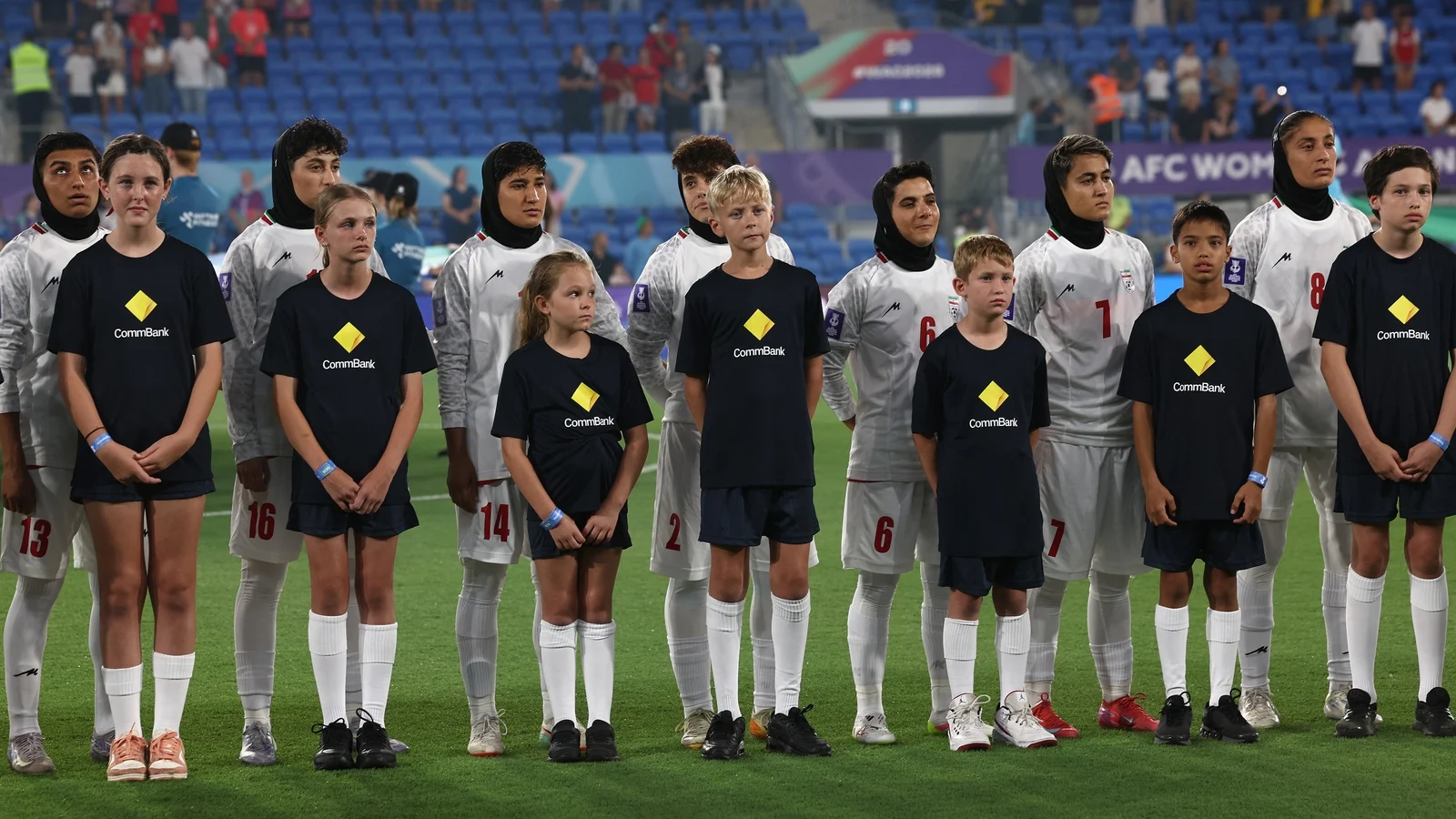
It was not the silence of boredom or the hush before a goal. It was a choice — visible, public, and dangerous. Five players from Iran’s women’s national football team stood together and did not sing their national anthem before a match at the Asian Cup. The act, which to some was a simple refusal, to others read like a shout for help. Within days they would ask a bigger, riskier question of the world: can sanctuary be found far from home?
From Stadium Seats to Safe Rooms
Reports from the scene described the players swiftly moved into police protection after the squad’s exit from the tournament. Australian Home Affairs Minister Tony Burke later announced that the five women had been granted asylum and “are welcome to stay in Australia, and they are safe here, and should feel at home here.”
“We had mothers next to us crying,” recalled Jasmine Chen, a volunteer steward at the stadium who watched fans drape pre-1979 Iranian flags over their shoulders and chant “save our girls!” “People were calling out their names. There was a real sense that something far bigger than football had come into the pitch.”
Within hours, the local police, federal officials and community workers were scrambling to coordinate shelter, legal counsel and basic essentials. The five players were placed under the protection of the Australian Federal Police, while advocacy groups, lawyers and diasporic networks mobilized to offer support.
Why Their Silence Mattered
In authoritarian contexts, refusing to participate in state rituals is rarely a private act. It becomes a statement — and statements have consequences. For these athletes, the choice to remain silent before the anthem was widely read as an expression of dissidence, one that could trigger reprisals back home not only against them but against their families.
“When you publicly dissent in a space so visible, it can be read as betrayal by some hardliners,” said Dr. Hannah Reed, a specialist in asylum and refugee law at the University of New South Wales. “Sport has always been politicized, but for women from repressive settings, the stakes are especially high.”
FIFPRO, the global union for footballers, quickly voiced concern for the welfare of the players and staff. More than 66,000 people signed an online petition urging the Australian government to prevent the squad leaving while “credible fears for their safety remain.”
Faces in the Crowd: Voices from the Diaspora
The Gold Coast’s Iranian community, a patchwork of families who left Iran across decades for varied reasons, took the episode personally. Old women who remembered the clang of protests, young students who came to Australia chasing degrees and new arrivals clutching remittance tokens — all found common cause.
“We waved that old flag because it means hope for many of us,” said Leila Mousavi, a local community organizer whose parents fled Iran in the 1980s. “When we chant ‘save our girls!’ we are also chanting for the freedom to speak, to choose, and to protect families from threats.”
A choir of voices emerged — lawyers offering pro bono help, psychologists ready to provide trauma support, and neighbors bringing hot meals to the temporary accommodation where the players stayed. It was community action at its most human: quiet, practical, fierce.
International Pressure and the Question of Asylum
As stories circulated online and in the diaspora press, governments and rights groups weighed in. Social media amplified fears, while national broadcasters debated whether sports teams should be allowed to travel with government minders or guard their players’ autonomy.
Experts point out that Iran’s diaspora activism has been particularly visible in recent years, with expatriate communities using protests, cultural events and social media to maintain pressure. The episode in Australia taps into larger global debates over the protection of athletes and the role of host countries in weighing humanitarian obligations.
“We’re in a moment where states, clubs and sporting bodies must recognize that athletes are not merely ambassadors of sport but individuals with the same human rights as anyone else,” said Amir Vakili, a human rights researcher in Melbourne. “Granting asylum in this case signals that countries can — and will — prioritize safety.”
Statistics and the Bigger Picture
The asylum of five athletes is poignant on its own, but it is also one thread in a growing fabric of forced migration and displacement. According to UNHCR, the number of forcibly displaced people worldwide exceeded 110 million in recent years — a record high reflecting conflicts, persecution, and climate-driven upheavals. Within that vast number are stories like these: nimble, dangerous, heartbreaking.
Sport brings global attention in a way few other arenas do. When athletes defect or seek asylum, their cases spotlight broader injustices and force host nations to reckon with humanitarian obligations. Yet the pathways to safety are narrow and fraught: legal limbo, political backlash, and the long shadow of fear for family members left behind.
What Happens Next?
For the five players, the immediate future will be a mixture of relief and complexity. Legal processes can be slow. The trauma of fearing for one’s life — and the added burden of public prominence — will not evaporate with a legal status. Integration into a new community, learning a language, rebuilding a life — these are the slow, mundane tasks that follow dramatic headlines.
“They are safe today,” said an Australian social worker who asked not to be named due to client confidentiality. “But safety is also education, social networks and the ability to make choices without fear. That’s what we need to help them build.”
And the rest of us — spectators, citizens, policymakers — must decide how we interpret silence and how we respond when it is translated into a plea. Will we see it as a political problem to be managed or a human life to be protected?
Beyond the Match: Sport as Moral Mirror
Sport can be a sanctuary, a stage, and a mirror. It reflects the tensions of the society that surrounds it. When an anthem goes unsung, the stadium becomes more than a field of play; it becomes a litmus test for empathy and action.
Ask yourself: what would you do if you were in the stands? How would you balance national pride with the protection of a person in danger? The answers are rarely straightforward, but the community on the Gold Coast offered one: open doors, legal aid, shelter, and the warm human heartbeat of solidarity.
In the end, the story of the five players is not just about a stadium incident. It is about courage, the long reach of authoritarian power, and the global responsibility to protect the vulnerable. It is also about ordinary people — fans, volunteers, lawyers, neighbors — who decided that silence could be turned into sanctuary.
- 66,000+ petition signatures calling for protections
- Federal police protection and initial asylum granted in Australia
- International football union (FIFPRO) expressed welfare concerns
- UNHCR: over 110 million forcibly displaced worldwide
Across oceans and borders, the echoes of those five silent players are still with us. They asked for safety, and a city — for a moment — answered. What will the world do next when the next brave silence appears under the lights?