Bondi’s Quiet Shattered: A Community Seeks Answers After a Festival Turns Fatal
There are places where the sea seems to listen — where the surf keeps a steady, forgiving measure of time. Bondi Beach is one of them. On a night meant for candles and song, that calm was broken. Fifteen people died at a Hanukkah celebration on the sand, including a child named Matilda, just ten years old. The shock cut through the city like a winter wind; a neighborhood that greets sunrise with surfers and lattes now gathers around flowers and grief.
At the heart of the city’s response was a promise from Canberra: a sweeping crackdown on hate, division and radicalisation. Prime Minister Anthony Albanese, standing before cameras with an expression worn by many leaders in moments of national sorrow, vowed legislative and administrative measures intended to address a problem that many feel has been growing for years.
The moment of reckoning
“We will not let this become another story we tell in shock and then forget,” the prime minister said, his voice raw with the weight of the country’s grief. “We must act decisively to protect our communities, to root out people and ideas that seek to tear us apart.” He signalled new laws to broaden and harden penalties for hate speech, a formal system to list organisations whose leaders promote hatred, and expanded visa powers to block or cancel entry to those who inflame division.
Those measures are more than policy talk for families who have watched their children light menorahs and ask why. In a small synagogue white with winter light, Matilda’s coffin — pale, simple — was carried out amid a hush so complete you could hear shoes on linoleum. People hugged until their arms ached. “She loved the sea and the festival lights,” one aunt told me, pressing a folded program to her chest. “She had the kind of laugh that made other children quiet down and listen.” The image of Matilda — small hand clasping a candle, eyes bright — will not leave this city.
Voices from the square and the synagogue
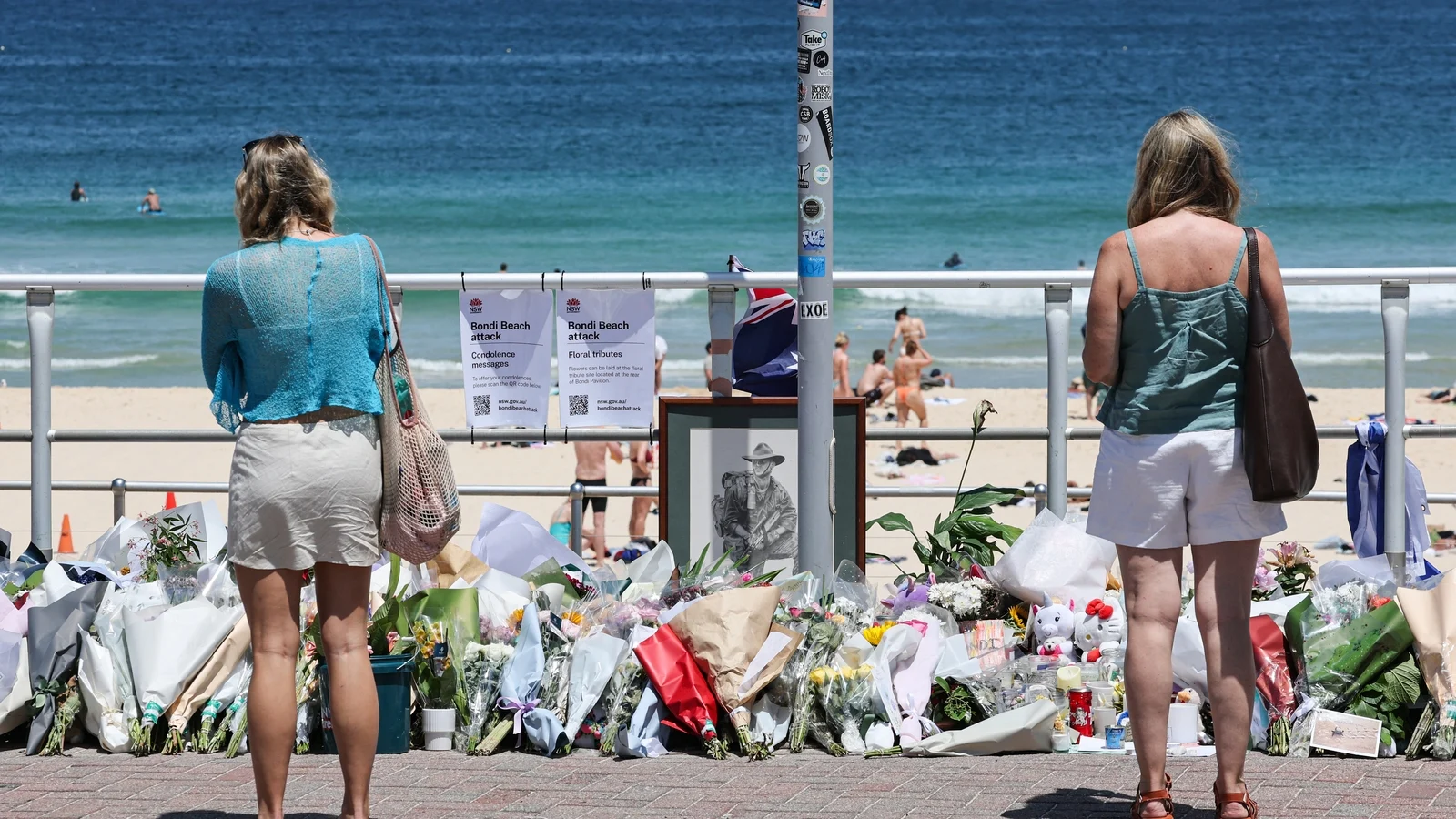
At the floral memorial by Bondi Pavilion, a procession never quite ended. Residents left notes, a soccer ball, a child’s scarf. “We never thought this could happen here,” said Jamal, a café owner whose shop faces the beach. “Bondi’s a tapestry of people. Today that tapestry is frayed.” A woman named Leah, who had come to the festival with her parents, stared at a string of paper stars and said, “You’re meant to feel safe at your own festival. It’s that simple. That’s the cruelty of it.”
Community leaders, too, have been both grateful for the state’s response and insistent that words now become action. Jillian Segal — Australia’s anti-Semitism envoy — called the announcement “an overdue and necessary turning point.” “We have been sounding the alarm for years,” Segal told me in a quiet, measured tone. “This is about protection, yes, but also about dignity. Jews in Australia must be able to practise freely without fear of harassment or harm.”
What the government is proposing — and what it must prove
The measures the prime minister outlined are broad-ranging. Officials say new “aggravated hate speech” laws will aim to capture leaders and preachers who stoke violence and denigrate groups on the basis of race or religion. Canberra also plans a federal offence against “serious vilification,” a mechanism for formally listing organisations whose leaders engage in hate, and enhanced powers for the home affairs minister to cancel or refuse visas for those who spread hatred.
There’s also an education-focused task force: a twelve-month commission to ensure schools and universities respond to anti-Semitism with robust curricula and prevention programs. “If young people are being radicalised online, we need to meet them where they are — and the classroom is a critical battleground,” one official said.
These are significant steps on paper. But there is healthy scepticism among activists. “We need laws that protect, yes, but we also need implementation,” said Miriam Goldstein, head of a community legal centre in Sydney. “How quickly can police investigate? How will prosecutors prioritise these cases? Will schools receive funding and training? Announcements are the first steps, not the last.”
Beyond the speech: the infrastructure of prevention
Tackling radicalisation is messy work. Experts say it requires social services, mental health support, robust online regulation, and community-led initiatives. “You can’t arrest your way out of ideology,” said Dr. Amir Patel, a researcher in extremism and social cohesion. “We need to understand the pathways people travel toward violence — which often involve isolation, grievance, online echo chambers, and real-world enablers. Laws help, but prevention is a long-game play.”
Data underscore that complexity. Community organisations have reported upticks in targeted harassment and a sense of emboldened hostility in recent years. Globally, episodes of mass violence and publicised geopolitical conflict tend to correlate with spikes in hate incidents; Australia is not immune to these patterns. Some Jewish groups here say that antisemitic incidents — from graffiti and abuse to physical attacks — increased sharply in the wake of international flashpoints.
Place, memory, and the long arc of safety
Bondi is a cosmopolitan mix: students from across the Pacific, retirees who have watched decades of change, small business owners who greet regulars by name. Its identity is not monolithic, and that diversity is precisely why the attack feels so personal to a city that prides itself on being open.
Walking the beach at dusk the day after the funeral, I saw teenagers laying candles in the sand, leaving handwritten notes that read: For Matilda. For safety. For community. A teenage boy named Omar told me he had never imagined he would need to explain to his parents why he was nervous to go to a public event. “We always said Australia is different,” he said. “Now everyone’s asking: what will keep us safe next time?”
That question will define the coming months. Will laws be fast, effective and just? Will policy changes translate into prevention and protection rather than simply more surveillance? Will communities across Australia — from mosque congregations to neighbourhood councils — be included in the work of rebuilding trust?
Asking the hard questions
We must also ask how society treats those pushed to the margins. Who is listening to young people at risk of radicalisation? Are social services visible and funded where they are needed? How will online platforms be held accountable for content that fuels hatred? These are the gritty, long-term queries that a single policy package cannot fully answer.
And there is an ethical imperative to keep memory alive. Matilda’s funeral was not a political moment only; it was a human one. “We want our children to return to light, not cover their lights in fear,” a rabbi said to a packed room. “We want to teach them to love, and to stand up when anyone is demeaned. That teaching can be a society’s greatest law.”
Where we go from here
Bondi’s flowers may be cleared away. The headlines will move on. But for those who lit candles in the sand, whose families held one another close, the need for change will remain intimate and immediate. Action must follow rhetoric — with resources for schools, training for police, mental health services, and sustained attention to the online environments where hatred often germinates.
What will you do in your community? How will you teach the next generation to listen with curiosity and to reject narratives that dehumanise? These are not only questions for policymakers — they’re for neighbours, teachers, and friends.
In the shadow of this tragedy, Australia has promised to act. Now it must show, over months and years, that safety and dignity are not just words in a press release but realities lived by everyone who calls this country home.