Dawn Gunfire, State TV and a Country Holding Its Breath: Inside Benin’s Foiled Coup
At first light in Cotonou, a cadence of shots cracked the usual Sunday rhythm — the clatter of motorbikes, the distant call to prayer, the vendors arranging their stalls at Dantokpa market. People paused, looked up, and then did what people do in cities that have learned caution: they shuffled toward radio and television, toward neighbours’ doorways, toward the small truths that anchor a community in an uncertain morning.
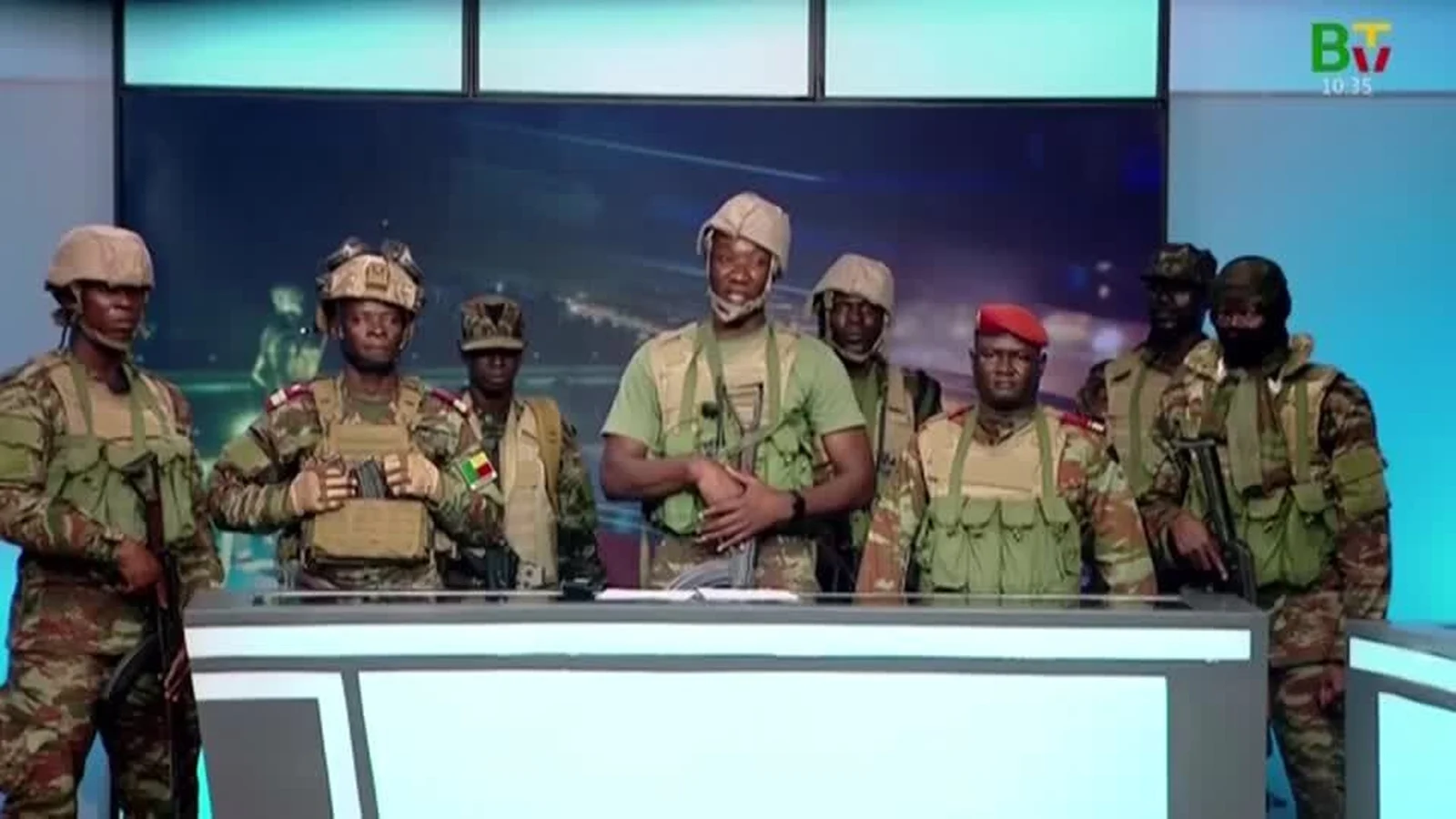
By mid-morning, the startling image of uniformed men had flooded state television: at least eight soldiers, faces set, rifles at their sides, announcing the dissolution of national institutions, the suspension of the constitution and the closure of borders. “The army solemnly commits to give the Beninese people the hope of a truly new era,” one of them declared on air, speaking of fraternity, justice and work as if reciting a national pledge.
Hours later, Interior Minister Alassane Seidou appeared on the same network and told the nation the plot had been thwarted. The minister’s calm, measured voice — an attempt to return the country to its ordinary pulse — was underscored by practical reassurances: go about your business, police have deployed to key intersections, normality will return. A government spokesperson confirmed arrests linked to the bid.
What Really Happened This Morning?
The details are still being sorted, but a skeletal timeline is emerging.
- Early morning: gunfire reported in several neighbourhoods, including near the president’s residence.
- Soon after: a group of soldiers briefly took control of the state broadcaster and read a statement announcing a takeover.
- Within hours: loyalist forces regained control, broadcasting resumed, and authorities announced arrests connected to the attempt.
“It was surreal,” said Narcisse, a furniture salesman in Cotonou who asked to be identified only by his first name. “I heard the shots around 8.00am. I brought the sofas inside and closed up. People were in the streets whispering. Now it’s calmer, but you can still feel the unease.”
The Echoes of a Troubled Region
Benin’s scare cannot be read in isolation. Over the past decade, West Africa has been a testing ground for an uneasy pattern: civilian governments challenged by military actors citing insecurity, corruption or national decline.
Since 2020, Niger, Mali and Burkina Faso have all seen coups; Guinea and Guinea-Bissau have also experienced ruptures. The ripple effects are as political as they are human. Families flee violence; markets lose confidence; international partners scramble to respond. Regional bodies — notably ECOWAS and the African Union — swiftly condemned the attempt in Cotonou, framing it as yet another threat to fragile democratic advances in the region.
“You can’t separate national politics from regional currents,” said Amadou Diop, a Sahel analyst based in Dakar. “What happens in one capital resonates across borders — security forces talk to one another, grievances are shared, and opportunists see openings.”
Security Concerns, Political Tensions
The soldiers who spoke on air referenced deteriorating security, particularly in northern Benin, and invoked the “neglect of our fallen brothers-in-arms.” The country has, after all, been confronting a new reality: jihadist violence spilling south from Mali and Burkina Faso.
In April, the government publicly acknowledged a devastating attack that killed dozens of soldiers — an assault it attributed to a group affiliated with Al Qaeda. Those losses have reverberated. For many Beninese, the questions are raw: are the forces we trust able to defend us? Who protects the protector?
“Our communities in the north have lived with fear. Farms lie abandoned. Children don’t go to school,” said Mariam Ade, a teacher from a town near the border with Burkina Faso. “When soldiers die and families get no support, anger grows.”
The Politics Behind the Guns
Security aside, political tensions have been simmering. President Patrice Talon — in power since 2016 — has been praised for economic reforms that helped push Benin’s growth into single-digit territory after years of sluggish performance. At the same time, critics accuse his administration of tightening its grip on state institutions.
In recent months, Benin adopted a new constitution that created a Senate and extended presidential terms from five to seven years. Finance Minister Romuald Wadagni has been selected as the ruling coalition’s candidate for the upcoming April election, a vote that would mark the end of Mr. Talon’s current tenure but under circumstances critics say favor the incumbent bloc.
“Constitutional change is a legitimate part of politics,” said Professor Hélène Kpatindé, a political scientist at the University of Abomey-Calavi. “But when reforms are rushed and opposition voices feel marginalized, the avenues for peaceful contestation narrow. That creates fertile ground for those who believe a rifle can reset the scales.”
Indeed, the opposition Democrats party, founded by Mr. Talon’s predecessor Thomas Boni Yayi, saw one of its potential presidential candidates barred over what the courts said was insufficient backing. To many on the streets of Cotonou, those judicial decisions feed a sense of injustice.
Voices from the Ground
Across town, a pastor named Father Kossi stood outside a small church, the fragrance of incense mixing with the morning sun. “People looked to the heavens today,” he said. “We pray for peace and for leaders of conscience. Violence solves nothing.”
A market woman, Awa, folded her hands over her basket of peppers and smiled tightly. “We want stability,” she said. “We want to sell, to send our children to school. Guns scare customers away.”
A European diplomat, speaking on condition of anonymity, said embassy staff had warned nationals to stay home when gunfire was reported near the presidential residence and commended the swift response by loyalist units.
Questions That Outlast the Headlines
What happens next matters not only for Benin but for West Africa’s democratic trajectory. Will the arrests lead to prosecutions and a transparent accounting? Will political doors be opened to the opposition so citizens can choose without coercion? Will the government address the security vacuum in the north that prompted the coup plotters to invoke their dead comrades?
“A foiled coup is not an answer,” said Amadou Diop. “It’s a symptom. The work now is to stitch back trust in institutions, to show citizens that constitutional politics can deliver security and justice. Otherwise, the cycle repeats.”
After the Shock
For now, Cotonou is tentatively returning to its rhythms: buses hum, markets reopen, churches and mosques resume their services. But there is a new layer in the city’s conversation — in the hair salons, cafés and on the radio. People ask the same question: what price for peace?
As night falls, the lights along the lagoon shimmer and the city exhales. The day’s gunfire becomes a story told with new details, shape and consequence. The story of Benin’s foiled coup attempt is not finished — it will be written in courtrooms, parliamentary chambers and in the slow, stubborn rebuilding of public trust.
So I ask you, reader: when institutions wobble, what do we owe one another as citizens — to demand justice, to protect the vulnerable, and to insist that change come through ballots rather than bullets?