Bondi’s Quiet Hero: How One Man’s Instincts Turned a Celebration into a Lifeline
On a warm evening when Bondi Beach should have been all candlelight and laughter, a handful of seconds split the world for dozens of families. Voices rose in terror. Sand turned to chaos. And in the middle of it all, a tobacco shop owner with two children tucked under his jacket became, for a beat, the difference between life and death.
His name is Ahmed al Ahmed. He did not expect to be a hero. He didn’t train for headlines or interviews. He left his hometown in Idlib, Syria, nearly two decades ago for work and a future in Australia. He runs a small shop. He’s a father. And he is now, unmistakably, a symbol — of courage, of the migrant contribution to civic life, and of a community’s fierce need to heal.
A moment that changed everything
It was Hanukkah, a festival of lights. Families had gathered near the famous curve of sand and surf that is Bondi, candles flickering, children bundled against a chill wind. Then gunfire ripped through the air. Two men, police later said, opened fire on the crowd. By the time it was over, 15 people were dead and dozens more wounded — a statistic that has stunned a nation where such mass violence is painfully uncommon.
Ahmed’s response was instinctive. Videos and eyewitness accounts show him ducking behind parked cars, then charging. He tackled one of the assailants from behind, wrenching the weapon free and bringing the man to the sand. Another gunman then apparently fired, striking Mr Ahmed. He was rushed to St George Hospital, where he underwent surgery and remained in recovery as communities and leaders visited to pay their respects.
“When I saved the people I did it from the heart,” Ahmed later told visitors at his bedside. “It was a nice day, everyone enjoying… they deserve to enjoy.” He raised his uninjured fist and added, almost defiantly, “This country is the best country in the world… God protect Australia. Aussie, Aussie, Aussie.”
The oversized cheque and a global outpouring
Within days, tens of thousands of strangers had decided that a man they had never met deserved more than applause. A GoFundMe campaign set up by social media organiser Zachery Dereniowski quickly became an avalanche of donations. More than 43,000 people from around the world contributed, sending messages of thanks, solidarity, grief and hope.
The fundraiser passed A$2.5 million — enough to stop anyone from pretending the moment was forgettable. Billionaire investor Bill Ackman donated A$99,999 and shared the campaign with his followers, fueling a wave of international support.
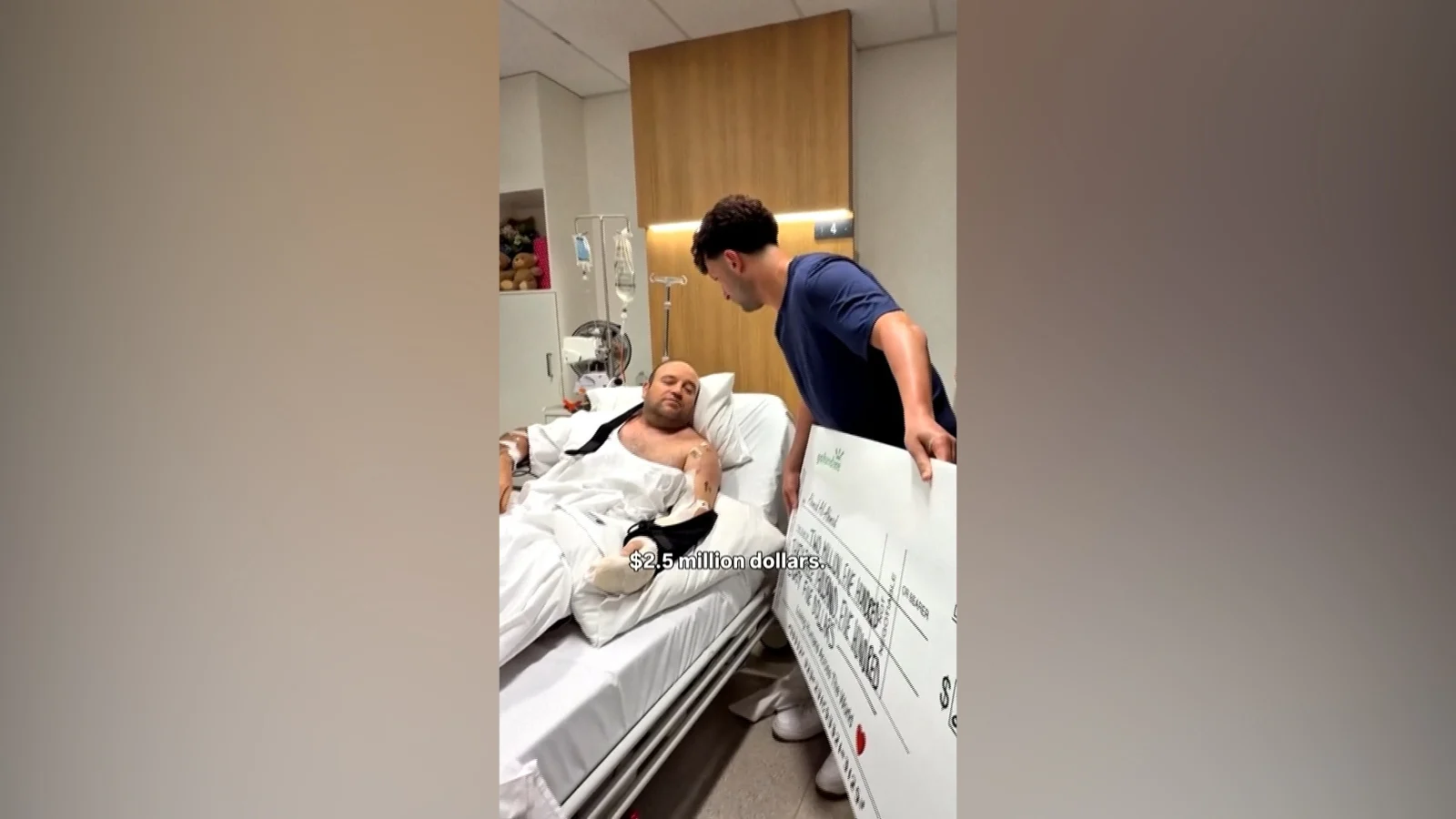
At Ahmed’s hospital bed, Mr Dereniowski presented an oversized cheque in a quiet scene that played out like a modern fable: a stranger’s bravery, the internet’s pocketbook, community generosity. “I deserve it?” Ahmed asked, incredulous. “Every penny,” Mr Dereniowski replied.
Quick facts
- Casualties: 15 people killed; dozens wounded.
- Donors: Over 43,000 contributors to the GoFundMe campaign.
- Funds raised: More than A$2.5 million (≈€1.4 million).
- Notable donor: Bill Ackman donated A$99,999 and shared the page online.
- Suspected attackers: A 50-year-old man, shot dead by police, and his 24-year-old son, critically wounded.
Voices from Bondi
In the days after the attack, the beach — an icon of sun and surf, avocado toast and lifeguards orange flags flying — pulsed with a different kind of energy: grief, bewilderment and a fierce tenderness.
“I’ve worked in Bondi for 12 years. You think you know every sound of this place — the gulls, the waves, kids’ laughter,” said Maria Santos, who runs a small café a block from the sand. “To hear shots here… it felt unreal. But then I saw Ahmed’s face on the news and I thought, there’s our neighbour. That man is us.”
A local lifeguard, who asked not to be named, described how the rescue felt like choreography gone wrong: “We switched from sunscreen to triage. Lifeboat crews became stretcher teams. People were calling for their parents. It was a moment when everyone did what they could.”
What this moment says about Australia
Australia’s modern identity includes the 1996 Port Arthur massacre, an event that reshaped gun policy and national conscience. In the years since, sweeping firearms reforms dramatically reduced the frequency of mass shootings — a rarity that has made this latest attack all the more shocking.
And yet the response to Ahmed’s courage reveals another thread in the nation’s fabric: community solidarity. Thousands donated not because they expected to solve structural problems overnight but because they wanted to give a tangible thank-you to the man who ran toward danger to protect strangers.
“It isn’t just charity,” said a social policy researcher who studies migration and civic participation. “It’s a signal that Australians value bravery and civic action — and that they see migrants, like Ahmed, as integral to the social glue.”
Questions we can’t ignore
How do societies balance the shock of rare violence with long-term prevention? What measures can protect public spaces without smothering the very freedoms they aim to preserve? And perhaps most poignantly: how do we honor acts of courage without reducing people to symbols?
Ahmed himself sidesteps heroics. When asked what he would say to donors, he offered a simple appeal: “To stand with each other, all human beings. And forget everything bad … and keep going to save life.”
That plea is worth sitting with. So much of our public life is now mediated through screens and algorithms. Yet a hospital room in Sydney became the scene of something starkly human — someone wounded, someone thanking strangers, a community pooling resources.
Where do we go from here?
Small acts accumulate. Vigils will be held; legal and security reviews will follow; politicians will make statements and promises. But the more intimate work — the healing, the remembering — will happen in cafés, in schools, on the sand where children will one day run again.
Would you know what to do if terror erupted where you were? How would your community respond? These are uncomfortable questions, but the story of what happened at Bondi — and the man who leapt into danger — offers an answer of sorts: when ordinary people act, they can rewrite fate, if only for a few seconds that mean everything.
Ahmed has not yet said how he will use the money. For now, he remains in hospital, recovering and surrounded by messages and visitors. Across the city, a new chorus has begun: outrage at what happened; gratitude toward those who intervened; and the quiet work of stitching a wounded community back together.
Bondi will return to its rhythm of surf and sun. But it will not forget the night the lights went out, nor the man who chose to charge toward them. In that choice lives a stubborn reminder: human courage is often unspectacular, born of love and habit and the simple desire to protect a stranger’s child. It is, in the end, what binds us.