Echoes under the sand: a night strike near Palmyra and the long shadow of IS
When the bombs fell north of Palmyra, they did so into a kind of silence that has settled over this region for years: the hush of an emptied city, the brittle wind over broken columns, the husks of villages only intermittently lived in. The British Ministry of Defence said Royal Air Force aircraft, working alongside French forces, struck an underground facility believed to have been used by Islamic State fighters to store weapons and explosives.
“Royal Air Force aircraft have completed successful strikes against Daesh in a joint operation with France,” the ministry said. “This facility had been occupied by Daesh, most likely to store weapons and explosives. The area around the facility is devoid of any civilian habitation.”
That official assurance — that civilians were not at risk — matters in a place where the line between combatant hideout and civilian shelter is often a blurred, terrifying one. “We check every day if the ruins are still standing or if there are new craters,” said Amal, a Palmyra native now living in a battered displacement camp outside Homs. “But mostly we count the missing, the homes burned, the memories stolen. We cannot afford another mistake that kills our people while pretending to fight extremism.”
Not the end, only a chapter
Though the so-called caliphate collapsed territorially in 2019, ISIS’ ideology and its small, mobile insurgent bands never truly vanished. Across the vast Syrian Desert — the badia — the group and affiliated cells have adapted, slipping into caves, hollowed-out bunkers and underground stores, waiting, regrouping, and occasionally launching lethal attacks.
Estimates of the group’s remaining strength are imprecise, but analysts and international reports suggest that several thousand fighters remain scattered across Syria and Iraq, operating in cells and exploiting remote terrains. “This is classic insurgency: deny, lurk, and pick the moment,” said Majid al-Saleh, a regional security analyst. “Cracking down on a weapons cache in a cave does not end it. It forces them to change tactics. We need political and social strategies, not just munitions.”
Why Palmyra still matters
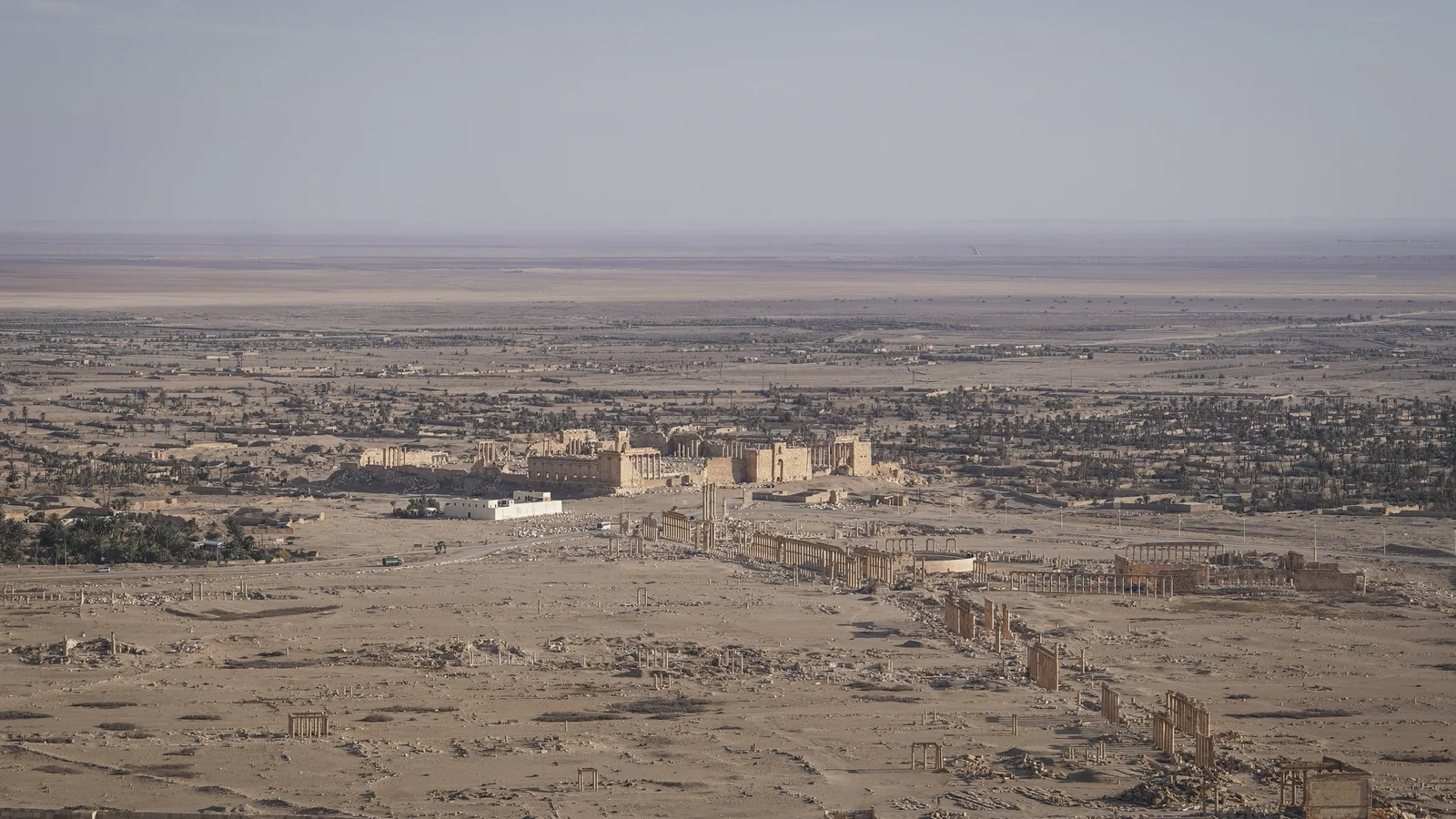
Palmyra is not only a military chess square. It is a symbol. Once a thriving Roman city and a UNESCO World Heritage site, its towering colonnades and the funerary towers were defaced, looted and dynamited in 2015 and 2016. The scars run deep — carved walls and missing sculptures are a testament to cultural devastation as much as to human loss.
“When explosives go off near Palmyra, we watch closely,” said Leïla Karam, an archaeologist who has spent decades documenting Syria’s monuments. “There is an ongoing battle between protection of cultural heritage and the necessities of counterterrorism. We do not want to become collateral in a global fix. But neither can we allow caches of weapons to sit beneath the ruins, threatening anyone who returns.”
That tension — between eradicating a security threat and preserving the fragile remnants of a civilization — plays out in every decision a distant capital makes when it fires into the Syrian desert.
Voices from the perimeter
The people nearest the strike are not generals or ministers, but displaced shepherds, market vendors and aid workers. “You can’t imagine how the nights are,” said Hassan, a Bedouin elder who grazes goats in the outskirts. “We hear planes. We hear rumors. We send our boys to fetch water in the day, and if a strike happens, they won’t come back the same. Everyone is tired of being a map dot.”
A humanitarian worker who has coordinated aid convoys into central Syria for years, speaking on condition of anonymity, stressed the complexity: “We have to balance access with safety. After strikes, checkpoints tighten, roads close, and aid convoys are delayed. People die because they can’t get medicine as much as they die in the blasts. That is the full cost.”
What the strike reveals about the wider fight
Military cooperation between Britain and France is part of a broader pattern: Western airpower intermittently targets Islamic State infrastructure even as local and regional actors — the Syrian regime, Russia, Iran-backed militias, Turkey — pursue their own agendas on the ground. This creates a patchwork of authority and risk.
- ISIS was territorially defeated as a state-like entity in 2019, but morphs into an insurgency that thrives in deserts and broken governance zones.
- Estimates of remaining fighters vary widely; monitors point to a resilient core that remains capable of lethal operations.
- Foreign air strikes in Syria continue, often justified as pre-emptive or retaliatory, but they complicate humanitarian access and local dynamics.
“Strikes like this are tactical wins,” said Dr. Helena Weiss, a counterterrorism scholar at a European university. “They degrade assets, hurt logistics, and signal resolve. But without political reconciliation, economic opportunity and local security governance, the vacuum fills again. The desert is unforgiving. Opportunities for exploitation remain.”
How do you strike something that lives underground?
Artistically, the image of a cavernous bunker seems cinematic — a laser-lit target under a ruined amphitheater. Practically, it is hide-and-seek. ISIS has used old oil pipelines, natural caves, and ancient tombs as storage. The counter is intelligence: signals, human sources, satellite imagery. And, increasingly, precision munitions and coordinated multinational operations.
“You can’t bomb your way to stability,” Majid al-Saleh said. “You need credible local forces, reconciliation, economic programs and secure supply chains for food and water. These are long games.”
What now? Questions that linger
For many Syrians, the strike is another day in a long, exhausting headline crawl. For policy makers, it is a tactical measure. For the world, it is a reminder that the ideology which produced one of the most brutal terror movements of our time is not neatly boxed away in history.
So: do we accept intermittent air strikes as our main line of defense against dispersed terror cells? Or do we push for deeper solutions that combine security, diplomacy and cultural protection? How do we restore places like Palmyra without making them permanent battlegrounds?
As dusk settles over the Syrian Desert, the columns of Palmyra stand like a question mark. They ask whether the world will invest in the slow, hard work of rebuilding societies and safeguarding memory — or whether we will keep circling, bombs overhead, hoping silence will finally fall.
“We want to live, not to be watched like a country in a picture,” Amal said, her voice a mixture of weariness and stubborn hope. “We want our children to see the ruins and not the gunmen. Is that too much to ask?”