Under the Cold Light of a Candle: Tumbler Ridge Grieves
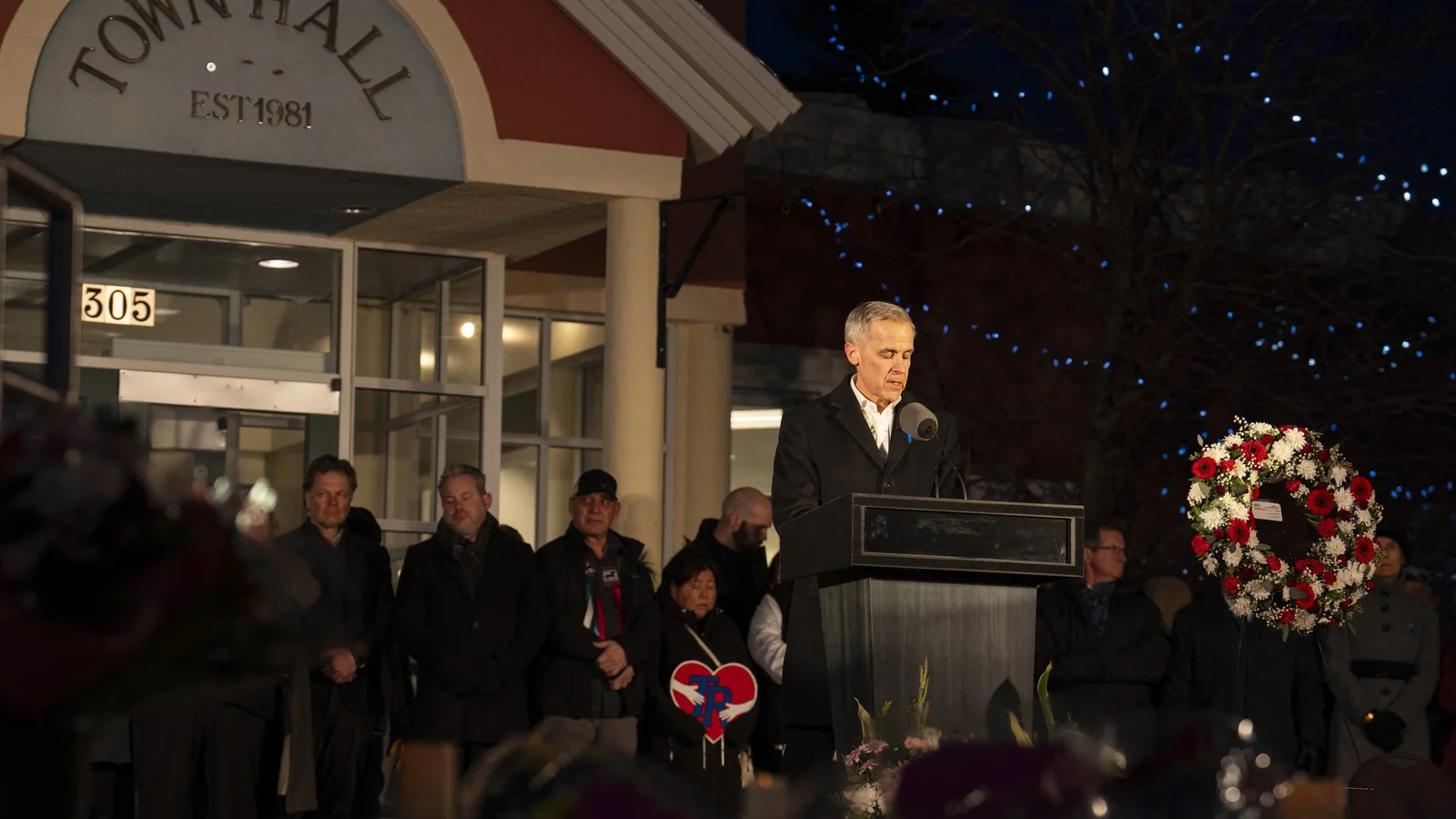
Snow hissed in the streetlights as a small, determined procession threaded its way toward the town hall of Tumbler Ridge — a mining town where houses wear winter like a second skin and hockey is as much civic ritual as pastime. Candles trembled in mittened hands. Mothers hugged close to children who had come because they could not bear to stay away.
Prime Minister Mark Carney arrived that evening and stood beside leaders from across the political aisle. He did not offer grand promises; he offered presence. “I know that nothing I can say will bring your children home,” he told the crowd in a voice that broke the hush, “I know that no words from me or anyone can fill the silence in your homes tonight, and I won’t pretend otherwise. We wanted you to hear that Canadians are with you, and we will always be with you.”
It was a simple statement, but simplicity is sometimes what steadies people when everything else feels fractured. His visit — shared with opposition leaders and local responders — read as a national embrace, a gesture that the small town’s grief would not be absorbed in silence.
The Night That Changed Everything
On a winter day earlier this week, a young person moved through two homes and a school and left a community raw. The 18-year-old shooter, identified by police as Jesse Van Rootselaar, killed her mother and younger brother in their home before walking to Tumbler Ridge Secondary School, where five students and a teacher were fatally shot. She then took her own life. In total, eight people were lost — children, a teacher, a parent — a number that matches no tally of value.
The Royal Canadian Mounted Police said the shootings were not targeted at specific individuals, describing the gunman’s actions as “hunting.” Investigators released a photo of Van Rootselaar and noted she had a history of mental-health issues. Her modest brown house — two overturned bicycles resting in the snowy front garden — was cordoned off by police tape; officers maintained a presence there as the town sought answers.
Faces Behind the Names
The victims’ names have been shared sparingly, each one a bullet-point in a larger human ledger. Twelve-year-old Ticaria, remembered by her mother Sarah Lampert as having “a beautiful, strong voice that was silenced,” is now described in the present tense by the people who loved her: “She is forever my baby.” Zoey Benoit, another 12-year-old lost in the shooting, was hailed by family as “resilient, vibrant, smart, caring and the strongest little girl you could meet.” Ezekiel, 13, is named in Facebook posts that read like a town’s shared obituary: friends posting photos, grandparents posting memories, people trying to stitch a life back together by retelling it.
These are not statistics to the townsfolk; they are kids who learned to skate on the same backyard rink, kids who crowded the stands at junior hockey games, kids who were being taught the reading, the jokes, the small rebellions of adolescence. The sense of proximity here amplifies the hurt. Tumbler Ridge has about 2,400 residents: close enough that loss ricochets door-to-door, kitchen-to-kitchen.
A Community’s Rituals of Comfort
Within hours of the killings, the town’s rhythms shifted toward care. Inside the community centre, volunteer coordinators mapped out meals, counselling, and logistical support. Outside, a vigil drew people from surrounding towns: a woman named Christine James drove 120 kilometres from Dawson Creek because “I just needed to be here.” A pastor, George Rowe, pledged, “This will not break us. I think we’re going to be OK,” words that were both belief and a promise to the people clustered around him.
Across the street, a makeshift memorial sprouted: hand-written notes pinned to a bulletin board, stuffed animals soaking snow, bouquets arranged into patient crescents on the snow-packed curb. Children still skated at the rink — not out of callousness, but because routines can be a salve, a way to hold up normal for a day at a time.
- Eight people were killed, including five students and a teacher at the school, and two family members at a residence.
- Tumbler Ridge is roughly 1,180 km north of Vancouver and home to around 2,400 people.
- National leaders attended vigils and met with first-responders and health workers.
Questions That Won’t Go Quiet
When a town like Tumbler Ridge is scarred in this way, global questions gather at the edges: How do we keep our schools safe? How do smaller communities support mental health? What does prevention look like in places where everyone knows your name and yet some suffering goes unseen?
“We have to stop treating this as inevitable,” said a crisis counsellor who has worked in rural communities for two decades and who asked not to be named in order to speak candidly. “Smaller towns can be incredibly resilient, but they are also often underserved. Resources, early intervention, school-based mental-health supports — these are not luxuries, they are essentials.”
Canada’s record with gun violence is complex. Compared with its southern neighbour, the United States, Canada has far lower rates of gun homicides per capita, but it is not immune to mass-casualty events. Experts note that in recent years attention to community-based prevention, Indigenous mental-health services, and rural access to care must be part of the conversation — not only in the immediate aftermath but in the long tail of recovery.
The Long Work of Healing
Prime Minister Carney spent part of his visit meeting privately with first-responders, health workers and bereaved families. He described learning, once again, what had always defined Tumbler Ridge: “people caring for each other.” His words were small, but the unseen labor unfolding in the community is enormous: therapists wheel into the high school for sessions; volunteers coordinate meal trains; neighbours shovel driveways for families who cannot sleep.
Not all answers are policy prescriptions. Sometimes the work is simply this: to show up, to hold a candle, to deliver a casserole and hold hands with someone who is cold in more ways than one. “I made soup for a family on our street,” said an older woman at the vigil, her breath a white cloud. “It felt like the only thing I could do.”
What We Owe Each Other
As the vigil broke up and people wandered back through the slick streets to their homes, the town bore its losses into the night. For many readers far from northern British Columbia, Tumbler Ridge will be a name in a headline. For those who live there, it is the place where a daughter, a son, and a teacher once walked, laughed, learned.
What do we offer when a place like this carries the unthinkable? We offer presence. We offer sustained attention, not the flash of headlines and then distraction. We offer reforms shaped by science and compassion: better access to mental-health care, investment in emergency response in rural areas, school safety that does not render classrooms into fortresses. We offer to listen to the people who lived these lives, not speak for them.
And we ask ourselves: if a community this small can show up for each other in such fierce, palpable ways, what might it look like if the rest of us did the same — not just tonight, but tomorrow, and the day after that?