China Launches Shenzhou-24 Mission Carrying Its First International Astronaut
 Caalamka
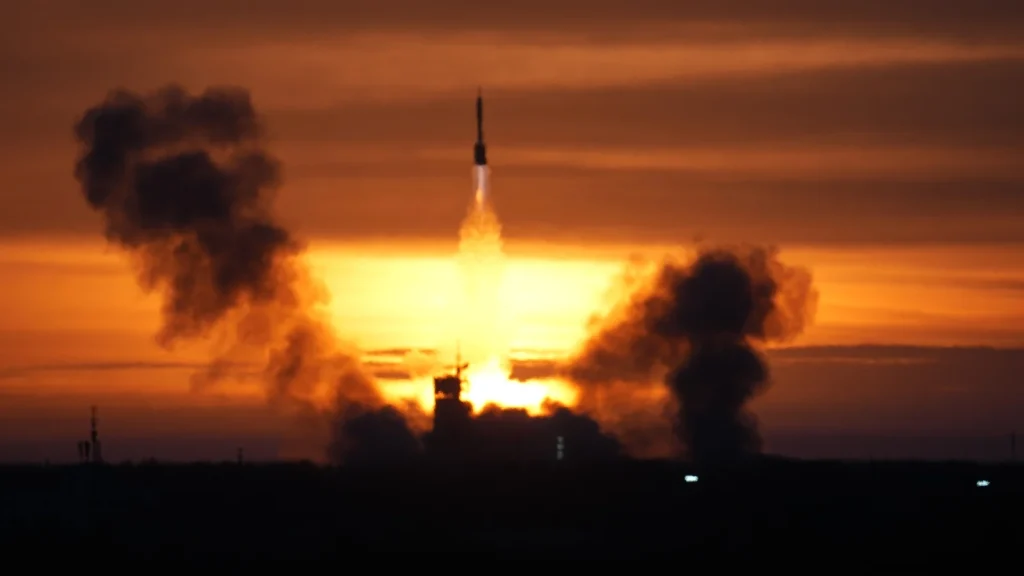
China blasted off its Shenzhou-24 mission on Wednesday, sending a three-man crew toward the Tiangong space station — and putting a Pakistani national on track to become the first foreign astronaut to board the Chinese outpost.
Riding a Long March-2F rocket, the spacecraft lifted off at 8.18am local time (12.18am Irish time) from the Jiuquan Satellite Launch Centre in northwest China.
On board is Zeeshan Ali, a 40-year-old pilot who has now become the first Pakistani in orbit. He will serve as a payload specialist and is expected to remain on the station for five to 10 days while carrying out experiments.
Ali is flying alongside Chinese commander Tang Hongbo and flight engineer Wu Yi.
Within minutes of launch, state-run CCTV showed the trio on a live feed, paging through a manual as the broadcaster said the crew were in good condition.
Beijing has been pitching Tiangong as a platform for international cooperation, an effort that comes as the NASA-led International Space Station faces possible retirement by 2030.
Pakistani astronaut Zeeshan Ali will be the first foreign astronaut to board the Tiangong space station
In the run-up to the mission, Mr Ali spent seven months training in Beijing. The preparation included intensive Chinese-language instruction, learning Chinese songs, and reading Chinese poetry.
He also practised calligraphy and played table tennis.
“I’m not flying for myself. I carry the name of Pakistan on my shoulder,” Ali told reporters on Tuesday.
China-Pakistan space cooperation stretches back to the early 1990s.
Over the years, China has launched Pakistani satellites, and a Pakistani-built rover is expected to fly on a Chinese lunar mission around 2028.
Pakistani Prime Minister Shehbaz Sharif described the launch as “a historic first” in a post on X and thanked Chinese President Xi Jinping, adding: “Pakistan-China friendship is surpassing the heights of the Himalayas, in its journey to outer space”.
Although Mr Ali’s visit is far shorter than the standard six-month rotation for Chinese astronauts, the mission carries significant weight in Pakistan.
“It brings prestige, important science and technology know-how, and a level of deeper collaboration and diplomatic goodwill with China,” said Blaine Curcio, founder of Hong Kong-based Orbital Gateway Consulting.
Long stay for one Chinese astronaut
Tiangong — meaning Celestial Palace — has been fully operational since late 2022 and is China’s self-built space station.
The complex can accommodate as many as six astronauts during crew handovers, when an arriving three-person team overlaps with the departing group.
This time, however, the handover will not follow the usual pattern.
The crew of the Shenzhou-24 in a press conference before the launch
Shenzhou-23 commander Zhu Yangzhu will remain aboard to support China’s research into how the human body adapts to long-duration spaceflight — work viewed as essential for a planned crewed mission to the moon and a potential journey to Mars.
The other Shenzhou-23 astronauts will leave Tiangong together with Mr Ali.
By the time he returns, Mr Zhu will have spent a full year in orbit, setting a record for the longest single stay by a Chinese astronaut.
China says its aim of achieving a human presence on the moon by 2030 has not changed, despite delays to its Chang’e-7 lunar mission. The mission failed to meet launch conditions this year due to adverse weather linked to a tropical storm.
The timeline contrasts with the US goal of returning astronauts to the moon by 2028, as competition intensifies over building a lunar base — a proposed stepping stone toward eventual human exploration of Mars.
China has said it plans to establish a research base on the moon by 2035 in partnership with Russia.
The US has warned that Beijing could try to dominate access to resource-rich lunar regions.
China rejects those claims, saying it supports the peaceful use of outer space.