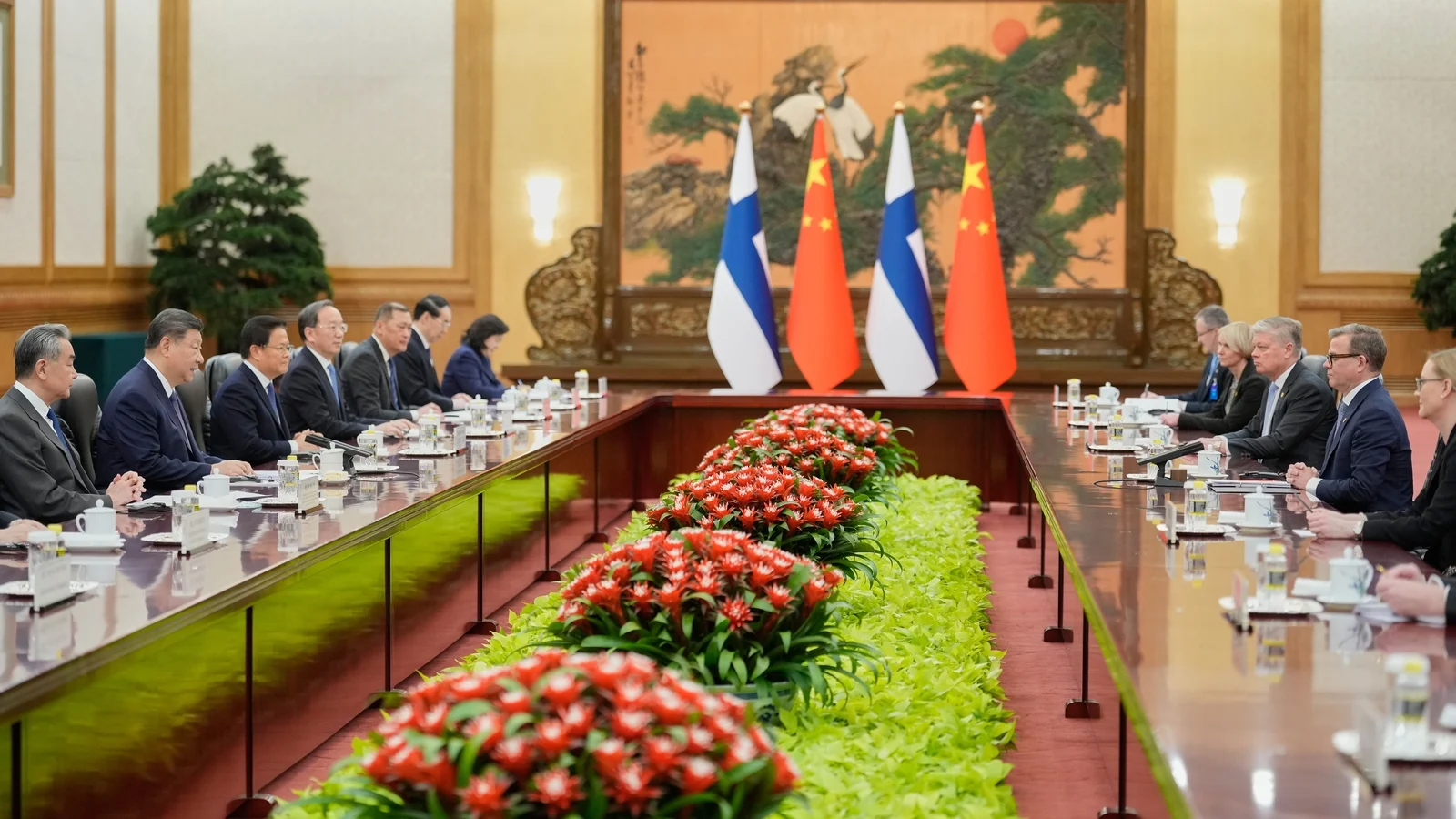
In the Great Hall, a Quiet Plea for the UN—and the World Watches
Under the gilded dome of Beijing’s Great Hall of the People, where history and ceremony rub shoulders with power, President Xi Jinping folded a familiar argument into a diplomatic embrace: China, he said, wants the United Nations to remain at the heart of the international system.
“China is willing to work with Finland to firmly uphold the international system with the United Nations at its core,” state media reported Xi telling Finnish Prime Minister Petteri Orpo during a meeting that felt both stately and strategic. The words were smooth, practiced—an appeal to the language of global order at a moment when that order feels, to many, worryingly frayed.
Why Those Words Matter Now
That public nod to multilateralism did not occur in a vacuum. This month’s unveiling of an American initiative dubbed the “Board of Peace” has set capitals on edge and spurred an unmistakable rip of diplomatic activity. Washington’s plan—portrayed by some as an attempt to create a rival mechanism to the United Nations—has left many allies recalibrating their approach to Beijing.
And so here was Finland’s leader, a northerner who remembers the thin Arctic light and the long history of careful balancing between East and West, seated across from the man who has increasingly defined China’s posture on the global stage. Orpo’s four-day visit to Beijing forms part of a pattern: a procession of Western delegations—French and Canadian envoys in recent weeks, and Britain’s leader expected to arrive soon—who are testing how to engage a Beijing that is both indispensable and controversial.
Conversations on Cooperation—and Contention
“We came to talk about cooperation, but we also came to listen,” Prime Minister Orpo said in remarks after their talks, according to the Finnish readout. He spoke of “international issues” and “bilateral cooperation,” words that sound modest but carry the weight of trade agreements, arctic security, and climate commitments.
On the streets of Beijing, the visit was a small, almost human counterpoint to the statecraft in the hall. A tea vendor near Tiananmen shrugged when asked what he made of the talks. “They promise many things,” he said. “We only understand the things that affect our pockets and our children.” For people in Beijing’s hutongs and Helsinki’s neighborhoods alike, diplomacy is often a distant spectacle; its consequences are not.
Fault Lines: Ukraine, Russia, and the Arctic
But beneath the formal pronouncements lie real disagreements. Finland, which only recently completed its NATO accession in 2023, has been blunt about its security anxieties. Finnish Defence Minister Antti Hakkanen told reporters in November that China’s economic ties to Moscow have been “massively” supporting Russia’s war effort—a charge Beijing rejects, insisting it takes a neutral stance and refuses to condemn Moscow’s invasion.
Across Europe and North America, politicians and analysts fret over the emerging geopolitical geometry of the Arctic. Melting ice has turned a region once sealed by cold into a new theater for shipping lanes, resources, and strategic influence. “We must protect the Arctic not only from a warming climate but from a dangerous competition for footprint and infrastructure,” said a senior NATO official in Brussels, asking not to be named. Dutch Prime Minister Mark Rutte and other European leaders have urged collective approaches to secure northern countries, implicitly naming both Moscow and Beijing as actors whose presence must be watched.
Trade, Influence, and the Question of Neutrality
China and Russia have deepening trade ties that, in recent years, reached record levels. Beijing insists its engagement is transactional and not an endorsement of Moscow’s military choices. “Our partnership is based on trade and mutual interest,” said a Chinese foreign ministry spokesperson during a press briefing. “We do not support actions that violate international law, and we promote dialogue.”
Yet the optics of commerce—energy shipments, technology exchanges, and diplomatic cover—have complicated Beijing’s insistence on neutrality. For Finland, which shares a long border with Russia and a history of strategic caution, those connections are not an abstract policy; they are proximate and immediate.
Global Repercussions: Multilateralism Under Pressure
What does this all mean beyond capitals and headlines? At its simplest, we are watching a test of multilateralism. The United Nations has 193 member states, a vast and imperfect convening power. Calls for a UN-centered system echo across speeches and briefings because many diplomats worry about the fragmentation of global governance into competing clubs, coalitions, and informally aligned blocs.
“When large powers start opting out of existing frameworks or proposing parallel ones, it raises the cost of cooperation for everyone,” said an international relations scholar based in London. “Smaller countries find themselves squeezed: do they hedge their bets, pick a side, or double down on institutions that, however flawed, at least offer predictability?”
Local Color: Helsinki to Beijing, Saunas to Silk Road Echoes
If you’ve never been to Finland in February, imagine streets powdered with snow, the northern sun low and amber, and saunas glowing like promises in nearly every home. These are not incidental details: Finnish culture and geography shape its foreign policy. A small country with a long border to a larger, unpredictable neighbor, Finland’s diplomacy is practical—and sometimes blunt.
In Beijing, agents of commerce and culture note a different tempo: high-speed trains, megacity skylines, and an urban appetite for new markets. Both societies watch the same global chessboard from different angles.
Questions for the Reader
What kind of world do you want to live in? One of tightly stitched, universally applied rules, or one of flexible, interest-driven arrangements? And who should guard that order—the United Nations, a new American-led consortium, or a shifting mix of regional alliances?
These are not purely academic questions. They shape whether humanitarian crises are resolved through coordinated channels, whether economic sanctions hold, and whether smaller states can find refuge in predictable rules rather than the whims of great powers.
Where Do We Go From Here?
For now, Xi and Orpo returned to their capitals with diplomatic routines observed and commitments—broad, conditional—recorded. The larger drama, however, plays out over months and years: in Arctic ports that may see more ships, in trade patterns that entangle economies, and in international institutions whose credibility depends on the good faith of their leaders.
“No country can or should be excluded from the global conversation,” another diplomat told me over coffee. “But conversation must be anchored in trust—or at least in rules everyone respects.”
Return to your daily life and pause: watch for the next visit, the next joint statement, the next policy paper. International order does not arrive fully formed; it is built, eroded, and rebuilt by choices—public and private, large and small. The Great Hall’s chandeliers may glitter tonight, but the future of multilateralism will be decided in countless quieter rooms where trade, security, and values meet.
- Key fact: The United Nations has 193 member states.
- Key context: Finland joined NATO in 2023, reshaping its security posture.
- Key tension: China’s trade with Russia has increased in recent years, complicating European security concerns.