A wail of sirens cut through the air outside Warsaw’s security establishment just as Polish Prime Minster Donald Tusk was preparing to open this week’s Warsaw Security Forum — a jarring soundtrack for a gathering focused on Europe’s growing sense of vulnerability.
The alarm, it quickly became clear, was not the start of an emergency but a local drill, one element of a week-long test of warning sirens across Mazovia, the central Polish province where the conference was being held.
Even so, the timing underlined why Polish authorities are stress-testing their response systems as reports mount of suspected Russian sabotage incidents across the region.
On the pavement outside the venue, delegates passed a battered Russian-made Geran drone set up as an exhibit by NAKO, a Ukrainian anti-corruption action group. Its hulking remains were a stark reminder that the war reaches well beyond Ukraine’s front lines.
NAKO staff used the display to spotlight what they say is an uncomfortable supply-chain reality: some technical components used by Russia to manufacture the Geran-4, they said, had been supplied by Western companies, including firms in the US, the UK and Germany.
Inside, the forum’s corridors and meeting rooms filled over two days with green and blue uniformed officers from across Europe.
They were joined by European foreign and defence ministers, analysts, senior figures from defence firms and at least three prime ministers at a gathering that now attracts roughly 3,000 participants and has evolved into a key venue for debate on European security and transatlantic cooperation.
In recent weeks, several European governments and intelligence agencies have warned that Russia is raising its threat posture toward Europe, including possible plans to assassinate senior management at European arms manufacturers. Yet the tone from the stage was notably steady rather than alarmist.
Participants inspect a weapon displayed at the Warsaw Security Forum
Many senior participants projected confidence that Europe and NATO could repel any future Russian attack.
Across the panels, the emphasis stayed largely on backing Ukraine and on measures to deter Russia from launching further hybrid actions — or even overt kinetic attacks — against NATO members.
Still, a separate source of agitation rippled through the conference: US President Donald Trump’s recent gestures toward Moscow. Delegates pointed to the easing of US sanctions on Russian diesel exports and to Mr Trump’s declaration of an energy truce in the war — a truce Kyiv had not been aware of and which Moscow ignored.
“I think it’s one of the most scandalous, disgusting policy moves that the United States has ever made in international affairs,” Bill Browder, an anti-corruption campaigner and once the largest foreign investor in Russia in the early 2000s, told RTÉ News when asked about the US-Russia diesel deal.
The 300,000 to 500,000 tonnes of diesel that Moscow had agreed to sell to Washington each month amounted to “a drop in the ocean of what America needs”, he said, and was “not going to bring down the price”.
Mr Browder, an American-born British national, was declared a national security threat by Russian authorities in 2005 and had his visa revoked after he exposed corruption at Russian state-owned companies.
His lawyer Sergei Magnitsky died in a Moscow prison in 2009 after being beaten by prison staff, an event that helped drive Mr Browder’s push for anti-corruption legislation in the US and Europe. That campaign culminated in the US passing the Magnitsky Act in 2012.
In Warsaw, Mr Browder said he was pressing for the European Union to treat serious corruption as an offence that can trigger sanctions.
“Any time you have crooked kleptocrats from Russia able to move their money around gives Putin many more degrees of freedom to buy weapons, grease palms, pay politicians, and do all sorts of stuff like assassinations,” he said.
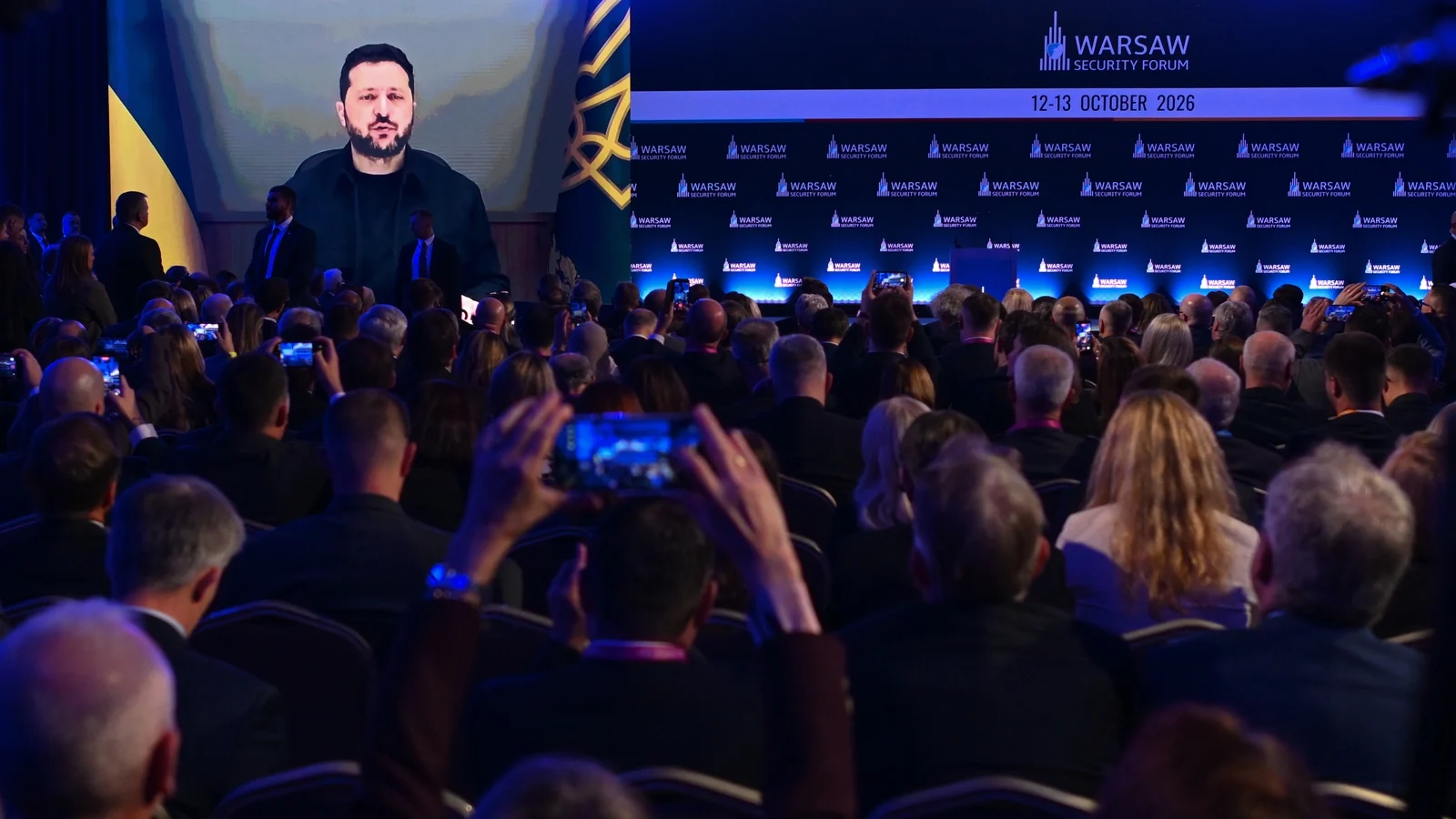
Ukrainian President Volodymyr Zelensky, addressing delegates by video link, urged Washington to increase pressure on Russia rather than roll back sanctions.
At this stage of the war, Mr Zelensky has shown that he has his limits when it comes to the Trump administration’s meek approach to Moscow.
He had signalled surprise at Mr Trump’s public announcement of a truce on striking energy targets. With few alternatives, he nonetheless praised the initiative, calling it “an important step towards ending the war”.
By Thursday, however, Kyiv’s patience had frayed after days of Russian strikes on Ukraine’s energy facilities, and Ukraine resumed attacks on Russian oil refineries — a move that drew Mr Trump’s disdain.
NATO’s top commander in Europe, General Alexus Grynkewich, delivered his ‘Theory of Victory’ strategy
For attendees dispirited by what they saw as Washington’s latest overture to Moscow, a very different message came from NATO’s Supreme Commander for Europe, General Alexus Grynkewich, who laid out his “Theory of Victory” — a blueprint for countering any Russian threat to the alliance.
“We will block the initial attack. If the attack persists, we will blunt it and prevent enemy advance,” the US general said on Monday from the forum’s main stage.
“Through manoeuvre, we will fix the enemy formations and deny the seizure of alliance territory. Land-based forces will attack the enemy and destroy his advancing forces.
“Our air forces and navies, working in concert with our space and cyber forces, will rapidly gain freedom of manoeuvre,” said General Grynkewich.
He told delegates that conflict was neither “imminent” nor “inevitable”.
European governments — especially those on the continent’s eastern flank — will be hoping that assessment holds.
No one at the conference stated unequivocally that war would spread to the rest of Europe.
But representatives from eastern and northern Europe spoke more openly about the risk of a serious confrontation, one they believe Moscow would initiate.
“We will fight, we will defend our home,” said Lithuania’s defence minister Robertas Kaunas if Russia were to attack.
Mr Kaunas said he believed Lithuania could hold out for two weeks until NATO reinforcements arrive via the Suwalki Gap, a strategically vital stretch of about 70km between Poland and Lithuania.
Mr Tusk and Lithuanian Prime Minister Mindaugas Sinkevičius used the forum to press other European countries to sustain financial support for Ukraine as a pillar of Europe’s own security.
“If you want to look after your national interests, it is your duty today to support Ukraine,” said Mr Tusk.
Mr Sinkevičius argued that backing Ukraine had increasingly become “a northern European effort,” and insisted that “we must make it a European one”.
German, British and Polish foreign ministers backed continued sanctions against Russia
One theme that repeatedly surfaced in panel discussions was the distance between the hard-line approach many European speakers advocated toward Russia and the direction the Trump administration appears to be taking with Moscow.
Poland’s foreign minister Radosław Sikorski, Germany’s Johann Wadephul and Britain’s Ed Miliband all made the case for maintaining sanctions, a position that stood in sharp contrast to Mr Trump’s recent steps.
Some former senior military leaders urged a more resolute Western posture as well.
“Russia is only a superpower in the heads of European and American elites,” retired US Lieutenant General Ben Hodges, who led US forces in Europe from 2014 to 2018, told participants near the forum’s close.
Russia, he argued, “cannot defeat Ukraine”.
“Why is Europe, why is the United States always so terrified about provoking Russia. We should have so much more self-confidence.”
Gary Kasparov, the former world chess champion and an exiled critic of the Kremlin
Not everyone shared that assessment. During a discussion on Kaliningrad’s strategic role, a Polish vice-admiral pushed back against claims that Russia’s Baltic fleet is obsolete, urging caution about underestimating Moscow’s capabilities.
Gary Kasparov, the former world chess champion and exiled Kremlin critic, described much of what he heard at the forum as “hypothetical” and challenged what he sees as Western leaders’ unwillingness to state plainly that Ukraine must win and Russia must lose.
“Unlike a game of chess, there is no option for a draw in the war in Ukraine. Either Ukraine, God forbid, collapses, or Putin’s regime goes down,” Mr Kasparov said in an on-stage interview.
To probe whether NATO’s Article 5 guarantee truly holds, he said, Mr Putin would only need to order a small incursion into Estonia or Latvia and watch whether the US would “sit it out”.
“In chess we have rules, Vladimir Putin doesn’t care about rules. He changes the rules any time he wants.”