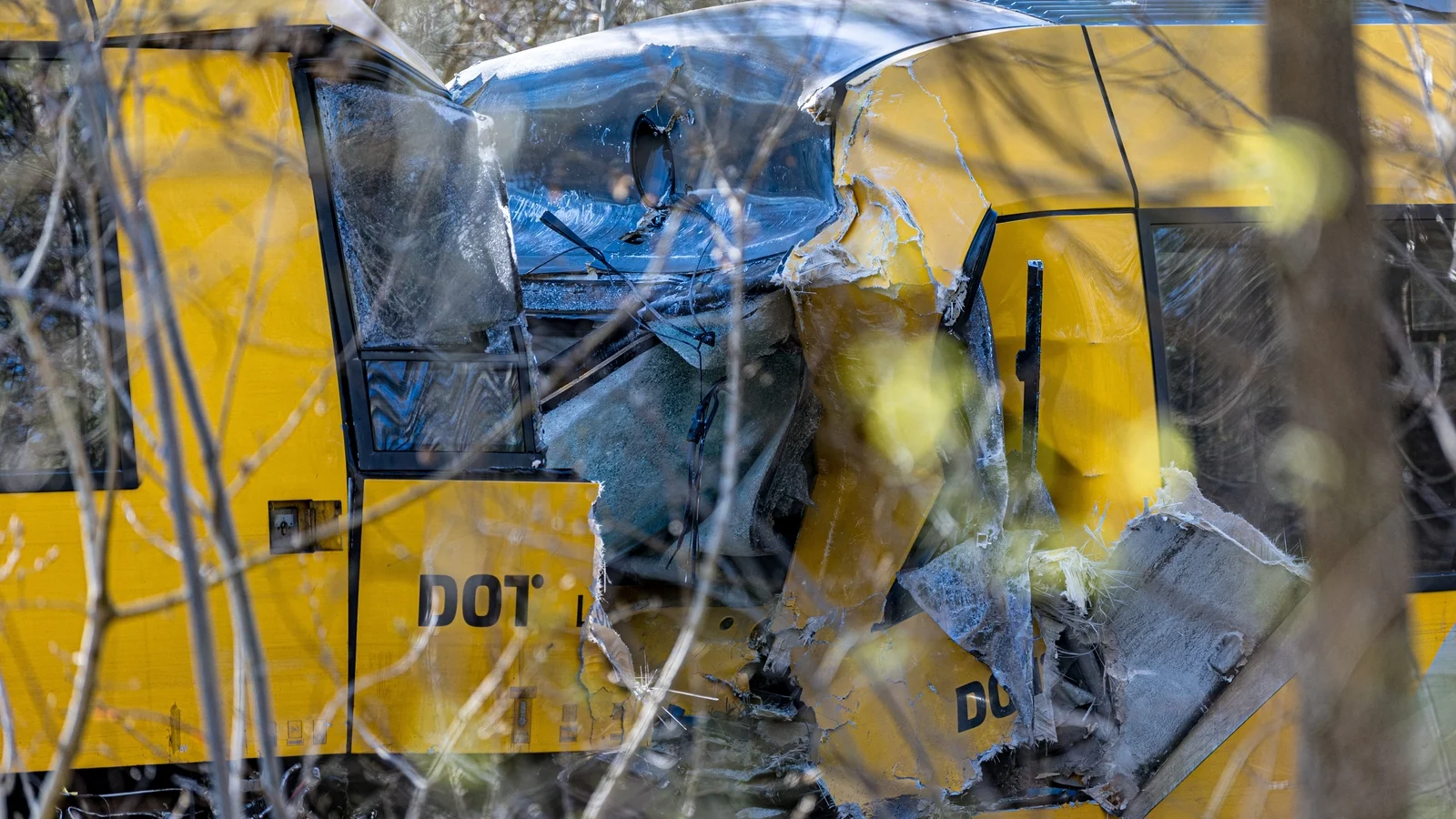
Dawn shattered: a commuter morning that turned into a rescue scene north of Copenhagen
It was still that fragile, blue-washed hour of morning when the routines of a small Danish town were interrupted by a sound that did not belong to the landscape: metal meeting metal, glass fracturing, the abrupt, wrong cadence of a collision where two commuter trains should have slid past each other in tidy silence.
The crash happened near a level crossing in a wooded stretch of North Zealand, about 40km north of Copenhagen, close to Hillerød and within the Gribskov municipality. Commuters who had planned a short train ride into the city found themselves instead caught in a scene of smashed yellow-and-grey locomotives, shattered windshields and the sudden, urgent business of rescue.
The facts, as they stand
Police were alerted at 06:29 local time. Thirty-seven people were on board the two trains. Eighteen people were injured, of whom five were in critical condition, authorities said. Emergency services — ambulances, police cars and helicopters — moved quickly, evacuating everyone from the carriages and bringing the injured to regional hospitals. Rescue teams wound down their on-site work roughly three hours after the collision as investigators moved in.
- Time of alarm: 06:29 local time
- Passengers on board: 37
- Injured: 18 (5 critically)
- Location: near Hillerød, Gribskov municipality, ~40km north of Copenhagen
By dawn the two locomotives appeared buckled where they met — heavy machines that had remained upright but with windows spiderwebbed by impact. For residents in the nearby villages, the sight was surreal; for the commuters, it was terrifying and immediate.
“We still can’t breathe out properly”
“I live two kilometres from the crossing. When I heard it I thought it was an explosion,” said Sofie, a schoolteacher who rushed to the scene with her neighbours. “There was glass everywhere on the road. People were sitting on the platform, wrapped in blankets. One man kept thanking the ambulance staff, even though he was shaking badly. You could see the shock in everyone’s eyes.”
Trine Egetved, mayor of Gribskov municipality, wrote on Facebook she was “deeply upset and shocked” and noted that the commuter line is a lifeline for local workers and students. “This morning it felt like a wound in our daily life,” she wrote, speaking to how local rhythms can be upended in a single instant.
“Several of the injured were airlifted by helicopter,” Egetved added in comments shared by local media, underscoring both the seriousness of some injuries and the scale of the response.
What investigators are looking at
At the scene police were cautious, reluctant to draw conclusions. “We can’t provide any details for now about the cause,” police official Morten Kaare Pedersen told reporters. “We are in the process of gathering the necessary information about the course of events. So there are, and will continue to be for quite some time, a lot of investigations under way.”
Technical questions loom large: how did two trains traveling on a commuter line come to collide head-on? Was it a signalling mistake, human error, equipment failure, or an unlucky cascade of smaller problems that converged at the wrong moment?
“From what we know right now, human error is a possibility,” said Kristian Madsen, a railway expert with the Danish engineers’ union IDA. “Either the driver missed a red signal — which can happen in low light or under stress — or the station control gave a green despite the other train being on the line. It’s important to note this section still uses an older signal system, and older systems can be less forgiving.”
Voices from emergency services
“We worked as quickly as possible to extract and stabilise passengers,” said an ambulance service coordinator who asked not to be named. “It was a complicated site because of the woods and the level crossing, but our teams trained for mass casualty incidents performed as they always do — methodically, calmly.”
Hospital staff in Hillerød and surrounding facilities reported receiving multiple trauma patients. “We are treating several serious injuries; some patients are in intensive care,” said a clinician from the regional hospital. “We’re focused on stabilisation, and we’re also providing psychological care — these events leave invisible wounds as well as physical ones.”
Context: a high standard but not immune
Denmark prides itself on high safety standards and efficient public transport. Still, rail accidents, while rare, leave a lasting imprint. In 2019 a train crash in the country killed eight people and injured 16. In August last year an express train struck a farm truck at a crossing, killing one and injuring 27. These events have prompted debates about modernising signalling systems and investing in level crossing protections.
Across Europe, rail networks face similar crossroads: ageing infrastructure inherited from a century of expansion, the need to integrate cutting-edge signalling and automatic braking systems, and the pressure to keep costs manageable while serving a growing population of riders. Commuter rails are essential to sustainable urban mobility, but they rely on complex systems where a single failure can ripple outward.
Why it matters beyond this morning
Ask yourself: how much do we trust the unseen parts of public life — the signals, the wires and the dispatchers — to keep us safe? This accident is a reminder that the smooth functioning of modern society depends on persistent investment in maintenance, training and technology. Upgrading signal systems, installing automatic train control, and improving level crossing protections can be expensive, but the alternatives are human lives and fractured communities.
“We’re good at building new lines, but maintenance and upgrades often get pushed to the back of the budget,” said an independent transport analyst based in Copenhagen. “What we’re seeing in incidents like this is the pay-off of that under-investment: risk accumulating quietly until it surfaces in the worst possible way.”
Local color and human aftermath
North Zealand is a landscape of beech and pine, small towns with red tile roofs and markets where people still greet each other by name. Hillerød is home to Frederiksborg Castle, a baroque monument that draws tourists; in the shadow of such history, ordinary residents depend on the trains to get kids to school, bakers to their ovens, and engineers to their offices in Copenhagen.
On platforms and in hospital waiting rooms, conversations turned to gratitude and bewilderment. “We take these trains every day without thinking,” said Jens, a pensioner who was heading to an early appointment. “Today it could have been us. It’s a miracle no more people were hurt.”
Next steps and wider questions
Investigators will comb through signal logs, black-box data, and steward and driver accounts. They will map the choreography of the trains and the decisions made in those first, critical minutes. Politicians will be asked tough questions about investment choices. And for the commuters who saw the collision with their own eyes, the road back to normal will likely involve counselling, reassurance and a renewed demand for safety.
Ultimately, this is not only a local story. It is a global conversation about how societies protect the daily lives of citizens who rely on public transport. It asks whether we will respond to this morning’s shock with fixes and investments, or chalk it up as an unfortunate anomaly.
Where do you stand on public investment in transport safety? How much is a life worth when decisions about budgets are being made? These are the questions that follow a day like today — and they belong to all of us, because we all ride on the systems others build.