Greenland on the Line: Between Ice, Independence and Global Geopolitics
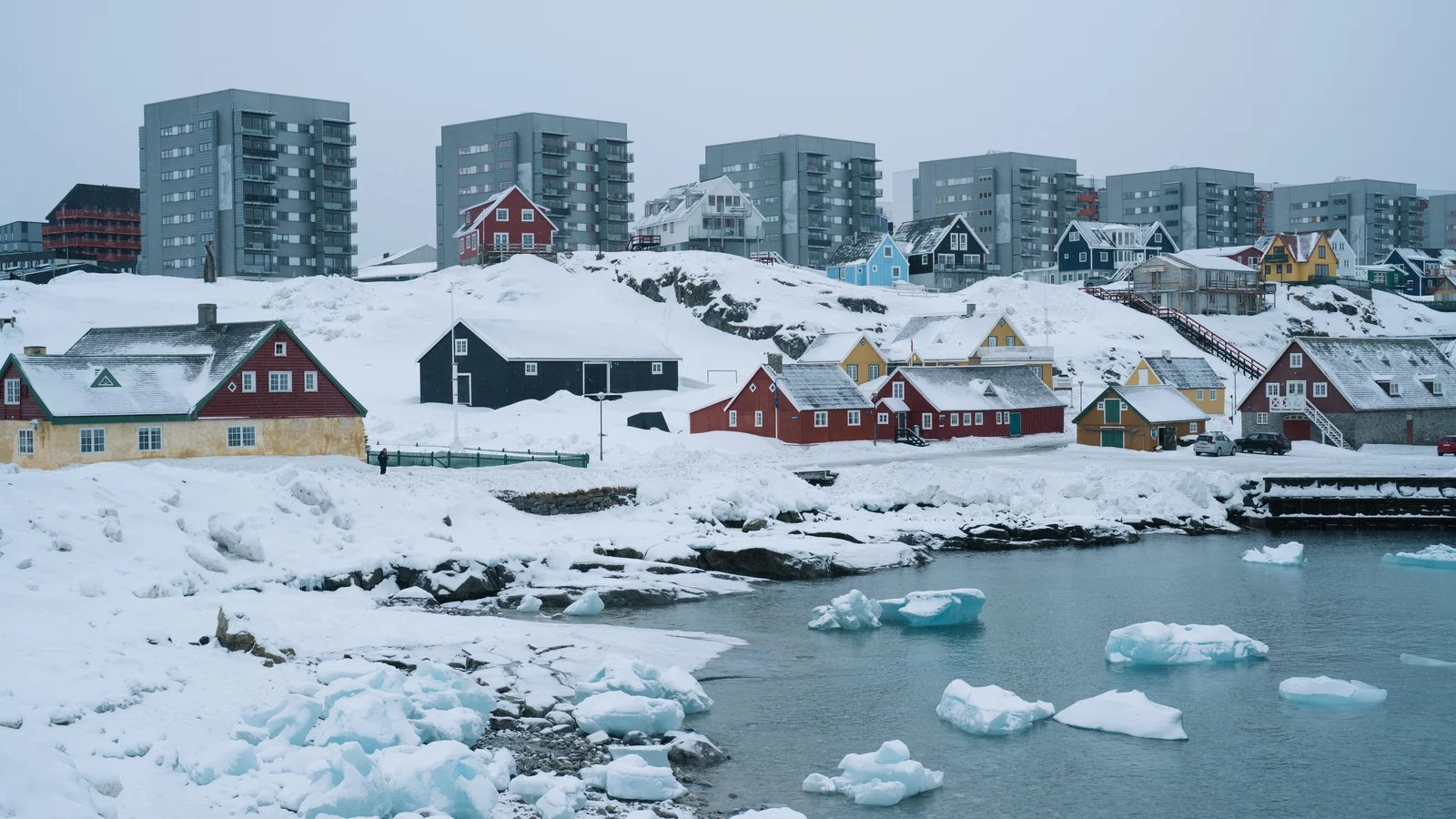
On a bright, cold morning in Nuuk, the capital’s painted houses look like jewels scattered against a vast white palette. Steam rises from a fishing trawler tied to the quay. Children weave between parked cars, their laughter drifting over the fjord. For the 56,000 or so people who call this place home, Greenland is not a chess piece to be traded between distant capitals — it is a homeland, a place of memory and weather and stubborn pride.
And yet, in recent weeks, headlines have placed Greenland at the centre of a geopolitical tug-of-war, reviving old questions about sovereignty, security and the value of the Arctic in a warming world. In Copenhagen, Prime Minister Mette Frederiksen responded sharply to suggestions from Washington that the United States might “need” Greenland for defence reasons — calling the idea absurd and insisting that the territory and its people are not for sale.
Why Greenland matters
To understand why a far-flung island of fjords and ice sheets suddenly commands global attention, you have to look past the clichés about polar bears and endless ice.
- Size and location: Greenland is the world’s largest island, more than 2.1 million square kilometres, located squarely between Europe and North America.
- Population: Roughly 56,000 residents, concentrated largely along the west coast.
- Ice and climate: About 80% of the land is covered by the ice sheet, whose future is central to global sea-level projections.
- Strategic footprint: The island hosts Greenlandic settlements, Danish administration and long-standing US military facilities such as Thule Air Base, established during the Cold War.
“Think of Greenland as a gateway,” said an Arctic security analyst I spoke to, tracing a finger over a map. “Control of Greenland touches transatlantic lines of communication, early-warning systems and the routes a new era of Arctic shipping might create. That is why big powers watch it.”
Voices from the fjords
Back in Nuuk, opinions are nuanced. “We grew up here,” said Anja, a 28-year-old nurse, as she sipped strong coffee outside a clinic. “This is not a commodity. People speak about mineral wealth and strategic value, but they don’t talk about our language, our music, our food. You can’t put a price on that.”
On the docks, Nuka — a captain who has spent his life hauling halibut and shrimp through the winter months — was more blunt. “We’ve been told what’s best for us before,” he said, eyes narrowed against the wind. “Independence is a hope for many, but money is real. The subsidy from Denmark keeps hospitals open, kids in school. We have to balance pride with survival.”
That Danish subsidy — a regular transfer that helps sustain Greenland’s public services — is often cited as a key factor in the island’s gradual, cautious path toward greater autonomy. The Self-Government Act of 2009 confirmed the right of Greenlanders to declare independence in the future, but also left a practical dependency: tens of thousands of jobs, essential public services and an economy still tethered to fishing and state funds.
Minerals, melting ice and the economics of influence
The Arctic’s mineral bounty — rare earth elements, potential oil and gas, and other strategic resources — has spurred outside interest. Global demand for rare earths, for example, drives a scramble by nations to diversify supply chains away from single-source dependencies. For Greenland’s small towns, mining projects promise jobs and infrastructure. But the memory of previous resource booms, and the environmental fragility of the Arctic, make the debate deeply contested.
“We must ask ourselves what kind of development we want,” said a Greenlandic community leader I met in a town hall meeting. “Will mining build schools and clinics or foreign megaprojects and empty promises? Will it poison water and change our way of life?”
Diplomacy, dignity and the dangers of language
When foreign officials publicly debate whether a territory should belong to another state, it is not merely diplomatic posturing. It touches the dignity of the people who live there. Prime Minister Frederiksen’s statement — that it would be “absurd” for another country to seek to take control of Greenland — was as much an appeal to principle as it was to geopolitics.
“Warm words are not enough,” said the Danish prime minister in a formal statement. “We must respect our allies and recognise the rights of the people who live on the island.”
That plea resonated in Nuuk’s cafes and municipal chambers. “We are not for sale,” repeated a community activist, who asked to remain anonymous because she feared reprisals from more powerful actors. “It’s painful to hear countries talk as if places like ours are empty containers to be filled with bases and mines.”
What comes next — and what it means globally
There are no simple answers. Greenland’s future will be shaped by internal debates about independence, external pressures from great powers seeking strategic advantage, and the relentless realities of climate change.
Here are some of the questions that matter globally, not just locally:
- Who decides what constitutes legitimate security interest versus coercive influence?
- How can resource development be done in ways that respect local rights and protect fragile ecosystems?
- What obligations do historical powers have toward dependent territories seeking self-determination?
“Greenland is a mirror,” suggested an international law scholar. “How the world responds to the island’s choices will say a lot about our commitment to sovereignty, indigenous rights and cooperative security in the 21st century.”
Closing thoughts
Walking away from the harbour that afternoon, the fjord spread out like an old map — white, blue, a smear of dark water where the current ran fast. Greenland will not be decided by a single speech or headline. Its people will move forward, sometimes slowly, sometimes with urgency, balancing the practicalities of life with the deep, human desire to determine their own fate.
So what do you think, reader? When a small community sits at the intersection of global strategy and indigenous identity, whose voice should carry the most weight, and how should the international community respond? The answer will shape not only Greenland’s future, but the contours of global diplomacy in a warming world.