Drone Strike Damages Russian Vessel in Benghazi, Libya
 Caalamka
A new drone strike off Benghazi has widened fears that Libya’s fractured coastline is becoming an unintended stage for the Russia-Ukraine war, after authorities in the country’s east said a second ship was hit within hours of an earlier attack involving a Russian vessel at the city’s port.
Officials in eastern Libya said a “merchant vessel was targeted this evening by explosive-laden sea drones off the coast of Benghazi”, without saying whether the ship was also Russian.
No one immediately claimed responsibility for either incident. The attacks come as Ukrainian forces have intensified long-range strikes against Russian interests well beyond the front lines.
According to reports, the second ship was sailing under a Maltese flag.
The eastern administration said all crew members had been rescued and were being treated for minor injuries.
Libya Alhadath television later reported that naval and air force units intercepted more than 12 “explosive-laden sea drones” off Benghazi.
‘Not a party’ to the war
On Saturday, a drone hit a Russian cargo ship in the eastern Baltic Sea, close to the waters of Finland, whose border guard said the strike was Ukrainian.
In its account of the Benghazi incidents, Libya’s eastern administration did not name any perpetrator behind the second attack but stressed that Libya was “not a party to the Russian-Ukrainian war”.
The conflict, which began with Moscow’s 2022 full-scale invasion of Ukraine, has killed hundreds of thousands of people and displaced millions.
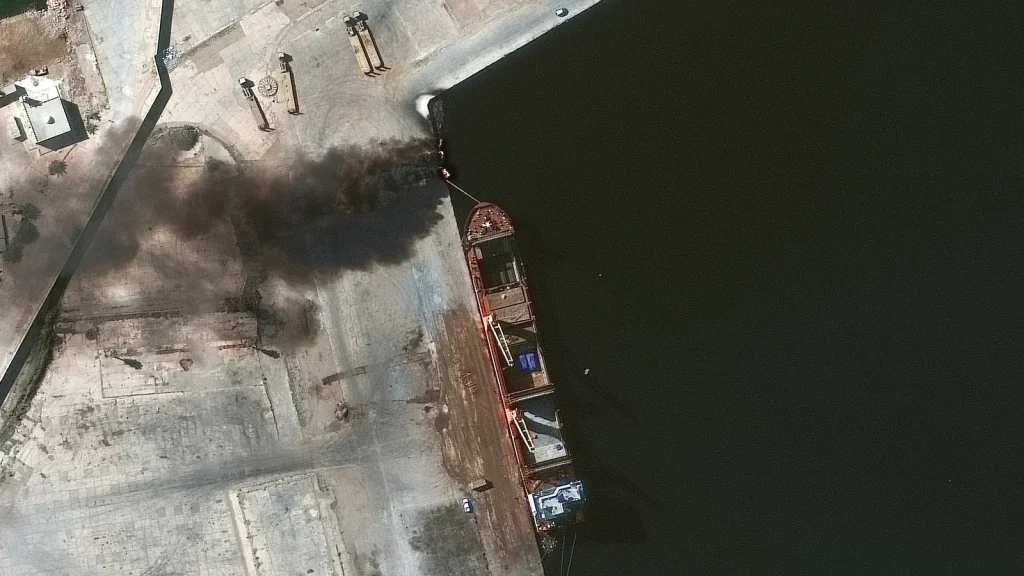
Initial reports had pointed to a blaze inside an ammunition depot at a naval base, but authorities in the east later revised their account, saying instead that “the explosion occurred on board a Russian ship docked in the port”.
“It is suspected that the ship was attacked by drones,” an official statement said.
“The ship was en route back to Russia and its stop was for refuelling and resupply.”
The eastern administration said it would open a joint investigation with Russia.
In Tripoli, the rival UN-recognised government said it was alarmed by “risks posed by involving civilian ports and facilities in activities linked to external conflicts”.
‘Shadow fleet’
In March, a Russian liquefied natural gas carrier sank off the Libyan coast following an attack, which Russian President Vladimir Putin blamed on Ukraine.
The ship was described as part of Russia’s so-called “shadow fleet” of tankers that move its oil and gas around the world while bypassing Western restrictions.
Ukraine has at times acknowledged targeting Moscow’s shadow fleet, including in the Mediterranean last December.
The Tripoli government said it rejected any effort to turn Libya into “an arena for international conflicts” and opposed the use of its territory “for any military or logistical activities that could jeopardise” national security or sovereignty.
Libya has been beset by violence and instability since the overthrow of longtime ruler Muammar Gaddafi in 2011.
The country remains split between the government in Tripoli led by Prime Minister Abdulhamid Dbeibah and a rival eastern administration backed by military commander Khalifa Haftar.
Earlier on Sunday, Al-Masar TV quoted local civil defence forces as saying response teams had been dispatched to a military facility to contain a fire after the reported blast.
Alhadath TV later reported that the fire had been extinguished.