After years spent witnessing conflicts and humanitarian disasters, Peter Power says nothing prepared him for what he encountered in Sudan.
The head of UNICEF in Ireland returned from a three-day visit to Khartoum last week describing brutality on a scale he had not previously experienced.
“The levels of violence, the depravity,” he told RTÉ News shortly after leaving the capital, “is definitely more than I have ever, ever experienced – particularly sexual violence”.
Mr Power said the use of systematic sexual violence as a weapon of war was “beyond belief”.
He said it is being carried out largely against women and girls, and is especially severe in western Darfur — a region still marked by the 2003-2005 genocide perpetrated by the Janjaweed militia.
Much of the capital city Khartoum has been destroyed
In October last year, the city of El Fasher — the capital of North Darfur — fell to the paramilitary Rapid Support Forces (RSF) after an 18-month siege. The RSF are widely regarded as the successors to the Janjaweed.
About 10,000 men, women and children were massacred, in what a Guardian newspaper investigation later called “the fastest and largest killing spree this century”.
That investigation also reported that US and UK intelligence assessments forecasting a massacre were ignored.
When asked for more detail on what he had been told during his trip, Mr Power said he did not want to elaborate.
Even thinking about it, he said, was hard.
“I’ve struggled with the evil that men can do this week – I have really struggled with it,” he said.
“How men can do what I’ve heard they have done? It’s beyond evil.”
A three-month old baby receiving treatment at Abolouk Hospital Stabilisation Centre, Khartoum
Sudan’s war has now raged for more than three years, generating what aid agencies describe as the world’s largest humanitarian crisis.
UN figures show 13 million people have been displaced.
Some 19 million people — around 40% of the population — do not have enough food, including 10 million children.
And 3.6 million children are classified as malnourished.
The conflict stems from a struggle between forces loyal to Sudanese Army leader General Abdel Fattah al-Burhan and the RSF commanded by General Mohamed Hamdan Dagalo, better known as Hemedti.
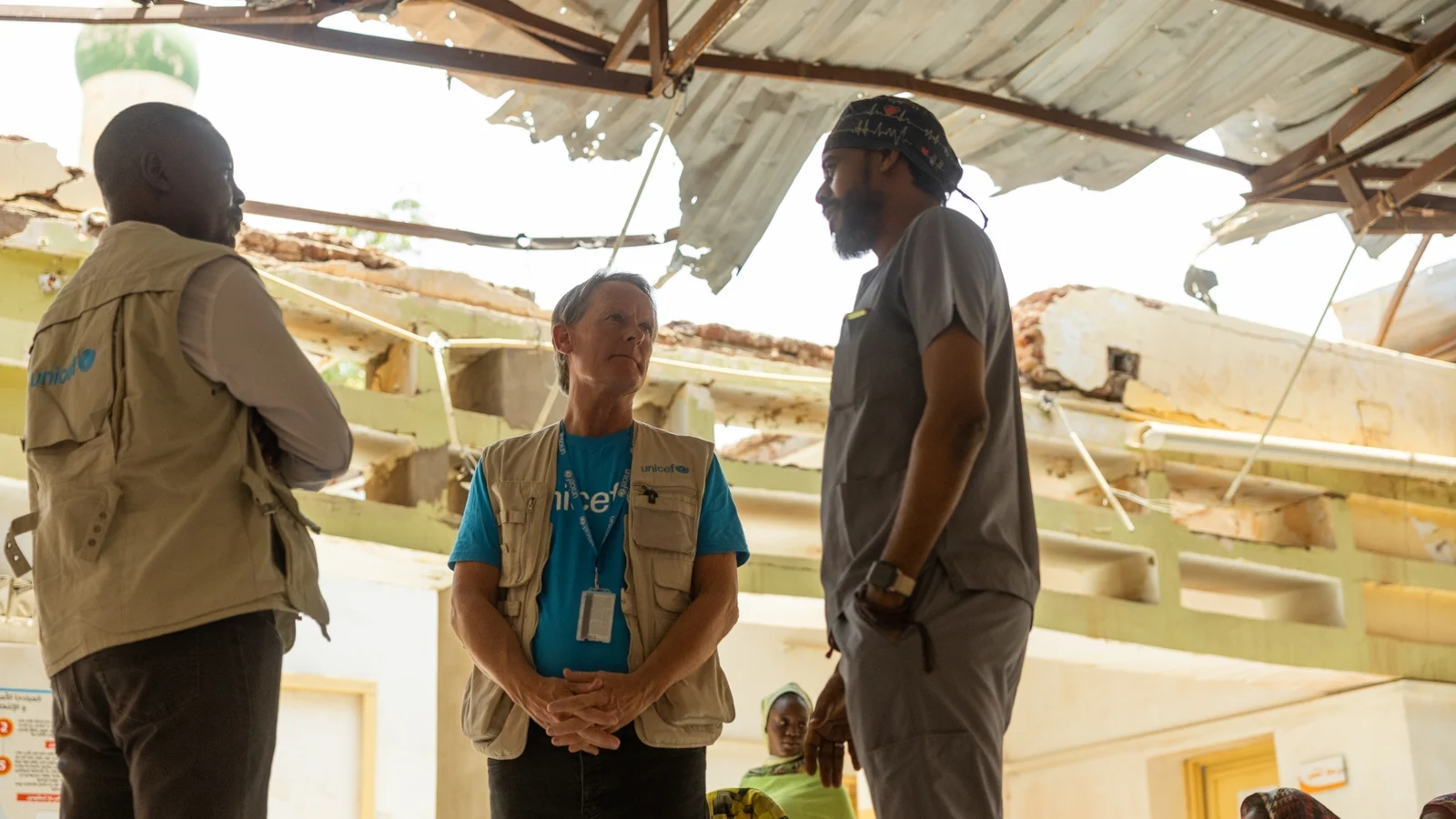
Peter Power, UNICEF, at a health clinic in Khartoum
Yet the war is also being fuelled from outside the country, with multiple foreign players backing opposing sides — a reality often linked to Sudan’s natural wealth, including significant gold reserves.
Egypt, Iran and Saudi Arabia have largely aligned with the Sudanese Army, while the United Arab Emirates is widely associated with support for the RSF, despite denials from Abu Dhabi.
There have also been reports of Russian and Ukrainian forces operating in Sudan.
“Diplomacy is paralysed as both SAF and RSF leaders have little incentive to do a deal since they and their regional backers continue to profit from Sudan’s war,” the International Rescue Committee said in a report.
“Large quantities of gold flow out of the country, while increasingly advanced weapons move in the opposite direction,” it found.
Khawla Bint Alazwar Girls Primary and Intermediate School
Like wars in Ukraine, Gaza, Lebanon and Iran, drones have become a defining feature of Sudan’s conflict.
“When I was in Khartoum, there were drones above and causing damage [on the ground,]” Mr Power said.
He said government forces have largely retaken the city, but the drones remain a constant presence overhead.
“Even our humanitarian convoys now see drones surveilling them all the time,” he said.
UNICEF said UN humanitarian convoys have been struck by drone attacks in four separate incidents since the start of 2026.
UN human rights chief Volker Türk has warned of a “sharp increase” in civilian deaths linked to drone warfare, with a thousand people killed in the first five months of this year.
Sudan’s army chief, Lieutenant-General Abdel Fattah al-Burhan (R) and Mohamed Hamdan Daglo (L), who commands the paramilitary Rapid Support Forces (RSF)
Mr Power said the destruction across Khartoum after three years of fighting was “astronomical”.
“There are virtually no buildings untouched, and so many destroyed, including the airport.
“The number of bombed-out aircraft as we were landing had to be seen to be believed.”
He recalled a city that once sprawled with modern buildings and a thriving commercial life.
Now, he said, “It’s just been dragged back 20, 30 years,” adding: “it’s shocking”.
For many watching Sudan’s war unfold, the pressing question is why a crisis of this size has not generated more sustained international attention — or money.
Humanitarians point to a steep fall in European aid as EU governments shift resources toward defence, alongside the dismantling of the US government aid agency USAID, leaving relief efforts struggling to stay afloat.
UNICEF said a 71% funding gap has interrupted critical services, compounded by persistent security threats.
The shortfall, it said, is “forcing difficult decisions about where UNICEF can operate and which children can be reached”.
Analysts say the war is frequently portrayed as an “intractable struggle” between two rival generals, with limited appetite among governments or regional blocs to spend the political capital required to push a settlement — particularly amid multiple global conflicts.
United Nations Humanitarian Coordinator in Sudan, Denise Brown
“Attempts to generate more international attention for the Sudan war have often struggled due to competing global crises, including the Ukraine war, and more recently the US-Israeli attack on Iran,” said Magnus Taylor, Horn of Africa Deputy Director of the International Crisis Group.
But he said increased focus on Sudan — including the suffering of ordinary Sudanese people — would not necessarily bring the fighting to an end at this point, given the degree of outside involvement.
“The conflict is now bound up with complex regional and geopolitical dynamics, including intra-Gulf rivalries, that help sustain the fighting and risk tipping the Horn of Africa into a wider regional crisis,” he said.
To some, the world’s inability to respond earlier is increasingly viewed as a serious failure by the international community.
“Please don’t call this the forgotten crisis,” said Denise Brown, the UN Humanitarian Coordinator in Sudan, as the war entered its fourth year in April.
“I’m referring to this as an abandoned crisis.”