A courtroom like a pressure cooker: 486 faces, a nation holding its breath
Outside the courthouse in San Salvador, the air tastes of fried corn and coffee. A vendor folds a pupusa on a skillet nearby as relatives and journalists shuffle past metal barriers. Behind a line of armored vans, a group of women clasp rosaries and stare at the sky as if asking for time to slow — or for an answer.
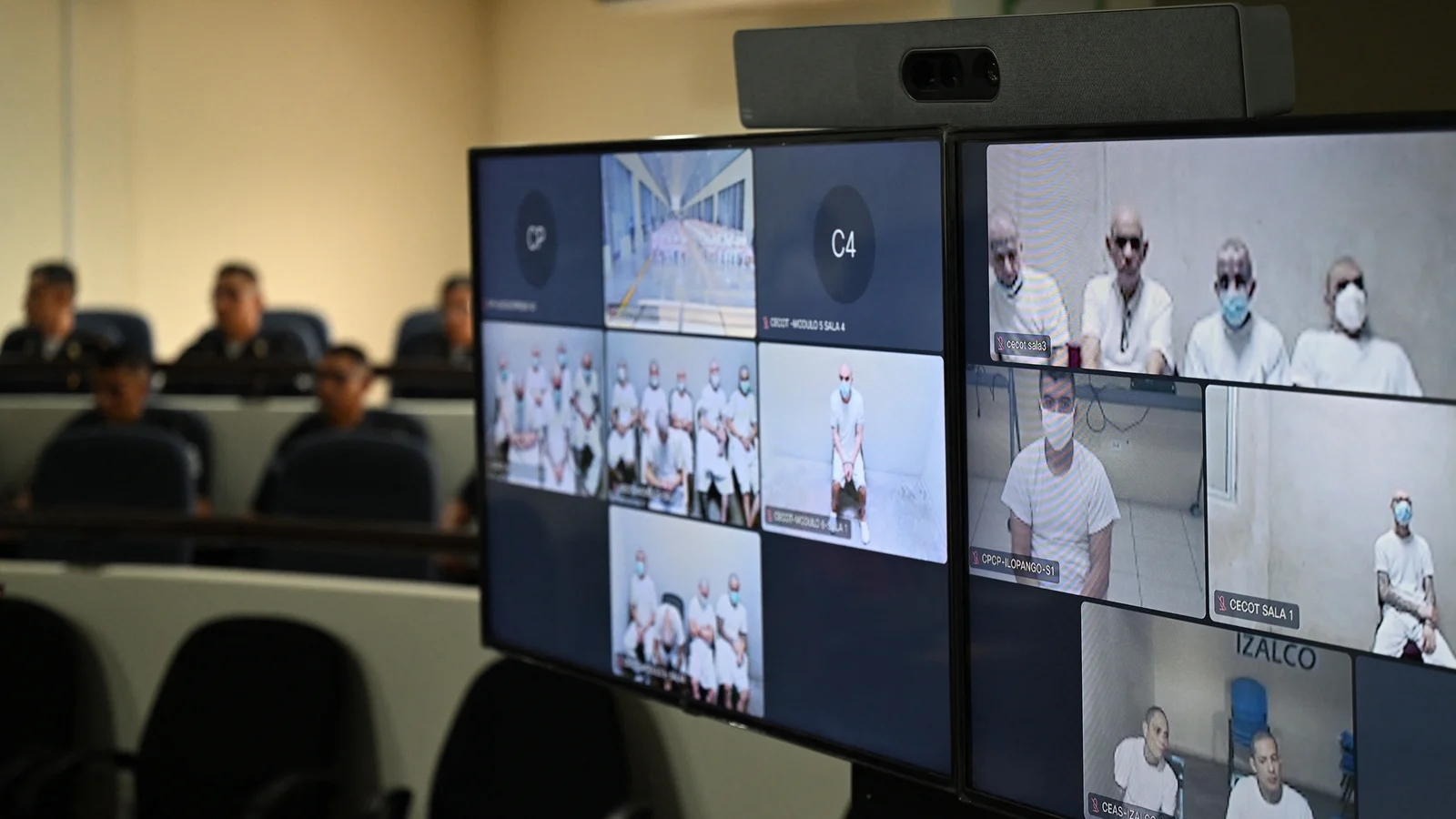
Inside, the room is not built for the story it now contains. Rows of defendants sit in bands, some with their heads shaved, some with the sort of tattoos that map neighborhoods and histories. There are 486 of them — almost five hundred people in a single collective trial that prosecutors call one of the largest in El Salvador’s modern history.
They are accused, authorities say, of belonging to Mara Salvatrucha, known worldwide as MS-13, and of taking part in a staggering catalogue of crimes: prosecutors list more than 47,000 alleged offenses committed between 2012 and 2022 — from homicides and femicides to extortion and arms trafficking. Under a decree passed during the government’s long-running state of emergency, El Salvador’s courts are managing mass cases in bulk, not one-by-one.
What this trial looks like
The trial’s scale is almost numbing. Prosecutors have produced autopsies, ballistic reports, and witness testimony compressed into days of hearings. They have asked judges to levy the maximum penalty available for each count. If convicted on all fronts, a single defendant could face up to 245 years behind bars, a legal impossibility in practice but a symbolic hammer nonetheless.
Many of the accused are housed across five prisons, including CECOT, the maximum-security complex opened by the Bukele administration in 2023. CECOT has become a physical emblem of a broader “zero tolerance” strategy: reinforced gates, solitary wings, and an isolationist design meant to sever gang leadership from street operations.
Voices in the hall
“We’ve been here since dawn,” said María López, the sister of a man charged in the trial, wiping her palms on her dress. “He is my cousin. He was caught on the street three months ago. We don’t know what evidence they have. They only tell us numbers.”
A prosecutor, speaking cautiously to a reporter in the hallway: “We are presenting forensic evidence, ballistic links, and testimonies. The victims deserve justice after years in which gangs terrorized towns and neighborhoods. The scale of the crimes requires a proportionate judicial response.”
Not all statements are warm. A human rights lawyer who asked to remain anonymous for safety reasons described the courtroom tempo as hurried. “Collective trials of this scale undermine individual review,” she said. “Time with each defendant to assess their role, their right to counsel — these are cornerstones of due process that are being compressed.”
Emergency powers, mass detentions, and a transformed public space
Since March 2022, El Salvador has been governed in large part through a state of emergency declared by President Nayib Bukele in response to a spike in violence. Congress repeatedly renewed that state of emergency, and the government’s security apparatus has since swept up more than 91,500 people, according to official tallies.
The mass detentions recalibrated daily life. Those detained vanished from neighborhoods that once hummed with karaoke evenings, corner stores, and pickup games. Buses run quieter; plazas see fewer young people lingering late into the night. For many Salvadorans, a palpable sense of safety returned. For others, a different fear emerged — fear that the state’s reach had become too broad, its discretion too unchecked.
“There is relief,” said Don Carlos, a baker from Soyapango, whose oldest son now runs his bakery instead of working late selling clothes in a mall. “Before, I was scared to close my shop. Now I’m not. But my neighbor’s son was taken, and we don’t know why. That’s the worry — who decides?”
Official results — and why they are disputed
The Bukele government points to a dramatic drop in killings as its primary defense. Officials claim the homicide rate fell from roughly 7.8 per 100,000 people in 2022 to about 1.3 per 100,000 the following year — an extraordinary decline by any standard. This statistical swing, they say, validates the emergency measures.
Independent analysts and international observers caution that while the numbers suggest a steep fall in homicides, the context matters: under a state of emergency, with restricted movement and press access, independent verification becomes harder. There’s also the question of what long-term social fabric is being altered in exchange for lower homicide figures: are community networks being rebuilt, or simply emptied?
Human rights groups sound the alarm
The Inter-American Commission on Human Rights, along with domestic NGOs, has been vocal about the legal implications of these mass operations. “This regime suspends the rights to a legal defence and to the inviolability of communications, and also extends administrative detention timelines,” the commission warned in a public release, echoing the concerns of lawyers in El Salvador.
“When judicial guarantees are suspended or eroded, you create a system where mistakes multiply,” explained Ana Rivera, a legal scholar focused on Latin American criminal justice. “Evidence can be misattributed, coerced statements can be used, and people who don’t belong in these cases get swept up. That’s why the conversation about security must include legal safeguards.”
A community divided
The polarities in Salvadoran society are stark. On one side are relatives of victims and many residents who declare they will accept strong-handed tactics if it means walking the streets without fear. On the other are families of the detained and civil liberties advocates who see the march of mass trials as an erosion of the rule of law.
“My cousin was killed five years ago; nothing was done. If this is the way to get justice, I don’t care if it’s harsh,” said Luis Martínez, a man who has campaigned for victims’ rights. Opposite him at a community meeting, a woman who declined to give her full name whispered, “They picked my nephew because he was in the wrong place at the wrong time. He’s only 19. How is this justice?”
Beyond borders: why this matters to the world
El Salvador’s experiment is watched across Latin America and beyond. In a world wrestling with the balance between security and civil liberty — from anti-terror laws in Europe to anti-crime pushes in parts of Africa and Asia — the Salvadoran case prompts urgent questions: can rights be temporarily curtailed without permanent damage? At what point does emergency governance become ordinary governance?
Scholars of comparative politics note that short-term gains in security can come at long-term costs: weakened institutions, normalized extraordinary measures, and a judiciary that may struggle to reassert independence. “We must ask not only whether violence decreases,” said Professor Marta Jiménez, a sociologist who studies gang dynamics, “but what kind of society we are building in the shadow of that reduction.”
What to watch next
- Trial outcomes and whether collective convictions are sustained on appeal.
- Independent reviews of evidence and access to legal counsel for the accused.
- Long-term trends in homicide rates and community restoration efforts.
Parting questions
As the trial unfolds, consider this: what does justice look like when numbers and human lives collide? Is security bought with the contraction of freedoms ultimately secure at all? El Salvador offers no simple answers — only the hard work of a society negotiating safety, fairness, and the rule of law.
Walking away from the courthouse that evening, the lights of San Salvador blur into the low silhouette of the volcanoes. The smell of pupusas lingers — ordinary life continuing — but under it, a hum of unresolved tension. For the relatives, lawyers, and judges inside that hall, the verdict will mean far more than a drop in a statistic. It will be a reckoning with whether a nation can lock up violence without locking up the principles that make justice meaningful.