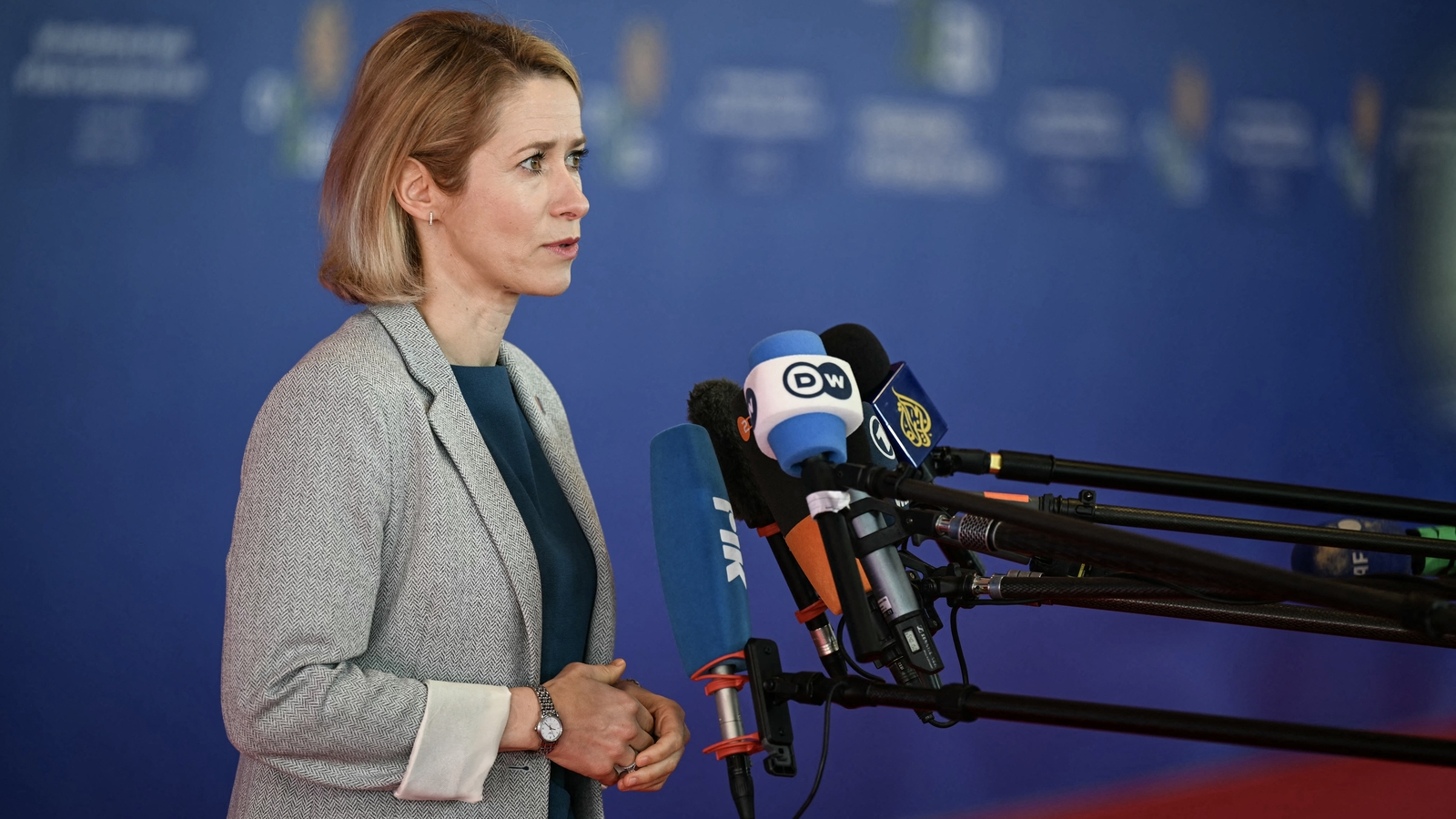
Warning that Moscow is escalating a shadow campaign against Europe, the European Union’s foreign policy chief Kaja Kallas urged the bloc to hit the Kremlin harder — including by taking a fresh look at whether Russian tourists should still be granted visas.
Speaking to the European Parliament, Ms Kallas said Russian President Vladimir Putin was choosing escalation over diplomacy, even as international efforts aim to stop the war.
“Despite international efforts to end the war, (Russian President Vladimir) Putin chooses to intensify his war of aggression against Ukraine and hostilities against Europe, and one thing is very clear: Putin will not stop unless he is stopped,” Ms Kallas told the European Parliament.
“So, as Russia is willing to take greater risks, Europe must impose a greater cost.”
Europe, she said, is contending with what she described as a “steady increase in hybrid attacks” linked to Russia — operations that can range from sabotage to disinformation and are intended to erode public and political support for Ukraine.
An incident over the summer sharpened those concerns after an explosive-laden drone was found at a German airport, an episode Berlin attributed to Moscow.
Alongside boosting backing for Kyiv and maintaining sanctions pressure on the Kremlin, Ms Kallas argued the EU should tighten oversight of Russians entering the bloc.
“We can tighten control further over the movement of Russian diplomats within Schengen. We can ban issuing visas for Russian ex-combatants, and we should review the issuance of tourist fissures to Russian citizens,” she said.
“We must reduce the pool of people conducting attacks on European soil.”
Ms Kallas also called on member states to improve intelligence-sharing and expand the use of artificial intelligence to counter Russian disinformation campaigns.
Even as EU leaders discuss additional steps, officials acknowledge the challenge of confronting actions that sit below the threshold of open conflict — activity that is often deniable and hard to attribute in public.
“We have all the response options we need when it comes to hybrid. It will not always be visible and public, what we do,” NATO chief Mark Rutte said on Monday.
“The most important one, of course, is making sure that Ukraine has what it needs to stay in the fight.”
Military police at the site of the drone crash near Pratkunai in Lithuania
Drone shot down by NATO fighter jet over Lithuania
NATO fighter jets shot down a drone over Lithuania, President Gitanas Nauseda said, marking the latest security incident on the alliance’s eastern edge.
Lithuania, Latvia and Estonia — NATO members that share a long border with Russia — have repeatedly reported drone incursions since Russia began its full-scale invasion of Ukraine in 2022.
“A drone that just entered Lithuanian airspace was destroyed by NATO fighter jets,” Gitanas Nauseda wrote in a post on X.
“With Russia intensifying its aggression against Ukraine, such readiness is vital for our region,” he added.
Lithuanian national radio LRT, citing preliminary information from the National Crisis Management Centre (NKVC), reported that the drone entered from neighbouring Belarus and was travelling west.
The broadcaster said it came down in a rural area near Lake Kaunas in central Lithuania.
Watch: Debris seen after drone downed by NATO jets in Lithuania
The NKVC said an Italian NATO fighter jet brought down the drone shortly after midnight.
The centre’s spokesperson said investigators had not yet determined where the drone originated. Officials also did not say whether the drone was believed to be Ukrainian or Russian.
However, Italian Defence Minister Guido Crosetto said the drone “most probably” came from Russia.
Authorities issued a drone alert earlier for Vilnius and surrounding areas.
The Lithuanian army released video from the crash site showing debris strewn across grass.
Some pieces appeared to be made of wood, while other fragments looked charred.
Foreign Minister Kestutis Budrys thanked Lithuania’s allies in a post on X, saying their presence helped safeguard the country’s skies and bolster security.
“This is best example of Allied unity and resolve in action – sending a clear message that NATO stands vigilant, committed, and ready,” he added.
NATO’s Baltic Air Defence mission has patrolled Latvian, Lithuanian and Estonian airspace since the three countries joined the alliance in 2004.
A NATO fighter jet shot down a Ukrainian drone over Estonia in May, the first time NATO’s air police have intercepted a foreign drone in the airspace of a Baltic state since the war began.
In recent months, Ukrainian drones have repeatedly crossed into NATO air space in the Baltic region.
Ukraine says Russian signal jamming caused the aircraft to veer off course.
Poland commences ‘aviation operations’ due to Russian activity
Poland, meanwhile, said it had begun “aviation operations” in its airspace “due to the activity of Russian Federation’s jet-powered unmanned aerial vehicles conducting strikes on Ukrainian territory”.
Warsaw described the moves as “preventive”, aimed at “securing airspace and its protection, especially in areas adjacent to threatened regions”.
Lithuanian President Gitanas Nauseda confirmed the drone had entered Lithuanian airspace
Belarusian opposition leader in exile Svetlana Tikhanovskaya also condemned the incident.
“We refuse to accept our country being turned into a source of danger to Europe,” Ms Tikhanovskaya wrote on X. “Lasting security requires a sovereign, democratic Belarus whose territory is never used against its neighbours.”
Across NATO’s eastern flank, officials say they have faced a series of hostile actions in recent months from Russia and Belarus, from drone incursions to cyberattacks.
A NATO fighter shot down a Ukrainian drone over Estonia in May, the first interception of a foreign drone in the airspace of a Baltic state by NATO’s air police since the war began.
European officials say Russia has been diverting Ukrainian drones intended to hit industrial sites and oil terminals in the Saint Petersburg region, on the Gulf of Finland.
In early July, Mr Nauseda said he wanted Lithuania to take part in Western nuclear deterrence against Russia.
Since then, Lithuania has begun the process of lifting a constitutional ban on storing nuclear weapons on its soil.
Last Friday, Russia threatened to aim its nuclear warheads at Lithuania if the Baltic state hosted any weapons from the nuclear arsenals of its NATO allies on its territory.
The three Baltic states were turned into Soviet republics by Moscow at the end of World War II and moved quickly to join NATO and the EU after the Soviet Union collapsed in 1991.