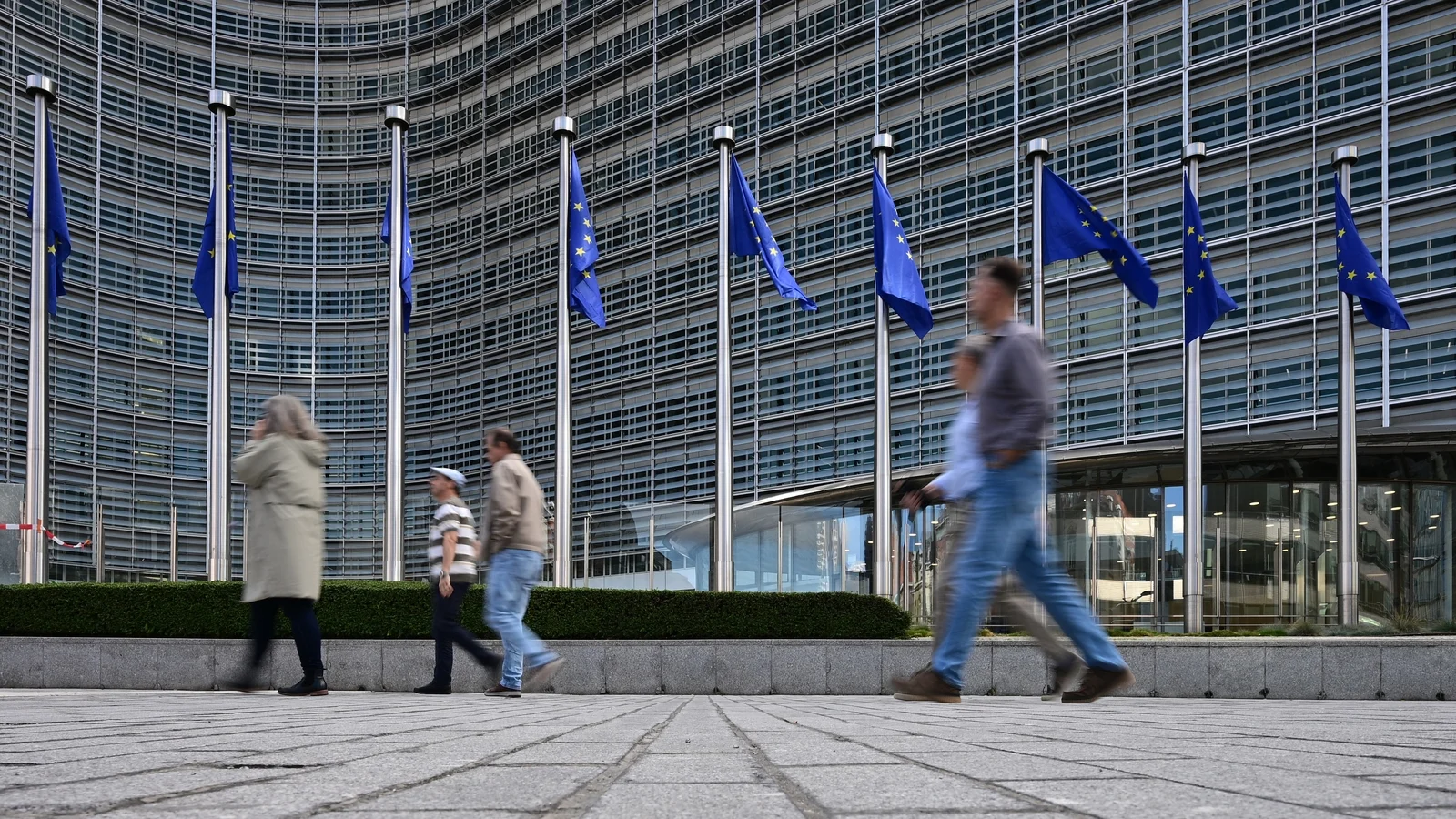
Europe’s post-pandemic borrowing spree and long-term financial backing for Ukraine are pushing the EU’s balance sheet into perilous territory, with the bloc’s budget watchdog warning overall debt could hit €1 trillion by 2027.
In its annual report on EU spending in 2025, the European Court of Auditors (ECA) also sounded the alarm about the shape of the next seven-year budget, cautioning that the redesigned system could increase mistakes and load additional bureaucracy onto member states.
The court said the EU faces a clear dilemma: without fresh income sources to meet spending pledges in the budget, any extra borrowing would simply stack onto the existing debt burden.
While the auditors issued a “clean” opinion on the reliability of the EU’s accounts for 2025, they reported that the error rate ticked up to 3.8%, from 3.6% in 2024.
In the ECA’s terminology, errors are payments that should not have left the EU budget because funds were not used in line with EU rules or with the spending intentions set by member states and the European Parliament.
The findings land as capitals jostle over the next seven-year EU budget, with net contributor countries pushing for a smaller package focused more heavily on competitiveness and defence, while others fight to protect agriculture and cohesion spending.
The Irish Presidency of the EU is due to publish a compromise draft on Saturday for a €1.9 trillion budget covering 2028-2034.
One of the most closely scrutinised elements will be whether the Government has managed to build agreement around new revenue streams that member states can accept politically—and that can still raise the sums required.
Those new revenue sources must bring in €60 billion a year in total. Options on the table include increased receipts from the EU carbon market, a levy on carbon-intensive imports, higher tobacco duties, a charge on non-recycled e-waste and a corporate levy.
CAP funding is to be administered through new National Regional Partnership Programmes
The redesign of the next EU budget, known as the Multiannual Financial Framework (MFF), has already been signed off by member states.
Instead of Brussels allocating fixed envelopes directly to areas such as farming, rural development, research or Erasmus, money would flow first to member state finance ministries, which would gain wider discretion over where and how it is ultimately spent.
The ECA warned that this shift could strain national administrations, especially where internal battles between departments over funding—familiar in national budget cycles—become an added annual headache.
“Ambitious budgets demand equally ambitious safeguards”, said ECA President Tony Murphy.
“If the EU moves to a new budget model where financing is no longer linked to costs, we must learn from experience and address what has not worked before, so that EU funds deliver the intended outcomes for citizens.”
He added: “The issue is mixing everything up in one pot. You have agriculture, you have cohesion, you have an element of defence – you’ll have all these different policy areas with different timescales, different objectives, different delivery mechanisms. The potential risk is that it will be more complex for member states.”
The annual report notes that Ireland remained a net contributor to the EU in 2025, paying in approximately €3.4bn and receiving €2.3bn, leaving a net contribution of €1.1bn.
Of the €2.3bn Ireland received, most came through Common Agriculture Payments (CAP) supporting farming and rural development, including just under €1.18bn in direct payments to farmers.
European Court of Auditors warns EU’s overall debt level could reach €1 trillion by 2027
In the next seven-year budget, CAP funding would be routed through new National Regional Partnership Programmes (NRPPs), which sit at the centre of the new architecture, with a portion of CAP money to be ring-fenced.
That ring-fenced share, however, would be tied to conditions: payments must be aimed at farmers “who need it most”, alongside changes to the CAP’s green architecture, according to a Department of Agriculture briefing note.
During the current budget cycle, 2021-2027, the State has received €10.7bn in CAP funding
But under the most recent budget draft, Ireland would receive €8.16bn in ring-fenced CAP funds over the seven-year period—down 24%.
The Department of Agriculture note says the Government is “analysing” the draft, including “exploring the possibility to top up CAP interventions from the wider NRPP allocation, and from other potential flexibilities in CAP financing such as the early release of mid-term review resources and the so-called ‘10% rural target’ announced in January.”
It also acknowledges that these options would amount to “a reshuffling of funds that were not immediately accessible under the original budgetary plan, and do not represent additional funding.”
The auditors’ report shows EU debt “increased significantly” in 2025 to €738.9bn, from €601.3bn in 2024.
Most of that debt stems from the borrowing programme launched to restart the European economy after the Covid pandemic.
The Recovery and Resilience Facility (RRF) provided €360bn in grants and €213bn in loans, paid out to member states based on the scale of the pandemic’s impact and tied to delivery of pre-agreed reforms focused on digital and green transformation.
The European Public Prosecutor’s Office (EPPO) is investigating 512 potential fraud cases linked to RRF spending, according to its latest report.
The ECA said the RRF differs sharply from traditional EU spending because payments are not tied to actual costs, and meeting EU and national rules is not a condition for payment.
Because of that design, the court warned that the level of errors seen in the RRF could reappear under the EU’s new budget model.
“EU countries were sometimes allowed to make their recovery-plan commitments easier or narrower without providing convincing reasons and evidence,” said the court.
“In some cases, the changes were made only after a country had asked the Commission for payment. This poses the risk that countries could receive EU money for delivering less than originally promised,”
Ireland received €1.15bn in RRF funding and has submitted its final payment request worth €225 million.
The European Commission estimates that paying interest and principal on the EU’s debt stock will cost about €24bn a year across the next MFF. The European Parliament has argued these repayments should be excluded from the budget’s books and is seeking a 10% rise in the overall budget.
Beyond the pandemic response, the EU has also borrowed to bolster Ukraine, including through the Ukraine Facility, which by 2025 had mobilised €31.3bn—among it €23.2bn in loans backed by unspent funds in the EU budget.