When Bondi Went Quiet: A Community Mourns
On a grey morning that should have felt like any other summer day by the sea, Bondi Beach sat unnaturally still — umbrellas folded, sand undisturbed, the roar of the Pacific softened by a hush you could almost touch.
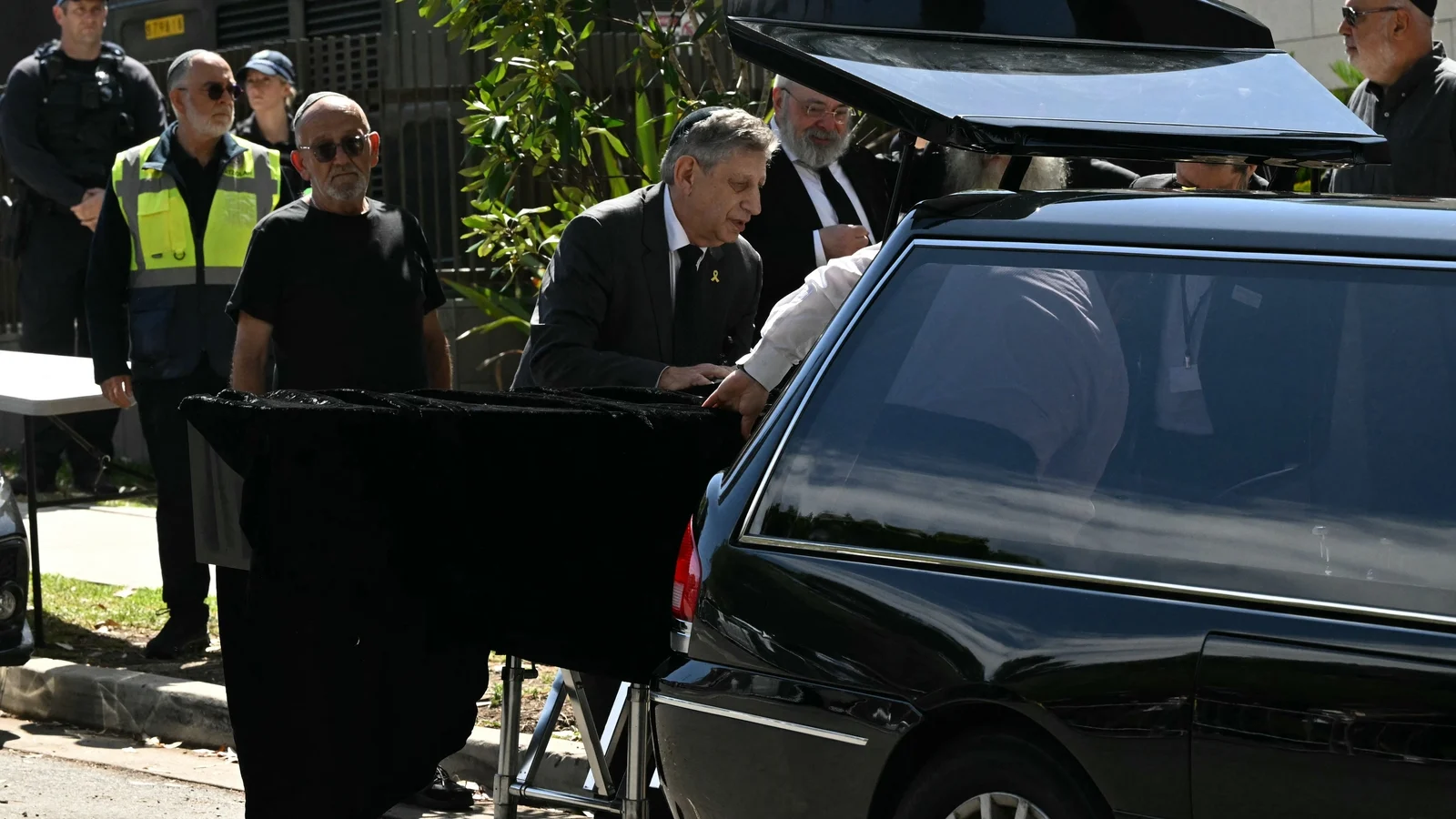
The hush was not from weather. It was from grief. Today, the first funeral for one of the 15 people killed in the attack that shattered this coastal suburb drew a crowd that filled the Chabad of Bondi Synagogue and spilled into the street outside, a reminder that public tragedy always becomes private sorrow.
The man being remembered — a husband, a father of five, a chaplain to prisoners and hospital patients — was known locally as the Bondi Rabbi. In the small print of public life he had performed rites, sat with the dying, and been a quiet, steady presence. In the words of a fellow congregant who wiped away tears at the synagogue gate: “Anyone who met him walked away lighter. He carried light like it was his job.”
The Night the Beach Was Attacked
The attack unfolded on a Sunday night when crowds had gathered at Bondi to celebrate Hanukkah — a holiday of light, of small flames kindled to outlast darkness. Two gunmen, a father and his adult son, opened fire on people on the sand and in the nearby park. In the ten minutes that followed, 15 lives were lost and dozens more were wounded; authorities say 42 people were taken to hospital.
Children, the elderly, people on dates, tourists with beach bags — the mix of the crowd owed nothing to politics or creed. Among the dead were a 10-year-old girl and two Holocaust survivors, bringing an additional cruelty to a massacre already hard to fathom.
On the shore, a makeshift memorial has grown: bouquets at the Bondi Pavilion, candles melting into the sand, messages tied to the fences. A menorah glowed in projection on the sails of the Sydney Opera House, the city’s skyline answering Bondi’s grief with its own quiet light.
A Community Seeks Answers
Authorities have said the pair were inspired by Islamic State ideology and that the attack was intended to sow fear among Jewish Australians. Prime Minister Anthony Albanese described the assault as driven by “an ideology of hate” and acknowledged investigators were probing whether the two men had radical contacts during a recent trip to the Philippines.
Police recovered a vehicle registered to the younger man near the sand. Inside were improvised explosive devices and homemade flags associated with the extremist group, police officials told the press. One of the assailants, the father, was shot dead by officers at the scene; the son remains in hospital in a coma under police guard.
“We are left with the awful task of picking up tiny pieces of a terrible puzzle,” said a retired investigator who has followed extremism cases for two decades. “Radicalisation is rarely tidy. It is often a messy braid of grievance, identity, online exposure and social isolation.”
Questions Over Prevention and Policy
As the city memorialised victims, another, less visible ritual began: an audit of systems and choices. The younger man had been on the radar of intelligence services in 2019, officials confirmed, but was not then judged to be an imminent threat. The father had been licensed to own several firearms, obtained last year under rules that critics now say need re-examination.
Australians remembered, uneasily, the Port Arthur massacre of 1996 — the calamitous event that led to sweeping gun reforms, including a national buyback program and tighter licensing that are often credited with preventing further mass shootings. Mass shootings have remained rare here since then, but questions are being asked about illicit markets, online sales, and private transfers of weapons.
“The 1996 laws saved lives,” said Dr. Lila Mendes, a criminologist at the University of New South Wales. “But the world has changed. The pipeline for weapons has diversified. And extremism has migrated online in ways we are still trying to fully map. Policy must evolve.”
- Victims killed: 15
- Hospitalised: 42
- Blood donations recorded in the days after the attack: more than 7,000 — a national record for a single day
The Face of Courage
Among the many small stories rippling out of the tragedy, one has become a focal point: a man who sprang into action when the shooting began. Ahmed al-Ahmed — a 43-year-old who fled Syria nearly two decades ago — was filmed tackling an assailant and has been credited with saving lives.
From a ward in Sydney Hospital, wounded but alive, Ahmed is the subject of a global chorus of gratitude: messages from neighbours, donated funds now numbering in the millions of Australian dollars, and a private swathe of flowers at the hospital entrance. “He did not think. He acted,” said a cousin by phone from a damaged hometown in Syria. “Ahmed is a hero, and our family is proud.”
In Bondi, strangers have sought him out and pressed envelopes into the hands of his family; elsewhere, online campaigns have raised money for his recovery. The scale of that response — and the quickness of it — is one of the few consolations in a story otherwise dominated by loss.
Who Mourns and Who Fears?
The attack has reopened painful questions already circulating in Australia: Are Jewish Australians safe? Has antisemitism been rising quietly, then loudly? Diplomats and community leaders say the level of fear among Jews — who have reported increasing incidents in recent years — is at a new height. Israel’s ambassador visited the memorial, urging decisive steps to protect worshippers and community centres.
“Only Australians of Jewish faith are forced to worship their gods behind closed doors, CCTV, guards,” the ambassador said at the site. “My heart is torn apart.”
Meanwhile, many Bondi residents have watched their neighborhood change from cosmopolitan seaside to a symbol in a global debate about hate, guns and the porous boundaries of online radicalisation. “I moved here for the surf and the hummus,” one café owner joked, voice breaking. “Now I keep a watch out the window in a way I never used to.”
Beyond Bondi: A Global Pattern
What happened on that Hanukkah evening is an Australian tragedy with international echoes. Cities from Paris to Christchurch have been forced to confront waves of radicalised violence and to ask how communities, intelligence agencies and democracies can keep people safe while safeguarding civil liberties.
We are left with urgent questions. How do societies detect the slow creep of violent ideologies in lonely online corners? How should gun policy respond to a market that no longer fits the molds of the 1990s? And how do communities stitch together their broken edges so that light — human, stubborn light — returns?
As you read this, consider: what would you do if a public place you loved suddenly felt like a risk? How much security is too much? How do we balance vigilance with the ordinary freedoms that make public life possible?
Small Acts, Large Grief
At the memorial this week, a woman in a sunhat laid a baby’s sandal atop a bouquet. A lifeguard kept watch, unmoving. A group of teenagers formed a circle and sang softly in Hebrew. These are small, human acts that push back against despair. They are also a reminder that communities are not only victims; they are actors — people who will decide how to rebuild, who to protect, and what lessons to carry forward.
For Bondi, the road ahead will be long and layered: funerals, investigations, policy debates, healing. For Australia, the attack is a sobering call to update the playbook for prevention and protection. And for the world watching, it is a reminder that the fight against hatred and the work of preserving open, plural public spaces remain unfinished.
In the end, mourners said at the synagogue steps, the smallest things — a smile, a soup, a warm hand on a shoulder — will matter. “Light always returns,” one elderly congregant said, placing a candle in the sand. “It always does.”