Fossil Fuels Take Center Stage at COP31 as Leaders Urge Emissions Cuts
 Caalamka
MUHIIM
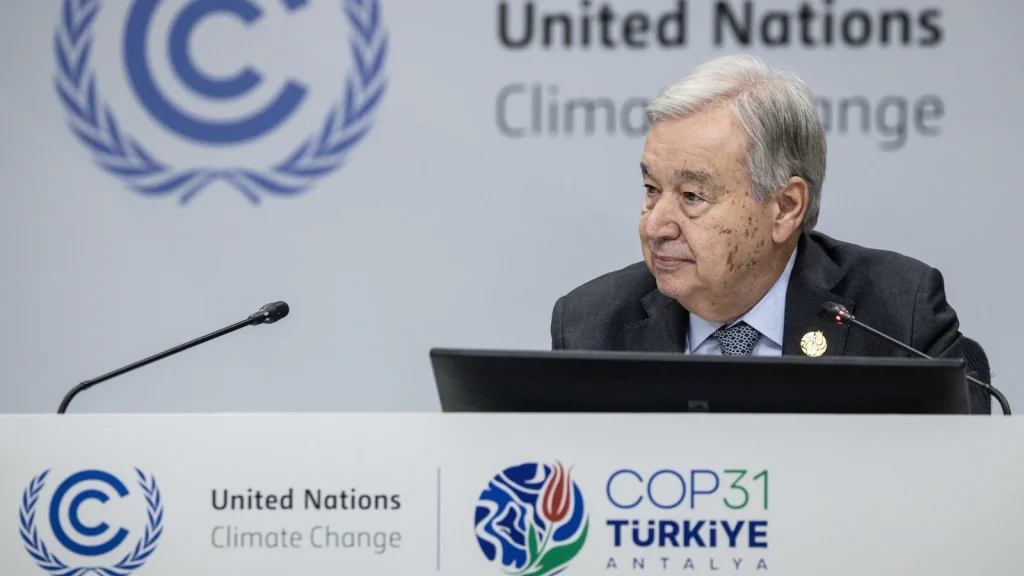
With the COP31 climate summit in Turkey entering a decisive second week, UN Secretary-General Antonio Guterres urged countries to pursue an “immediate and drastic reduction” in greenhouse gas emissions as disputes over fossil fuels overshadowed the talks.
As the first week wrapped up, observers said major producers and consumers of oil, gas and coal were pushing back against any agreement that would spell out new binding targets or explicitly chart a move away from fossil fuels.
That resistance is tightening the squeeze on Turkey, as host, and Australia, the lead negotiator, which must now try to steer negotiations toward the kind of far-reaching outcome climate advocates — including Mr Guterres — argue is essential.
“The central question is in the hands of member states, particularly the big emitters. They must recognise the need for an immediate and drastic reduction in emissions to keep the 1.5 goal still possible by the end of the century,” he said, pointing to the temperature limit countries agreed to pursue under the 2015 Paris Agreement.
A UN report released last month warned the world remains on a path to breach the 1.5 degrees Celsius warming threshold — a benchmark scientists say is critical to avoiding the most severe impacts of climate change.
Countries are meeting at Cop31 to raise funds to address climate change
Those impacts have been on stark display as temperatures climb: this year has brought extreme heatwaves across Western Europe and a glacier collapse in Nepal that set off flooding, killing more than 1,450 people. Thousands more are still missing.
The fossil fuel lobby
Negotiators have long battled familiar fault lines. Major oil producers, including Saudi Arabia and Russia, have repeatedly opposed wording that would constrain fossil fuels. Large developing economies such as India have also resisted measures they argue could restrict development and energy choices — a pattern that has diluted the ambition of previous deals.
The United States, the world’s biggest oil consumer, has again stayed away from the summit, skipping the talks for a second straight year under President Donald Trump. Mr Trump has labelled global warming a hoax and pressed for continued fossil fuel use.
“We must confront the disproportionate influence of the fossil fuel lobby. The future of our planet cannot be negotiated on the terms of those profiting from its destruction,” said Mr Guterres, who is set to leave office at the end of December after two five-year terms.
Read more: Climate delegates bring young voices to COP31 talks
Still, he said, the past decade has shown how quickly the energy landscape can change.
“But I remain hopeful. I’ve also seen something extraordinary over these 10 years. Renewable energy has moved from the margins to the mainstream. The economics have changed.
“Technology has advanced. A cleaner, safer, and more secure energy future is in our hands. The question is whether we have the courage and speed to reach for it,” he added.
Electrification and no firm targets
Turkey, as COP31 host, is working to place a plan to expand global electrification at the heart of any final agreement, arguing it can curb emissions by accelerating the transition away from fossil fuel-powered cars, boilers and other equipment.
However, the proposal does not mandate that the added electricity demand be met by renewable energy. Some countries — including last year’s COP host Brazil — are instead pushing to advance a separate plan that would require nations to lay out more clearly how they will transition away from fossil fuels.
Katrine Petersen, an observer for the non-governmental organisation E3G, said the fate of those proposals will be decided in the days ahead.
Participants gather ahead of an event to exchange experiences and views on the Global Implementation Accelerator at COP31
“We’ve also heard quite clearly from countries like India, the G77, that they don’t want any firm targets. They don’t want any kind of technology or fuel-specific language,” she said.
“(These are) the kind of consistent and ongoing divides that we’ve seen from those different parties before,” she added.
Representatives from India, Saudi Arabia and Russia did not immediately comment.
Diana Acconcia, head of the EU delegation, said Europe supported the electrification objective.
“Electrification is, in a way, an inclusive agenda because it is non-prescriptive in a way on how electrification is achieved,” she said.
“Of course, for the European Union electrification is to be achieved by clean sources of energy,” she added.
Australia, leading negotiations under a split presidency arrangement, spent the opening days gathering views on what should be included in a political text that must be agreed by consensus and would then be followed by the negotiated technical points.
Australia will continue accepting submissions from countries until tomorrow night, and aims to produce a draft text early next week.
We need your consent to load this rte-player contentWe use rte-player to manage extra content that can set cookies on your device and collect data about your activity. Please review their details and accept them to load the content.Manage Preferences