A courtroom, a calendar date, and the future of French politics
On a rain-slick afternoon in Paris, the marble steps of the appeals court hummed with more than the usual legal gravity. Television vans angled their satellite dishes like mechanical sunflowers. Journalists tucked damp umbrellas beneath their arms. People who months ago might have been strangers—senior citizens wrapped in tricolour scarves, young activists with folding bikes, a few men in well-worn RN caps—clustered and argued in small, urgent groups.
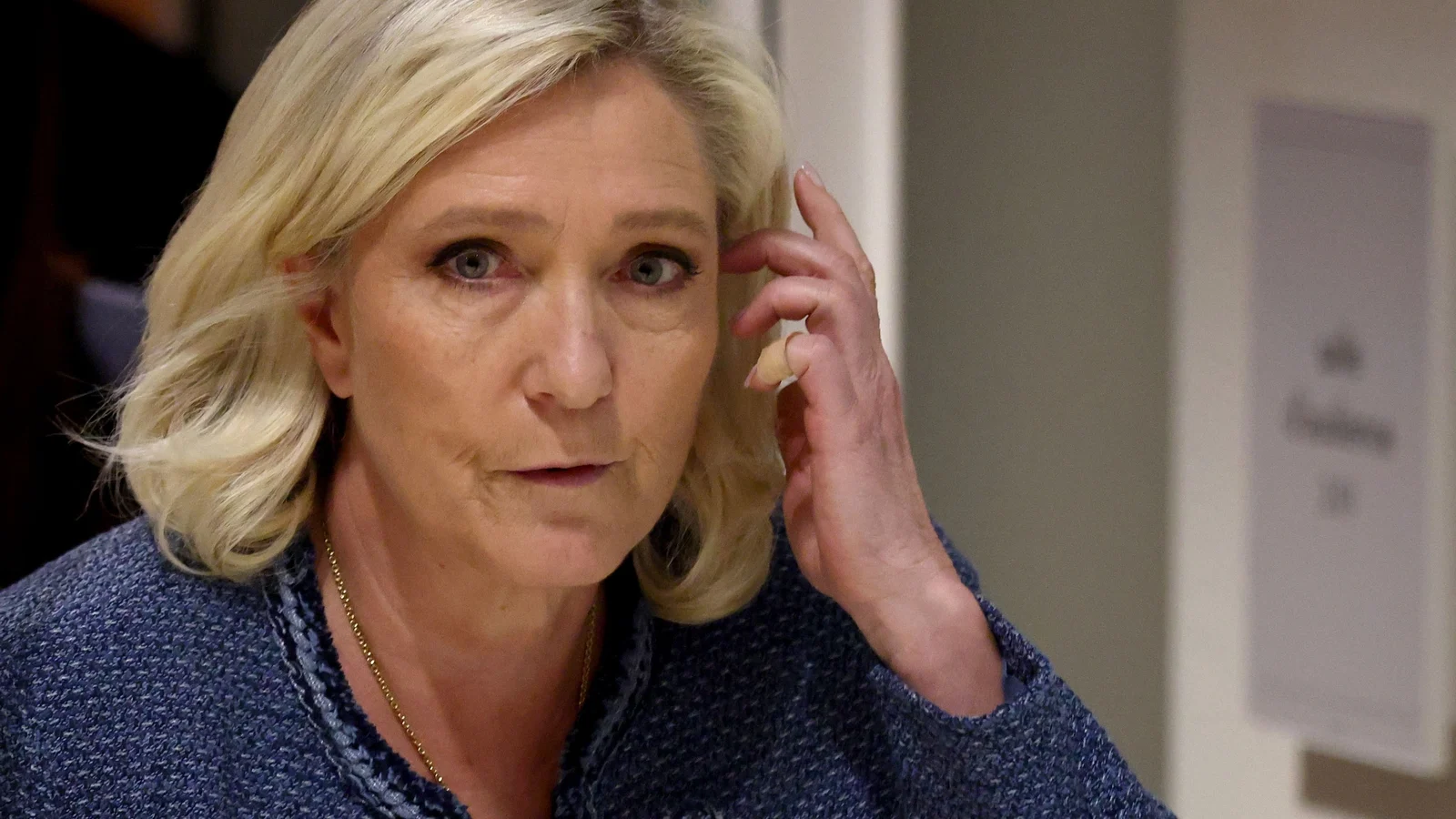
All of them came for the same reason: a date circled in the national consciousness. On 7 July, an appeals court will decide whether Marine Le Pen, the polarizing leader of France’s far-right who twice pushed the country to the final round of presidential voting, should be blocked from holding public office for five years. For a nation still digesting seismic electoral shifts, the verdict promises to be a hinge point: legal judgment on one hand, political fate on the other.
What’s at stake
The charge is deceptively simple on paper and knotty in practice. Prosecutors say that, while a member of the European Parliament, Le Pen and associates employed people on the EU payroll who in reality worked for her party—the National Rally—back in France. The result, according to the courts, was a misuse of public funds and a betrayal of public trust.
Last year a lower court concluded she should be banned for five years from holding public office and handed down a prison sentence in connection with the scheme. Prosecutors in the appeal have urged the same or harsher penalties: they asked for the five-year ban to be maintained and for a four-year prison term with three years suspended. The first trial had returned a four-year prison sentence with two years suspended.
Legal minutiae can feel arid, but the political consequences are vivid. If the appeals court upholds the ban, Le Pen—57, a veteran of three presidential campaigns—would be prevented from standing in 2027, widely seen as the clearest window for her to finally take the presidency. If the court overturns the judgment, she could as easily walk toward another run, or delay a decision to play the strategic long game.
Faces and voices outside the courtroom
“You can’t reduce this to a legal quibble,” said Amélie Rousseau, a schoolteacher who stood beneath a coffee shop awning watching the scrum. “It’s about standards. If politicians use public money like a personal slush fund, where does that leave the rest of us?” Her palms were warm around a paper cup; the rain had made conversation intimate.
A counterpoint came from Marc Lefebvre, a small-business owner from the northeastern suburbs. “I voted RN once,” he told me. “Not because I liked everything, but because I felt ignored. This is politics as usual—investigations, chases. We need hope, not endless scandals.” He glanced at a passing group singing snippets of campaign chants. “If she can’t run, there’s a new face ready—maybe that’s better, maybe not.”
Those new faces include Jordan Bardella, 30, the charismatic head of National Rally who has been floated as a possible successor if Le Pen is forced to step aside. A poll in November indicated that if he were the RN candidate, he could reach the second round and, according to that survey, win the final ballot against a range of opponents. Whether polls will hold up in three years—and whether that November snapshot still tells the story—is a matter only time will settle.
Why this matters beyond France
France occupies a special place in Europe’s democratic imagination. It is a nation whose presidents and policies often send ripples through Brussels and into capitals from Berlin to Rome. The rise of new right-wing movements across the continent has been one of the defining political trends of the last decade—waves that have reshaped debates on immigration, sovereignty, the economy, and the European Union itself.
So when a widely known national figure is entangled with questions of public funds and legal accountability, the implications travel farther than the Seine. The case raises deep questions about how democracies police their own leaders: Are courts an instrument of impartial justice or a political battleground? When should law intersect with politics, and when should it be kept at arm’s length?
Global echoes
Look around the world and you’ll see similar dynamics: charismatic outsiders driven to the brink of power only to be checked by institutions that are sometimes robust, sometimes fragile. From corruption probes in Latin America to constitution disputes in Eastern Europe, the same duet of accountability and political mobilization keeps replaying. In this light, the Le Pen case is both intimately French and broadly illustrative.
The woman behind the headlines
Marine Le Pen’s portrait is a study in persistence. She first shocked political insiders by breaking through to the second round in 2017, drawing roughly 34% of the vote against Emmanuel Macron. Five years later she did it again—stronger, more formidable—claiming about 41.5% in the 2022 runoff. She has recast the National Rally from a fringe party associated with her father, Jean-Marie Le Pen, into a party capable of commanding millions of votes. To her supporters she is a fighter who speaks plainly about security, identity, and the economic anxieties of the forgotten. To her critics she represents a vision of France at odds with liberal norms.
“She’s a complicated figure,” said Dr. Lucien Moreau, a political sociologist at a Paris university. “On one hand, she normalised a strain of politics that used to be taboo. On the other, these legal proceedings show the limits of that normalisation. Democracies must balance between giving voice to disaffected citizens and protecting the rule of law.”
Possible outcomes and what they could mean
- If the appeals court upholds the ban: Le Pen would be sidelined from running in 2027, but the National Rally would not necessarily collapse—leaders like Bardella could step forward, and the wider movement’s energies might intensify. Some supporters could see the ban as proof of elite obstruction, fuelling recruitment.
- If the ban is overturned: Le Pen’s path to a potential 2027 candidature would reopen, thrusting France back into the same polarised theatre of 2017 and 2022 and forcing other parties to recalibrate strategies in a Macron-less field (he’s barred by term limits from running again).
- If the court delivers a mixed decision: partial exoneration or reduced penalties could muddy the political waters, leading to protracted legal and electoral manoeuvring.
What will you be watching on 7 July?
The ruling could read like legal closure—or like kindling. Will it settle a decade-long debate about accountability, or will it fan the flames of grievance and political realignment? That is the question Parisian cafés, provincial town squares, and international commentators will be parsing in the days that follow.
As you read these lines, consider the broader currents in your own country. Are institutions resilient enough to handle uncomfortable reckonings? Do voters feel seen by the parties that claim to represent them? How should democracies hold leaders to account while ensuring the political arena remains open and fair?
On 7 July, France will turn a page—one that will be read domestically and abroad. Whether it becomes a paragraph of legal finality or the beginning of a new chapter of contestation, the outcome will remind us that in democracies, law and politics are never strangers. They’re roommates, quarrelling and negotiating the same space at the same time.