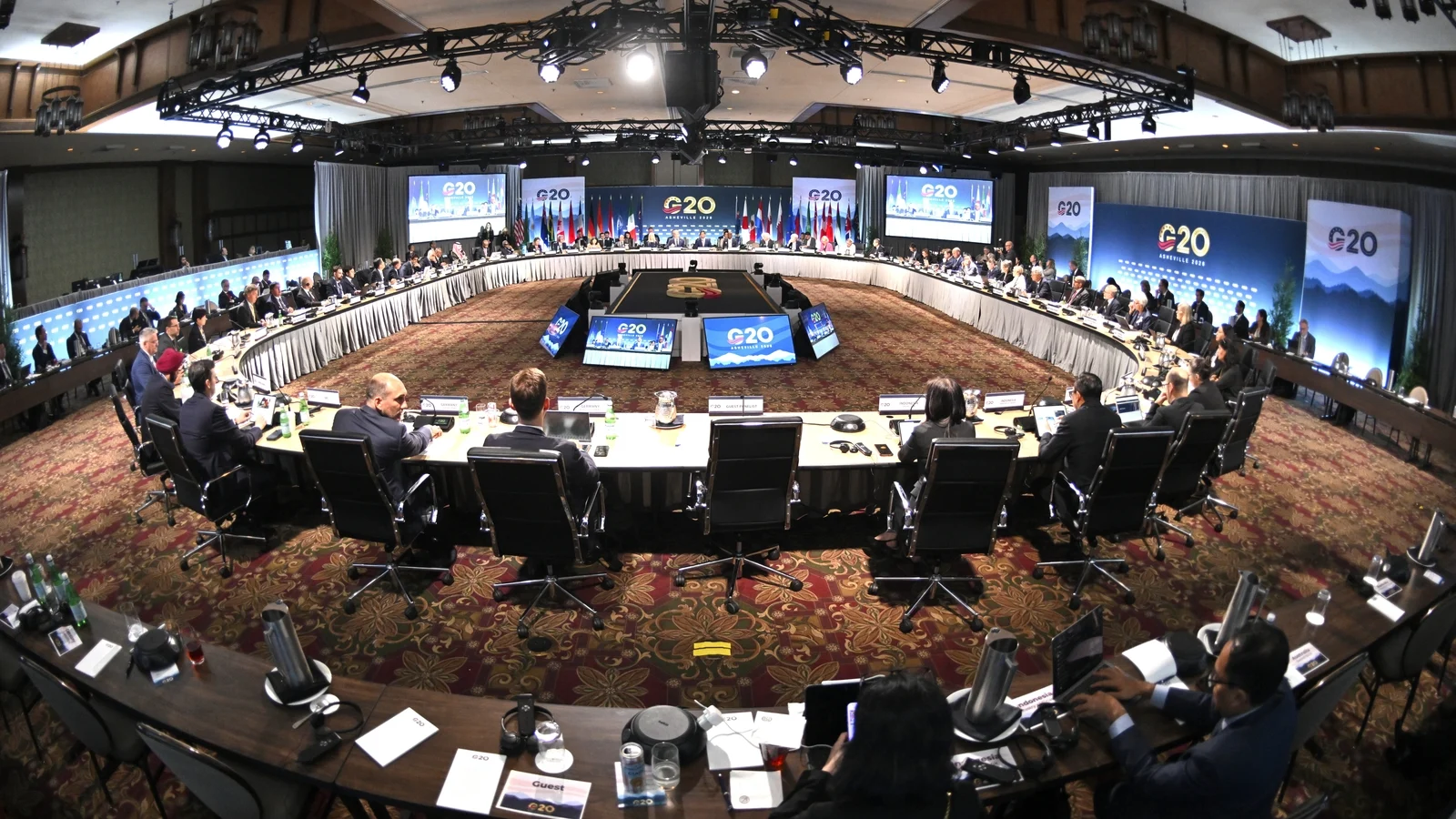
With the Middle East conflict boiling over and trade tensions simmering in the background, G20 finance leaders wrapped up two days of talks in the United States with a closing statement that drew near-unanimous support — except from China.
US Treasury Secretary Scott Bessent argued that the broad backing for the chair’s statement showed Russia’s presence did not derail the meeting.
“The fact that nearly all participants agreed to the chair’s statement suggested ‘there has been no impact’ from Russia’s attendance,” Mr Bessent said.
Still, Ukraine’s European allies voiced anger after Russian Finance Minister Anton Siluanov was received at the US-hosted gathering in Asheville, North Carolina.
The agenda unfolded under the shadow of the broader regional war in the Middle East and US President Donald Trump’s tariffs, both of which hung over the discussions.
In the final communique, the chair’s statement urged “free, safe, and predictable navigation through the Strait of Hormuz” — language China declined to endorse.
The strategic chokepoint has been largely blocked by Iran since the war erupted in late February following US-Israeli strikes on Iran.
Ukraine’s European allies had expressed frustration after Russian Finance Minister Anton Siluanov was welcomed at the meetings
Diplomatic unease also spilled into the optics of the summit. A traditional “family photo” of G20 participants was taken on Monday without Mr Siluanov after European officials objected.
At a separate G20 innovation meeting in Chapel Hill, North Carolina, organisers took two group photos, a move that allowed European leaders to stand apart from Russia’s delegation.
An EU spokesperson said representatives received only short notice that Mr Siluanov would attend.
“It created discomfort, no doubt about that,” Canadian Finance Minister Francois-Philippe Champagne said when asked whether the Russian minister’s appearance influenced discussions.
EU economy chief Valdis Dombrovskis told reporters it was not the moment to “normalise” Russia’s participation at such gatherings.
He warned that Russia’s inclusion means engaging on sensitive economic questions with envoys from a government that is “waging an aggressive war” and “killing civilians on a daily basis” in Ukraine.
Attendees take a photo during the G20 Innovation Ministerial in Chapel Hill, North Carolina
Mr Bessent pushed back during a press conference, saying, “I know that some Europeans had a sour taste, but I think it’s very important to engage.”
He added that the Russian minister he met is not under sanctions. “And I will point out that the finance minister who I met with is unsanctioned,” he said of Mr Siluanov.
The strained atmosphere comes as Germany blamed Russia yesterday for an attempted “hybrid attack” involving a drone at a strategic German airport last month and announced diplomatic counter-measures.
The United States, which holds the rotating G20 presidency, was also seeking this week to build partner support for Iran sanctions and for steps aimed at reducing trade imbalances.
Asked whether he pressed Russia to scale back support for Iran, Mr Bessent told reporters earlier that “many conversations are best done privately”.
‘Persistent imbalances’
China also objected to language stating that “excessive and persistent imbalances pose risks and can generate economic distortions”.
The same section urged countries to “take steps to eliminate non-market policies”.
The phrasing mirrored long-running criticism over excess industrial capacity in the world’s second-largest economy — a concern critics say fuels unfair competition and pushes prices down.
“We need to discuss and look at collective action, because global imbalances as they are today are not sustainable,” Mr Champagne said. “Everyone has to be at that table.”
US Treasury Secretary Scott Bessent holds a press conference at the conclusion summit
The G20 comprises 19 nations plus the EU and the African Union, and was created after the 1997-1998 Asian financial crisis to strengthen global economic and financial stability.
Talks in Asheville also served as a runway to the G20 leaders’ summit that Mr Trump is set to convene in December in Miami.
Support for Ukraine surfaced as well, discussed on the sidelines at a separate meeting of the Group of Seven advanced economies.
Russia has stepped up strikes on Ukraine this summer, while US-brokered negotiations remain stalled and the Kremlin has held to its maximalist demands for ending the war.
German Finance Minister Lars Klingbeil said there has been an “increase in brutal rocket attacks on the civilian population”.
“This all has to come to an end,” he added.
Mr Klingbeil said he and other European ministers “made our position on Ukraine absolutely clear”.
As G7 leaders met late on Monday, he said Ukraine’s finance minister joined remotely for talks on support for Ukraine.