Last Photos, First Steps: A Student’s Escape from the Ashes of Home
The photo is simple: a young woman grinning into a phone camera, three little girls shoulder-to-shoulder, smoke-darkened stones and a cooking pot steaming behind them. It is a collage of ordinary things — a meal, a selfie, a sibling stirring a pot — and yet, for Ghada Ashour, 24, it is everything she can carry of Gaza with her to Dublin.
“Gratitude, fear and guilt,” Ghada told me, pausing as if weighing each word. “Those three sum up how I felt the day I left.” She says the words slowly, as if letting them settle on the table between us. They do not feel like abstractions; they feel like luggage worn on the shoulders.
From Tents to Trinity — Not Quite, But Close
Until August, Ghada was one of many living in a tented displacement camp in Khan Younis, studying remotely through the American University in Cairo while the war unfolded around her. She had been filming life there for RTÉ: the long walks to find a plug and an internet signal, the patchwork rhythms of study and survival.
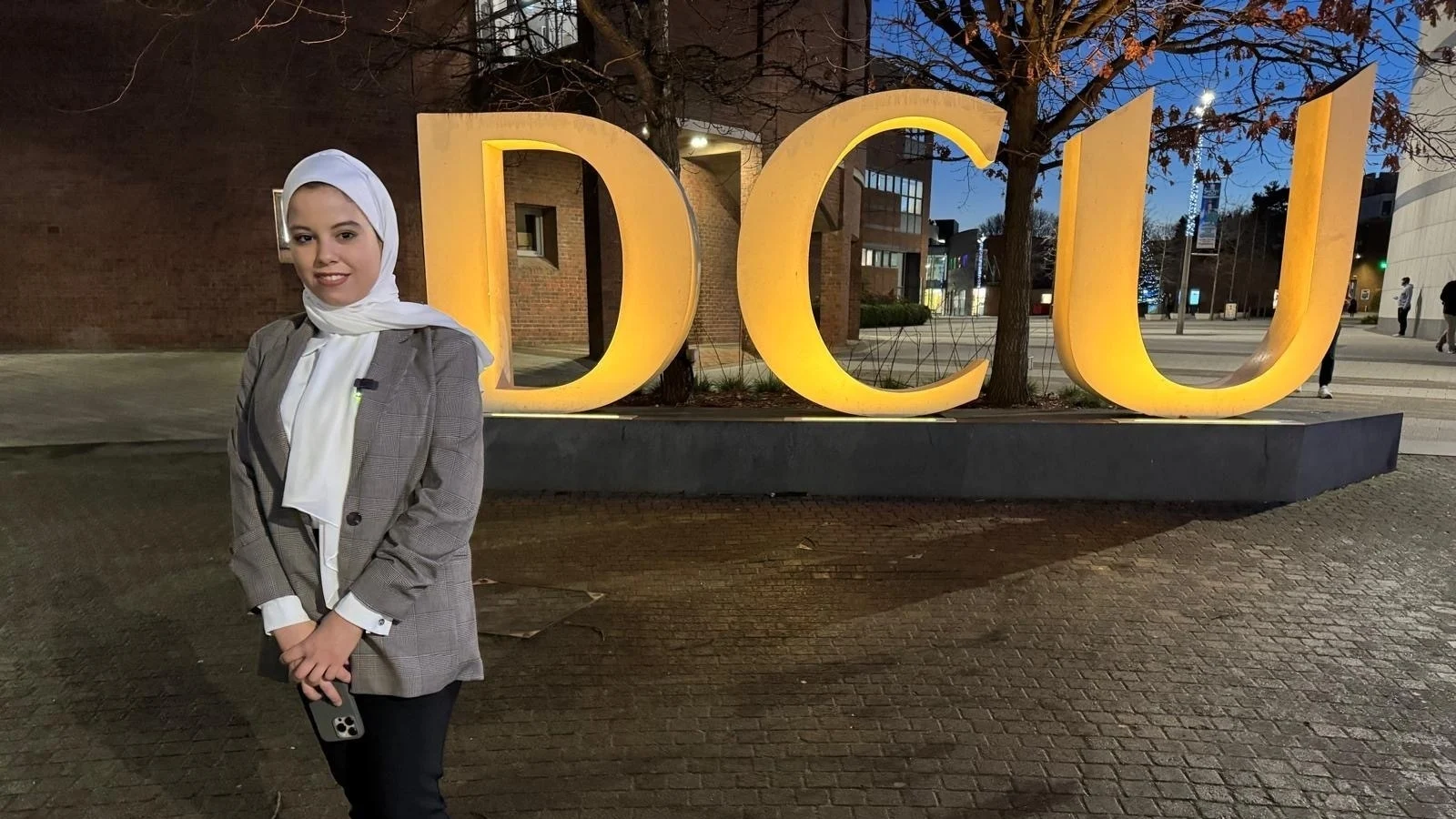
Then a door opened. Ghada was among 52 Palestinian scholarship recipients who were evacuated from Gaza in August and began studies at Irish universities in September. For her, Dublin City University — a scholarship made possible by United Against Online Abuse and DCU’s own support — became an improbable haven.
“I’m here, I’m in Ireland, I’m safe and sound,” she smiled from her Glasnevin student room, the chill of the city pressing at the window. “None of this would have been possible without the university and our sponsors.”
The Practical Miracle and the Emotional Cost
The logistics of getting students out of Gaza were a tangle of diplomacy, paperwork and peril. Officials from universities, NGOs and private sponsors describe sleepless nights coordinating visas, flights and safe corridors while monitoring ceasefire windows. For Ghada, the practical miracle arrived on 26 August — the day she shared a last lunch with family, snapped the photos now treasured on her phone, and boarded a plane.
“We had to choose between staying with family in a town that might never be the same, or taking a chance to finish our education,” she said. “It was the toughest decision I’ve ever made.”
Rubble, Memory and a Little Girl Named Mariam
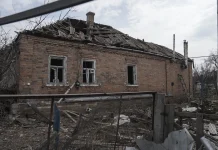
News reports said an agreed ceasefire came into effect on 10 October. For Ghada, however, the ceasefire is not a headline — it is a yardstick. “We can believe there is a real ceasefire when houses are rebuilt, when students and children go safely back to school,” she told me. Her family has been able to visit the place where their house once stood near Khan Younis. Footage sent by relatives shows a familiar plot reduced to dust and jagged concrete.
Among the faces in those videos is Mariam, a shy niece who wanders stones and remembers a home she can no longer find. “She is the daughter of my brother who was killed on 10 March 2024,” Ghada said, the date like a small, hard pebble lodged in her throat. “She wants to study. She always says, ‘I want to be strong like you, I want to resume my education.'”
It is a detail that refuses to be just poignant: a child naming education as her future even when safety, shelter and a father are gone. It cuts across assumptions about what people want when everything has been taken. It is also a reminder of the broader, quieter losses that accompany armed conflict — the loss of continuity, of classrooms, of teachers and textbooks, of the certainty that childhood will look like childhood.
Survivor Guilt, Determination and the Weight of Prayer
“Sometimes I ask myself, ‘Why me? Why not her?'” Ghada said, thinking of girls back in Gaza who are drawing water from reservoirs instead of opening books. “I have survivor guilt. I sit here and study while others run to fill water tanks.” She sifts through her memory: the smell of her mother’s cooking, the way her mother prayed over her. “I miss my mother’s prayers. I feel like I am here today because of her prayers.”
Yet survivor guilt sits alongside a sharp, pragmatic resolve. Ghada talks of high expectations for herself, of finishing a master’s degree and turning education into a tool for the future. “I feel I must work harder,” she says. “Not just for me, but for those left behind.”
Voices Around the Story
Not everyone sees evacuation as an unambiguous victory. A local teacher in Khan Younis, who asked to be named Amina, explained: “When a student leaves, the classroom loses energy. When many leave, schools may close. Education can be emptied out of a place long before buildings collapse.”
A spokesperson from DCU who coordinated student arrivals—Michael O’Connell—described the program as “a moral imperative, not a charity project,” adding, “Universities have responsibilities to global students and to the future we all share. Education is both sanctuary and instrument.” He also noted the logistical strain: “We housed dozens of students in the matter of weeks—supporting visas, courses, counseling. It changes us as institutions.”
And an aid worker who has spent years operating in Gaza, Leila Haddad, offered a sobering frame: “A ceasefire on paper does not mean reconstruction overnight. Basic services, schools, health centers—those take time, agreements, and sustained funding. Displacement is not a moment; it is a longer arc.”
What This Moment Tells Us
Ghada’s story is intimate and specific, but it reverberates with global themes. Who gets to keep learning in times of war? What does it mean when universities — traditionally anchors of stability — become, in effect, rescue ships for talent fleeing violence? And what happens to places that lose their young people, their future teachers, doctors and engineers?
Consider these questions: If education is an emergency need, why is it often the last to receive consistent humanitarian funding? How do host communities and universities balance rapid emergency support with long-term integration? And finally, how do survivors reconcile the moral complexity of safety built on someone else’s continuing peril?
Small Acts, Big Ripples
- Last lunches with family become talismans, small rituals that preserve identity in transit.
- Scholarship programs can pivot lives, but they do not replace collective reconstruction.
- Children like Mariam embody both fragility and fierce aspiration — the kind of resilience that is often underestimated.
Leaving, Staying, and the Work Ahead
Ghada watches her old RTÉ report sometimes, she told me, “to remind myself where I began.” When she studies, she says she carries two images: a tent where she once did exams, and a small Dublin desk cluttered with notes and a kettle. “I hold both. I don’t want anyone to think we’ve only escaped. We also carry responsibility to those we left behind.”
As readers, what are we to do with a story like this? We can feel helpless, or we can notice the power of small acts — universities opening their doors, donors funding scholarships, ordinary people lighting open fires and feeding families against a season of ruin. We can ask our institutions — educational and civic — to think globally about safety, access and the future of learning.
Finally, perhaps the most human response is to keep looking. To look at photographs, to listen to voices like Ghada’s, to remember that in the rubble there are names, ambitions and prayers. “Hope feels risky,” she confessed. “But I try.” It is a modest manifesto for a world where education can still be a form of courage.