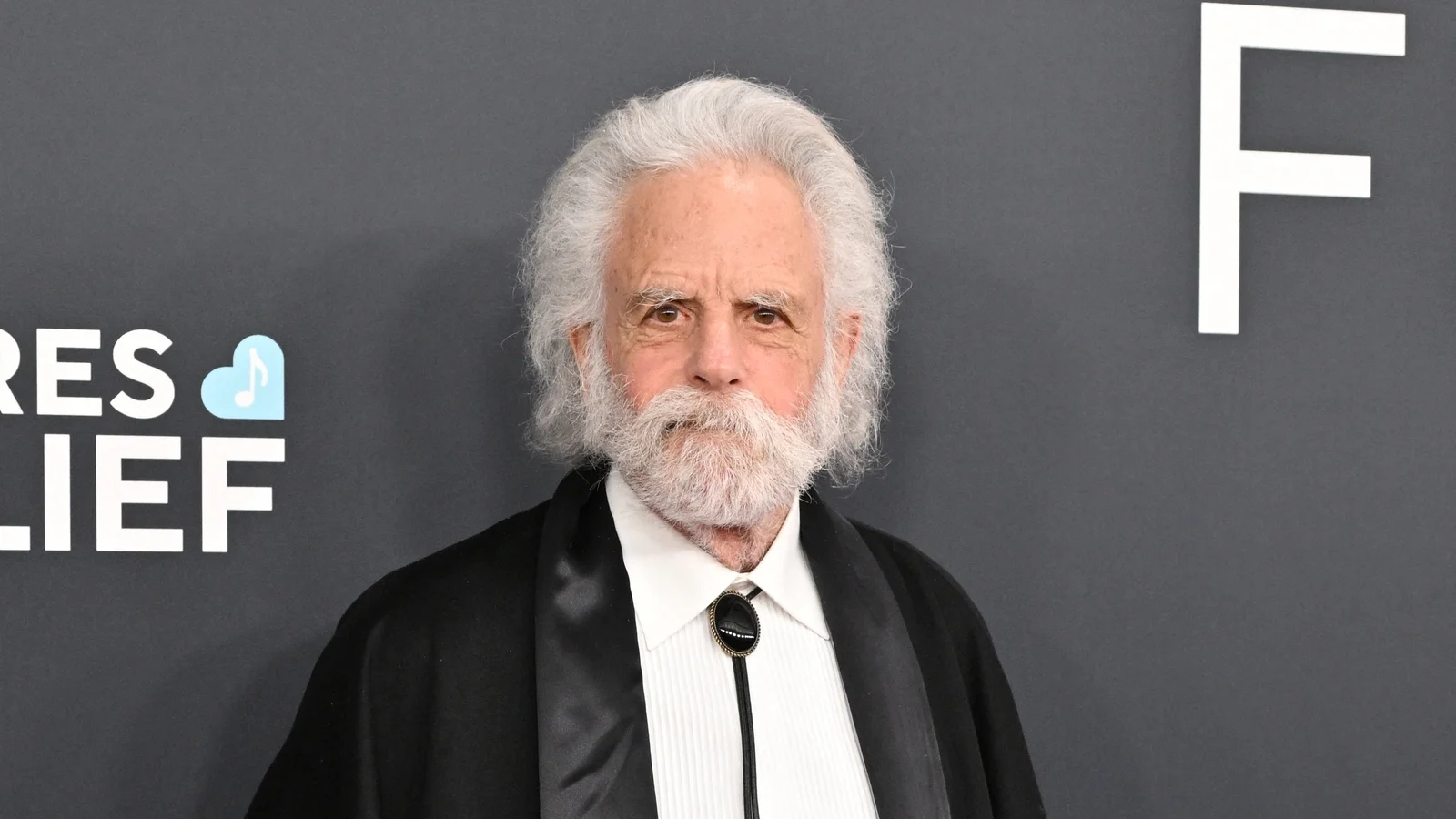
Bobby Weir, the Road-Worn Architect of a Musical Family, Has Died at 78
When you close your eyes and imagine the Grateful Dead—those long, meandering nights of guitar and light, the smell of campfires mingling with incense—there is a good chance you picture Bobby Weir. He was the man whose chord voicings wrapped around Jerry Garcia’s solos like a second map of the same country: familiar, surprising, and always inviting you to keep walking.
Weir’s family announced that the guitarist and songwriter, a founding member of the Grateful Dead, died at the age of 78. He had been diagnosed with cancer in July and, according to the statement posted on his personal website, had beaten that disease but “succumbed to underlying lung issues.” The family did not specify where or when he passed.
“For over sixty years, Bobby took to the road,” the family wrote. “Bobby will forever be a guiding force whose unique artistry reshaped American music.” They quoted lyrics he co-wrote—“A man driftin’ and dreamin’, never worrying if the road would lead him home. A child of countless trees. A child of boundless seas”—a fitting epitaph for someone whose life was both itinerant and rooted in the same breath.
A Life Lived in Motion
Born into the rumble of mid-1960s San Francisco, the Grateful Dead emerged from a city that was itself a kind of live experiment: psychedelic posters pasted to lamplit storefronts, jazz riffs spilled into folk salons, and a willingness to imagine new communities. Along with Jerry Garcia, Phil Lesh, Bill Kreutzmann and Ron “Pigpen” McKernan, Weir helped turn that scene into a musical network that would stretch across generations.
“Bobby was the one who could make you feel like you were part of the song,” said Elena Morales, a music historian who has lectured on American counterculture. “He had a conversational way of playing; it wasn’t just embellishment. It was an invitation.”
The band’s mythology is as American as it gets: road trips measured in bootleg tapes and benevolent chaos, concerts where the setlist was an open question and the audience became a community. Fans—later christened “Deadheads”—followed the band in caravans and vans, trading recordings and living in communal camps outside stadiums. The Grateful Dead revolutionized fan engagement long before social media made it corporate practice.
The Soundtrack to a Movement
There’s a reason songs like “Truckin’,” “Ripple,” and “Friend of the Devil” remain in the public ear: they are small ritual objects that have outlived their era. The Dead never played the same show twice; improvisation was both creed and currency. Albums and live tapes piled up, but it was the shared live experience that became the group’s real record.
“I taped their shows on a little cassette recorder in 1978,” said Mark Patel, a Deadhead who lives in Marin County. “We’d stay up all night in the parking lot, trade tapes, and argue about which version of ‘Dark Star’ was the best. It built a kind of intimacy that feels almost impossible to replicate now.”
Accolades, Reinventions, and the Long Goodbye
The Grateful Dead disbanded in 1995 after Garcia’s death, but Weir was never far from the road. He helped shepherd the music forward through new configurations—most recently performing with Dead & Company—bringing the old songs to younger ears without making them museum pieces.
In 1994 the band was inducted into the Rock & Roll Hall of Fame; in 2024, the members were honored with Kennedy Center Honors, an acknowledgement of the Dead’s place in the American cultural canon. Those formal recognitions tell a tidy story, but they don’t capture the real metric of the band’s impact: the way strangers can become family at a concert, or how a line of lyrics becomes a lifetime’s shorthand.
“Weir’s contributions are judicially underrated,” said Marcus Hale, a Santa Cruz–based music critic. “He was not just a rhythm guitarist. He wrote songs that cut to the heart—songs that felt like instructions for how to be part of a community.”
Local Color and the Small Rituals
If you travel to the old haunts—the Fillmore, the Haight-Ashbury storefronts, the beaches where bands would pull up and play—you’ll find murals and faded posters that still bear the swirl of a different time. Tie-dye, lentil soup recipes memorized from touring kitchens, the ritual of swapping tapes under the sodium lights of parking lots: these are the details that make the Dead’s story human.
“You’d bring a bag of clothes, a sleeping bag, and a willingness to be surprised,” remembered Lila James, who followed the band in the early 80s. “We weren’t just fans. We were collaborators in this enormous, improvisational rehearsal.”
Why This Matters Now
Ask yourself: what does it mean to build community in an age of streaming playlists and algorithmic discovery? The Grateful Dead’s model—where music is a lived, participatory act—feels increasingly precious. In a world where concerts are polished products and backstage access is monetized, the Dead’s barter-and-belong economy offers a lesson.
Weir’s death also highlights the human arc of a generation that once seemed immortal. The icons of the 1960s are aging and passing on, taking with them a direct link to a turbulent and hopeful period of American life. Their deaths force us to reckon with the fragility of movements built on presence rather than platforms.
What We Carry Forward
Beyond awards and recordings, Bobby Weir leaves behind an approach to music that insists on generosity: hand your guitar to the audience and see what they do with it. Whether it’s a jam improvisation or a crowd singing harmony, Weir’s legacy is the idea that music is a social technology for binding people together.
“It’s OK to be vulnerable on stage,” Weir once said in a 1990 interview. “Maybe that’s what people came to see.”
Final Chords
The family’s words are worth returning to: a man on the road, a child of trees and seas—images that speak to motion and belonging. Fans around the world are already lighting candles at kitchen tables, swapping stories online, and posting videos of grainy shows where a young Weir’s voice slides into a chorus like an old friend returning.
Where do you keep the music of your life? Is it on a playlist, a tattoo, a memory of a night when everything felt larger than your life? When musicians like Bobby Weir go, they don’t just leave a discography; they leave a way of listening. They leave a method for being together.
For those who followed him down that long road, his songs will continue to be invitations. For those who never saw him live, recordings and stories will pass what he built to the next ears ready to carry it forward.
“His work did more than fill rooms with music; it was warm sunlight that filled the soul,” the family wrote. “It built a community, a language, and a feeling of family that generations of fans carry with them.”
Rest now, Bobby Weir. The road remembers you.