Fog of Coffins: How One Assassination Could Unravel a Fragile Truce in Gaza
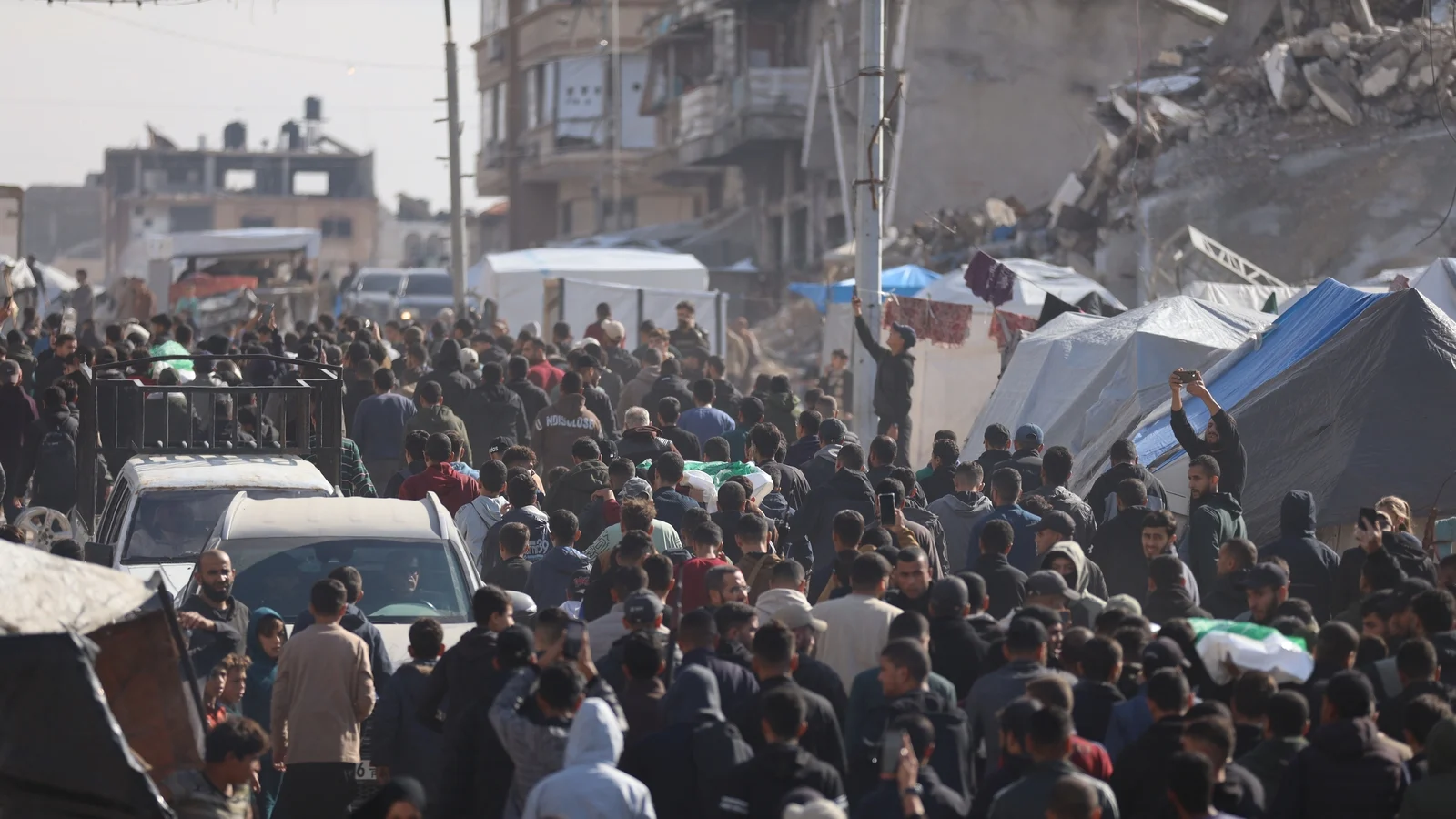
They carried the coffins like a current through the streets — a river of green flags, faces wrapped in keffiyehs, shoes dusty from rubble. The chants rose and fell, one steady heartbeat: “Martyrs are dear to God.” For many in Gaza City, yesterday’s funeral was more than a ritual farewell. It was a public dare: to whom does the ceasefire belong, and who will bend its arc?
At the center of the procession lay Raed Saed, a senior commander whose killing has sent shockwaves through an already tense truce. Alongside him, three other bodies were placed in the earth, each one a reminder that even where guns have ostensibly fallen silent, violence continues to shape the politics — and the daily life — of the enclave.
The moment, the man, and the message
From the rooftops, young men waved green banners and shouted slogans; an old woman pressed her palm to the metal of a coffin and wept. “He built things here,” said a shopkeeper who asked to be identified only as Bassam. “Not just machines, but an idea of resistance. You can’t take that with a missile.”
Hamas’s chief negotiator, Khalil al-Hayya, who speaks from exile, did not mince words in a televised address after confirmation of the strike. “The continued Israeli violations of the ceasefire agreement … and latest assassinations that targeted Saed and others threaten the viability of the agreement,” he said, appealing directly to the United States to pressure Israel to honor the terms of the truce.
In Gaza’s public square, those words landed like pebbles dropped into still water — each one rippling outwards. “If the guarantor of the deal is silent when one side kills, what is the point of a guarantor?” wondered Lina Hamdan, a schoolteacher watching the funeral from a collapsed building’s courtyard. “People here keep asking: who will stop the stoppage from stopping?”
Ceasefire on paper, fractures in the ground
The ceasefire that took effect in October — heralded as a fragile step towards stabilizing a battered territory where more than two million people live — has not erased the underlying contest for control. Israel retains a heavy military presence in the eastern, largely depopulated half of Gaza. Hamas and associated authorities have reasserted themselves in the western districts, where life carries on amid flattened buildings and makeshift markets.
That division is more than geographic. It is an everyday reality: checkpoints where once there were shops; children who have known little but blackout nights and curfews; bakeries that open and close with the truce’s tenuous rhythms. “People are exhausted,” said Omar Qassam, a nurse at a field clinic. “We patch wounds and run out of supplies. Then a strike like this comes and it’s like someone pulled the bandage off and said: keep bleeding, let’s see what happens next.”
Politics of assassination
Israel described Saed as one of the architects of the 7 October 2023 attack — the incursion that escalated into the full-blown war. Hamas confirmed his role as a senior figure in its armed wing and said it had already selected a replacement for his responsibilities in “military manufacturing.”
Targeted killings have long been part of the playbook in this conflict. But doing so during a negotiated halt tests the limits of any ceasefire’s terms — and the patience of the negotiators tasked with shepherding a fragile peace. “Assassinations during a truce are a strategic lever,” said Dr. Nadine Salim, a researcher on conflict mediation. “They signal that one party views the truce as tactical respite rather than a durable settlement.”
Violence from within: the shadow of internal conflict
Outside the funeral, violence shadowed the headlines: in central Gaza, masked gunmen shot dead Ahmed Zamzam, described by local authorities as a senior officer in a Hamas-run security service that pursues suspected collaborators. The Gaza Interior Ministry blamed collaborators acting on Israeli orders; a suspect was detained.
For his part, Ghassan Duhine — head of the Popular Forces, an anti-Hamas group operating in the Israeli-held sector of the strip — reportedly claimed responsibility, calling the killing “a fair revenge.” Duhine and other groups bitterly deny Hamas’s rule, accusing the movement of responsibility for Gaza’s devastation.
“This is not a neat two-sided war,” observed Mariam Al-Khatib, a community organizer. “There are fractures inside Gaza. There are grudges, and there are people who saw survival as taking sides. The truce did not stitch those wounds; it merely paused the bleeding in places.”
What comes next: forces, guarantees, uncertainties
Negotiations around the truce include plans for a UN-authorized International Stabilisation Force to help keep the peace. The United States — which was named a main guarantor by Hamas negotiators — has taken an active role in planning. U.S. Central Command is convening partner nations in Doha on 16 December to discuss the shape and scope of that force, according to officials who spoke to international media.
Hamas’s negotiators insist the proposed international force should be limited to Gaza’s borders rather than deployed inside the territory itself. Israel, meanwhile, has insisted on guarantees that Hamas will be disarmed and excluded from any future administration in Gaza — demands that seem, for now, non-negotiable.
“Who polices the policers?” asked an anonymous Western diplomat involved in the talks. “An Outside force has to be perceived as impartial. If it’s not, it will become either a target or a partner, and neither of those outcomes will stabilize Gaza.”
Beyond the headlines: questions for readers
So where does accountability rest in a ceasefire that is sustained by mutual wariness? If a guarantor is called upon to enforce terms, what leverage does it realistically hold over a state determined to pursue its security objectives? And perhaps most urgently: how do the people who live through this keep rebuilding lives that can be snatched away by a single targeted strike?
Gaza’s bazaars, its children who learn arithmetic on cracked sidewalks, its women who trade recipes and rations — these are the quiet witnesses to decisions made in rooms far from their streets. Their daily resilience, their refusal to be merely numbers in a diplomatic ledger, is a form of testimony.
“We want more than promises,” said Bassam, the shopkeeper, as he folded a flag at the end of the day. “We want the right to bury our dead without fear that another coffin will follow in a week.”
Final thought
Ceasefires can offer a breath; whether that breath becomes life depends on how the world chooses to listen when it is broken. The killing of Raed Saed is a story of strategy and force — but it is also, unmistakably, a story about the fragility of peace and the human cost of diplomacy gone awry. If international actors mean to stabilize Gaza, they must reckon with both the state actors and the invisible fractures inside Gaza’s own society. Until then, the chants in Gaza’s streets will continue to ask the same question: who will hold the ceasefire when the bullets stop calling the shots?