Tomorrow’s Vote: A Quiet Town, a Roaring Choice for Hungary’s Future
On a clear morning in Aszód, a small commuter town an hour east of Budapest, volunteers zipped into cobalt jackets and arranged flyers with a meticulous calm that felt almost ceremonial.
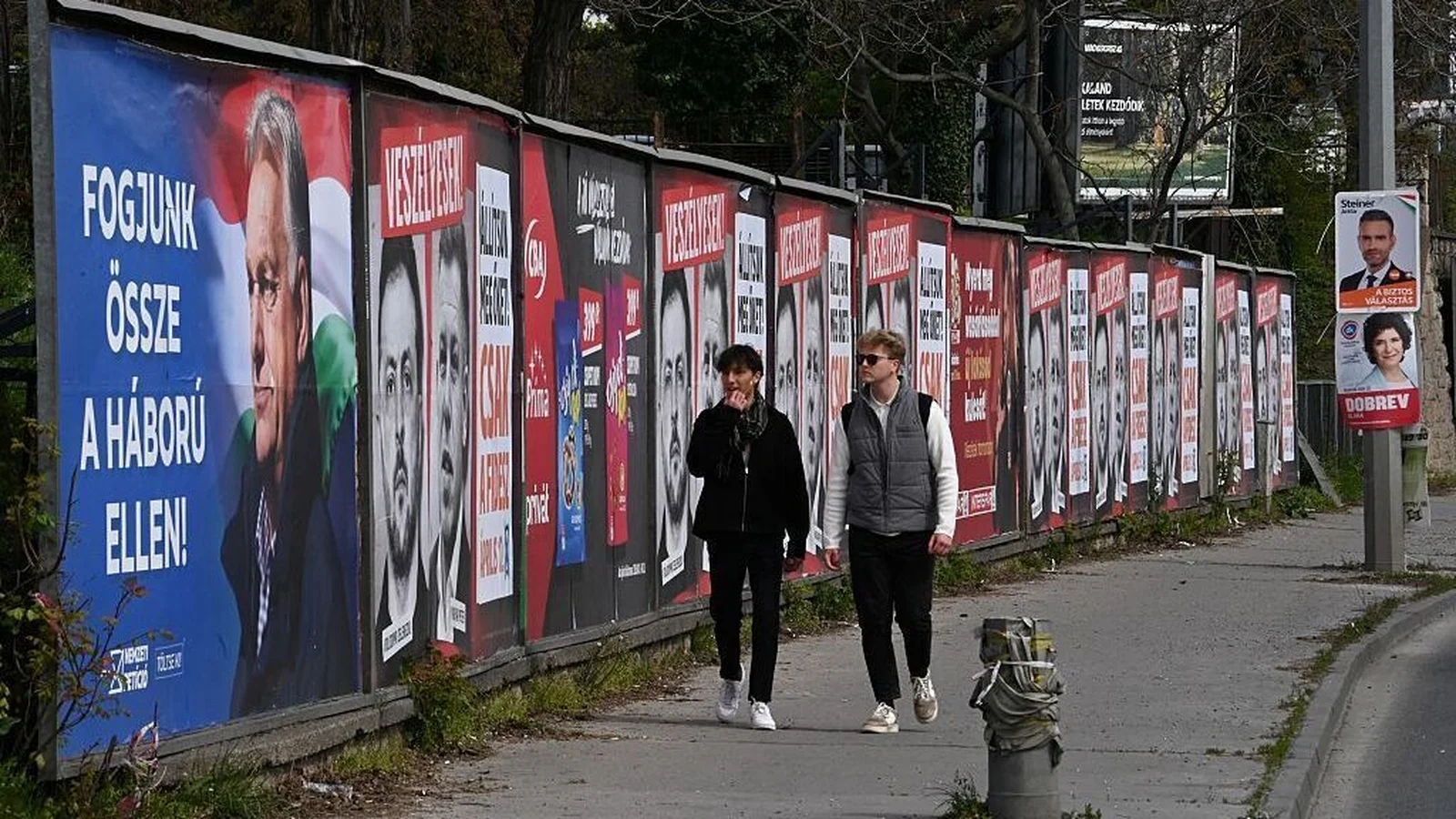
They were not setting up for a concert or a fair. They were preparing for what many Hungarians call the most consequential parliamentary election since 1989 — a phrase that has become almost a ritual invocation across Central and Eastern Europe, but one that, in this case, carries a peculiar weight.
By evening, a crowd had gathered beneath hungarian flags and strings of lights. People of every age — pensioners wrapped in wool coats, students clutching backpack straps, young parents with toddlers — pressed closer to the stage. When Péter Magyar arrived, there were handshakes, selfies and someone yelled, “Finally, a chance!”
Why This Election Feels Different
Viktor Orbán’s Fidesz party has dominated Hungarian politics for more than a decade, winning four parliamentary contests since 2010 and using its parliamentary super-majority to remake institutions — from the constitution to the judiciary, from state media to electoral districts.
That hold reshaped Hungary’s relationship with the European Union, turning a once-eager member state into a frequent friction point with Brussels over migration, rule-of-law standards and, lately, its ties to Moscow. The European Commission has frozen or withheld billions in cohesion and recovery funds over rule-of-law concerns — a figure widely cited at roughly €18 billion that could be unlocked only with a change in the political course.
So when an insurgent force emerges that promises not revolution but a return to Western partnership and a partial undoing of the last decade’s institutional changes, it feels seismic.
A New Opposition, or an Old One Recast?
Péter Magyar — 44, a lawyer who once moved within the same political orbit as Fidesz — has spent the last two years building what many observers call an unlikely national movement. The party he leads, called Tisza, has stretched beyond urban centers to contest the countryside, where Fidesz has traditionally been strongest.
“It’s not simply a party for Budapest anymore,” said Júlia Horváth, a schoolteacher from Szolnok who came to Aszód for the rally. “You can sense that people who were silent or resigned are suddenly talking about their future again.”
Polling aggregates in recent days put Tisza comfortably ahead — Politico’s compilation showed a double-digit advantage — and one Hungarian pollster, Median, suggested Tisza could be on track for as many as 138 of the 199 parliamentary seats. But electoral maps matter: fissures in district lines enacted during the last Fidesz constitutional redesign could narrow the translation of votes into seats, meaning a popular lead may not translate into an outright majority.
The Russia Question and the Ukraine War
If domestic governance and institutional reform are at stake, foreign policy is the other electrifying axis of this campaign. Orbán’s government has cultivated an unusually close relationship with Moscow compared with most EU members: high-level meetings with President Vladimir Putin, regular trips by his foreign minister to negotiate energy deals, and a foreign-policy stance that critics call accommodating toward Russian interests.
For many Hungarians, that posture is the heart of the controversy. “We remember 1956,” said an elderly man in the crowd, tapping his chest. “We know what it means to be occupied. The idea of being a vassal to another power — whether Brussels or Moscow — scares people.”
Orbán’s defenders argue that his approach secures energy supplies and a pragmatic neutrality amid a brutal war in Ukraine. Opponents answer that such “neutrality” has often meant blocking EU moves to support Kyiv and, according to leaked reports and media investigations, even lobbying in ways that favor Russian interests.
What Voters Are Talking About
On the campaign trail, Tisza mixes patriotic rhetoric with tangible economic promises: a new tax on the ultra-wealthy, insulation subsidies for households facing steep energy bills, and expanded family support payments. These are the details that, for many voters, matter more than foreign-policy debate.
“I flew home from Amsterdam,” said Anna, 24, who studies in the Netherlands and returned to vote. “If you ask me whether I want to live here in five years, I want a country that is in Europe, not stuck in geopolitics that makes life harder.”
Máté, 24 and studying IT, told me, “We’re tired of elections where nothing changes. This feels different because the questions are now: will my wages catch up? will healthcare be fixed? will my parents get decent pensions?”
Why Local Scenes Matter
Small town rallies like Aszód’s show a political movement with texture. Old folk songs blended into the crowd’s chants; someone handed out chimney cake from a street vendor; a grandmother quoted lines from a nineteenth-century revolutionary poem while her grandson scanned the QR code on Tisza leaflets. These details are not fluff. They reveal how parties weave national narratives into everyday life.
Possible Outcomes — and What They Could Mean
There are a few pathways out of this election:
- A clear Tisza victory with a solid majority, enabling meaningful institutional reversals and the potential unfreezing of EU funds.
- A narrow Tisza win that still leaves it short of a super-majority; reforms would require coalition-building or parliamentary compromise.
- A hung or tight result allowing Fidesz to seek partners on the right — including the far-right Mi Hazánk — to stitch together a working majority.
Each scenario maps onto a different Hungary: one more aligned with Brussels and swifter rule-of-law reforms, one muddled and slow, and one that potentially accelerates the country’s drift toward nationalist, Eurosceptic politics.
Why the World Is Watching
Hungary is a member of the EU since 2004 and NATO. Its choices ripple beyond its borders. A pivot back to cooperative EU relations could unlock funds and strengthen an often-fractured Union. A continued Fidesz-led course could perpetuate standoffs within EU councils, affecting everything from migration policy to common defense postures amid the war in Ukraine.
“Orbán is one of the few EU leaders who can talk directly with both Washington and Moscow,” noted a European analyst I spoke with. “That gives him influence, but also makes the country’s direction a geopolitical litmus test.”
A Personal Moment Before the Polls Open
As the rally wound down, Péter Magyar recited lines from an old Hungarian poem and the crowd echoed them back. Then, without ceremony, people drifted into the night — some to the train home, some towards the nearby market, others to discuss plans for a final day of canvassing.
Tomorrow, Hungarians will decide. Will they opt for the familiar solidity of Orbán’s machine, with all its promises of stability and strong borders? Or will they gamble on a fresh, imperfect effort to re-engage with Europe and recalibrate domestic institutions?
What would you choose if you were standing in their shoes? The question is not only about politics. It’s about identity: which stories will Hungarians tell themselves about sovereignty, dignity and where they belong in a rapidly changing Europe?
Whichever way the vote goes, the aftermath will reverberate far beyond Aszód’s square. And perhaps that is what makes one small town’s rally feel like the opening scene of a national turning point.