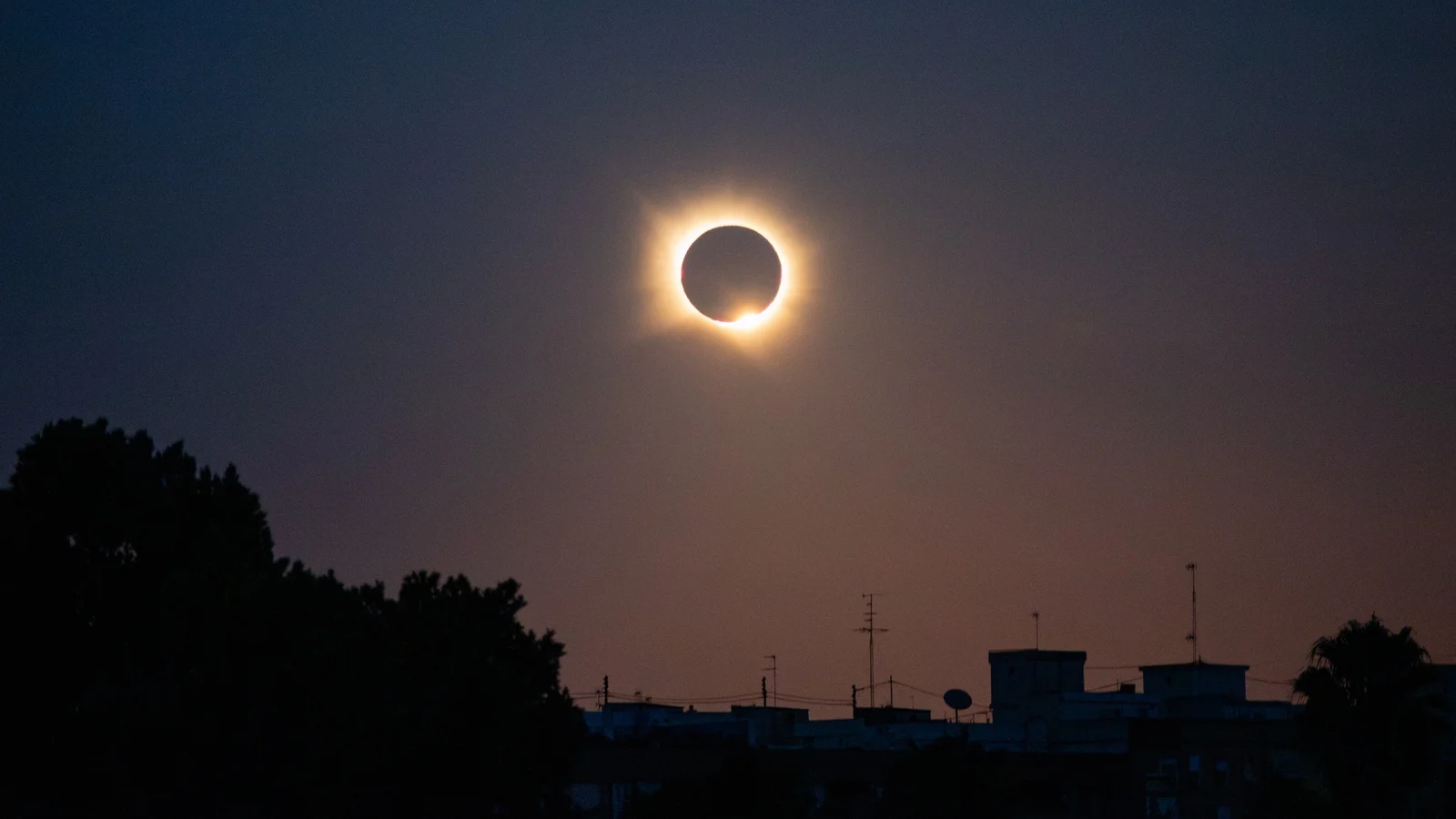
For a few breathtaking minutes, the day disappeared over Iceland as a total solar eclipse plunged the country’s western coast into darkness.
A timely break in the cloud cover offered locals and tourists a clear glimpse of the spectacle.
Live footage from Reykjavik captured the moment: even under an overcast sky, people gathered outside Hallgrimskirkja church erupted in cheers as the light suddenly dropped and the sky went black.
Across Iceland and northern Spain, millions turned out for Western Europe’s first total solar eclipse in 27 years.
In Spain, officials urged caution, warning against travelling to places where a heatwave has pushed wildfire danger higher.
Spain’s Secretary of State for Science Juan Cruz said authorities were bracing for as many as six million visitors, many heading to rural areas along the eclipse’s track across northern Spain and the Balearic Islands.
“I hope that tonight will see the emergence of a wonderful generation of astrophysicists. It’s such a special moment.”
The eclipse’s timing added to its draw in Spain, with sunset following soon after and heightening the sense of a once-in-a-generation evening.
That eerie shift — when midday briefly resembles twilight and some animals grow quiet as the moon moves directly between Earth and the sun — has long been wrapped in myth, seen as an omen, a cosmic battle or a display of divine force.
Today, Spain is treating it as an opportunity to spotlight regions that rarely see mass tourism and to ease pressure on its crowded coastal resorts, while pairing the influx with a wide-ranging police presence and public-safety push aimed at preventing wildfires.
Interior Minister Fernando Grande-Marlaska told reporters that 25,000 officers had been assigned to ensure security around eclipse viewing, and that nearly 100 planes and helicopters were also being deployed.
He urged the public to use the hundreds of official viewing points established by authorities and to comply with restrictions in and around certain parks.
“Let’s not forget that the wildfire risk is very high, it’s extreme due to high temperatures,” he said.
A view of the eclipse from San Sebastian in Spain
Among those making the journey, Lola Guerreiro spent the night in the mountains near Arcos de las Salinas in eastern Spain — home to Galactica, Europe’s largest educational astronomy centre, and the Javalambre observatory — after driving from Extremadura to be in position for the eclipse.
“Watching a total solar eclipse has been a dream of mine for many, many years, and I didn’t want to miss the chance to experience it, even though it meant a seven-hour journey,” she said.
Sergio, a 60-year-old Italian, travelled with his family in a camping van to Arija in northern Spain.
“I do feel a little emotional. Yes, because I know I won’t have another chance in my life to see an eclipse, a phenomenon like this,” he said.
The Iberian Peninsula last witnessed a total solar eclipse in 1912.
It is set to see another on 2 August 2027, followed by an annular eclipse in January 2028, together forming the so-called “Iberian Eclipse Trio.”
The eclipse, as seen from Iceland
A view of special solar eclipse glasses held towards the sky in Antibes, France
In Reykjavik, protective glasses that allow people to watch without harming their eyes have been sold out for days, as the Nordic nation of roughly 400,000 people prepared to welcome up to 80,000 visitors.
Totality reached Iceland’s westernmost coast at about 5.44pm (6.44pm Irish time), casting the far west into complete darkness for up to 2 minutes and 13 seconds, although most cities experienced shorter intervals.
The moon’s shadow has since continued moving east.
Authorities had warned of heavy traffic and advised eclipse watchers to arrive early.
Singer Björk was due to play a DJ set at an eclipse-themed event south of Reykjavik.
NASA planned to send a high-altitude WB-57 aircraft from Iceland to track the moon’s shadow, while NASA-funded teams launched balloons to examine how the abrupt darkness and cooling influence the lower atmosphere.
Beyond casual onlookers, the eclipse also attracted dedicated “eclipse chasers” — enthusiasts who travel worldwide to stand in the narrow corridor of totality whenever it appears.
Gordon Telepun, a retired plastic surgeon and amateur astronomer from the US who has photographed six total eclipses, said he would watch from Mallorca, describing Spain as a destination that ticked every box for eclipse chasers.
The eclipse was also visible from Ireland.