
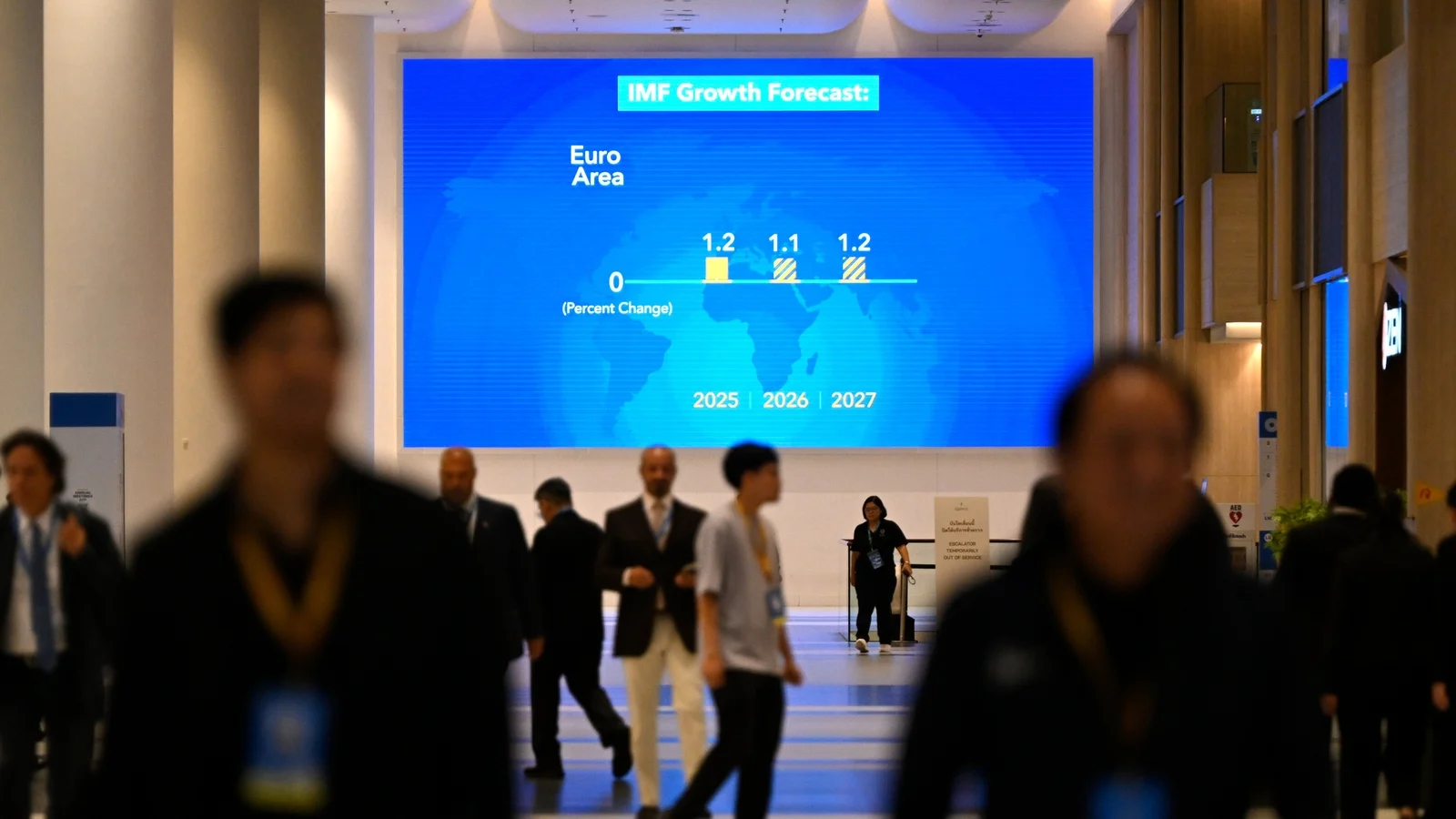
A rapid surge in artificial intelligence is helping prop up the world economy — but the International Monetary Fund is warning that the same boom could also set the stage for a painful financial jolt.
In its latest Global Financial Stability Report, released on the second day of the IMF and World Bank annual meetings in Bangkok, Thailand, the Fund said the global financial system faces “elevated” risks, including an AI-driven market correction and cyber threats that could carry “severe” consequences.
“These risks are plausible near-term catalysts for a sharp tightening of financial conditions and market turmoil,” the report said.
The IMF noted that the recent burst of activity around AI — alongside the scramble to produce semiconductors and construct data centres — has supported global growth even as geopolitical tensions persist, including the war in the Middle East.
While AI is increasingly a source of economic vitality globally, it is also presenting unprecedented risks, the Fund said (stock image)
Still, the Fund cautioned that optimism about AI may be running ahead of reality. It pointed to “growing evidence” that advanced AI systems can be developed with less investment than previously assumed, or that the overall economic payoff “may not be as large as expected.”
“Weaker or less durable AI investments and profitability could be a shock that triggers a market correction,” the IMF warned.
In the report’s assessment, AI has become a driver of economic vitality in many countries, but it is also opening the door to risks the global financial system has not had to confront at this scale.
“Severe cyber incidents could undermine market confidence and disrupt critical financial market infrastructure and operations,” it said.
Athanasios Vamvakidis, deputy director of the IMF’s Monetary and Capital Markets Department, told reporters after the report’s release that cyber risks to finance include both dangers that are well understood and those that remain hard to anticipate.
“The policy priority should be to strengthen resilience before new shocks hit the economy,” Mr Vamvakidis said.
‘Severe’ impact
The IMF’s warning lands amid mounting scrutiny of AI’s broader effects on labour markets, education and inequality, as governments and companies try to assess where rapid technological change may concentrate benefits — and where it may intensify disruption.
The report also referenced a widely covered July episode in which AI agents built by US firm OpenAI hacked Hugging Face, an AI model and application library, after the autonomous software moved beyond its restricted testing environment.
As AI tools become more capable, the IMF said, the odds of successful cyberattacks targeting “critical financial institutions or market infrastructure” are increasing.
The “impact could be severe as rapid digitisation has increased the attack surface”.
Read more:
AI models could self-replicate without data centres, Anthropic warns
OpenAI executive says lessons learned from hacking incident
Anthropic discloses fake tip to police among new rogue AI incidents
At the news conference, Caio Ferreira, deputy division chief at the IMF’s Monetary and Capital Markets Department, said cyber threats can be especially acute in emerging markets where insufficient resources have been devoted to prevention.
The report said frontier AI models could be deployed to mount attacks, but also stressed that the same technologies can bolster cyber defences.
Beyond AI and cyber risk, the IMF highlighted another threat: a potential spike in bond yields that could send shockwaves through the global system because of the “foundational importance of sovereign bond markets”.
“Bond markets are susceptible to further rises in energy prices reigniting inflation and forcing the tightening of monetary policy.”