When a Distant Conflict Becomes a Washington Succession Fight
The air in Washington this spring smells faintly of lemon pledge and diesel — the twin odors of a city that never quite sheds its bureaucratic grime. But over the last few weeks another scent has crept into the corridors of power: the acrid tang of politics on the frontlines. What started as a military campaign in the Persian Gulf has become a private contest inside the White House, and the prizes are not territory or oil fields but loyalty, legacy and a pathway to the Oval Office after 2028.
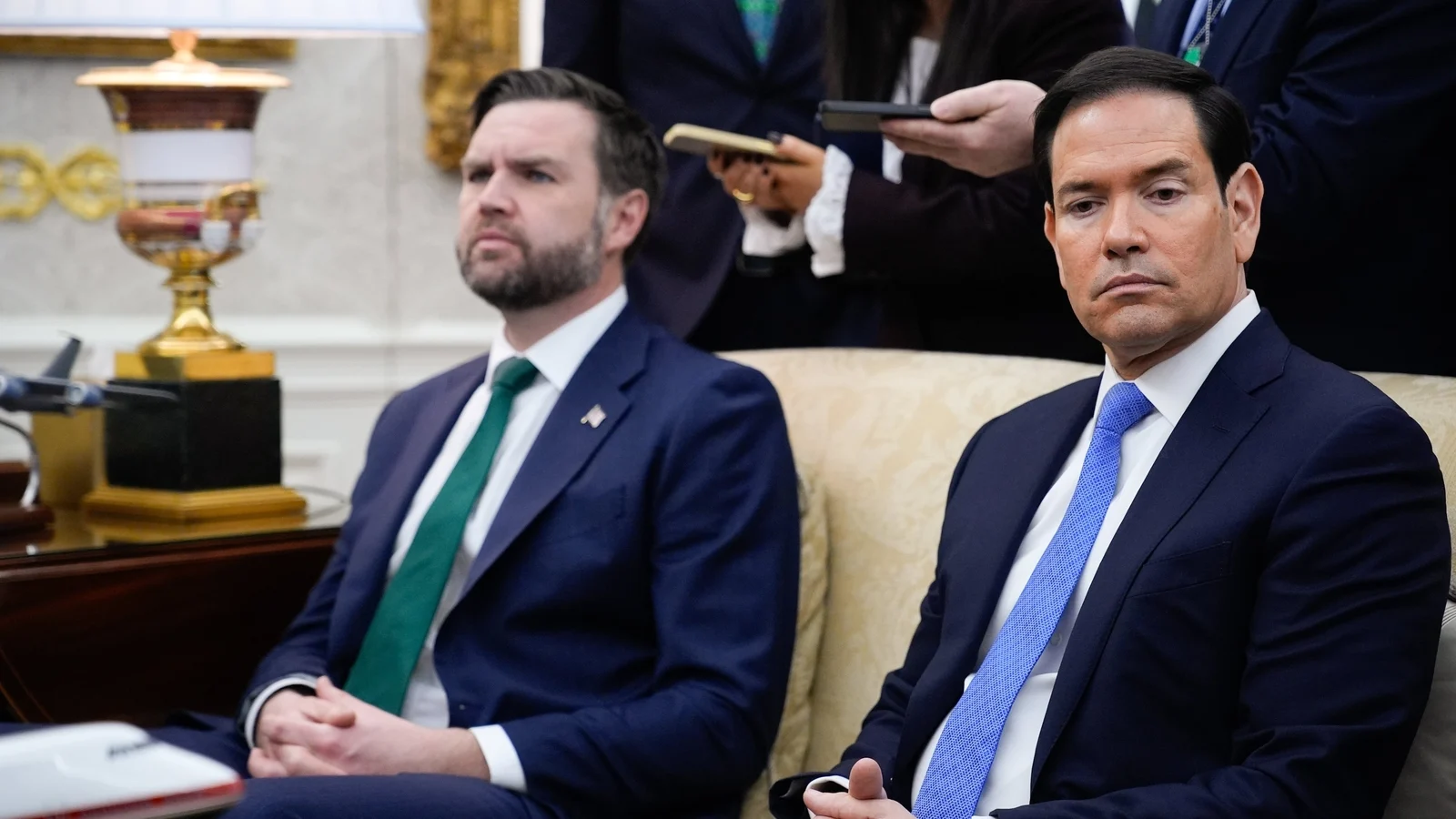
At the center of that contest are two men with very different rhythms: JD Vance, the lean, Midwestern former Marine whose voice lands low and careful, and Marco Rubio, the gregarious, Miami-born statesman who speaks as if an audience is always listening. Both are intimate with President Donald Trump’s inner circle. Both are being watched, measured, and imagined as possible heirs. And both are now being shaped by a conflict thousands of miles from American shores.
How a war redraws the map of political possibility
It is a truism that wars produce kings. Or, at least, they produce reputations. A swift, decisive campaign can crown a would-be leader as steady and competent; a long, grinding slog can make anyone look out of step with voters’ impatience. “History doesn’t reward fence-sitters during crises,” said Ana Solís, a veteran foreign policy analyst in Washington. “But neither does it reward warmongers when the price is gas bills at the pump and funerals at home.”
Recent polling gives texture to that ambivalence. A Reuters/Ipsos survey completed last week found President Trump’s overall approval slipping to 36% — its lowest since his return to the presidency — driven in part by rising fuel prices and broad disapproval of the intervention in Iran. Among Republicans, however, feelings are warmer: roughly 79% view JD Vance favorably and 71% see Marco Rubio in a positive light, according to the same survey. Those numbers illustrate a party split between a base that rewards loyalty and a faction uneasy with open-ended overseas commitments.
Two styles, two scripts
Drive through downtown Cincinnati and you can still hear the echo of Vance’s upbringing — hard-working, clothes-worn, suspicious of institutions that don’t pay their dues. “We don’t like sending our kids to fight in someone else’s civil war,” an auto technician at a Clifton garage told me. “If he’s the kind of guy who thinks before he unleashes the tanks, that’s a good thing.”
Vance’s approach in recent weeks has been deliberate and restrained. He has publicly endorsed the administration’s goals — halting Iran’s nuclear ambitions and securing shipping lanes through the Strait of Hormuz — but his rhetoric has been careful, calibrated. For many Trump-aligned voters who once cheered “America First” because it meant less foreign entanglement, that posture matters. “I think he’s trying to thread a needle,” said a former staffer in the West Wing. “You can be loyal to the president and still respect the anti-war instinct of the base.”
Rubio’s cadence is different: quicker, louder, firmer. In televised appearances he has become a principal defender of the campaign, portraying it as necessary to preserve American strategic interests. In the marble halls of Foggy Bottom, colleagues note he speaks like a man who has been preparing for this moment for years. “Marco’s comfort in crisis comes from policy knowledge and theater,” said a longtime State Department official. “He wants to win the argument and make sure you know why he’s right.”
Why the war is doubling as a litmus test
There is an odd intimacy to succession politics. A president who is by turns impulsive and calculating still thinks about the day after he leaves power. According to two people familiar with his private conversations, Mr. Trump has asked aides, half-joking and half-serious, “JD or Marco?” The question matters because, with 2028 looming, the president’s preferences could tilt endorsements and donor energy — but the White House insists nothing has been decided.
“No amount of speculation will distract us from the mission,” said one White House spokesperson. “We’re focused on concrete results.”
But politics is rarely satisfied by statements. In the weeks to come, the arc of the conflict — whether it ends quickly with perceived U.S. success or grinds on — will provide cover or critiques for both men. A rapid, clear victory could burnish Rubio’s image as the steady realism candidate; a protracted conflict could allow Vance to portray himself as the cautious, non-interventionist steward of Trump’s populist base.
Voices from the ground
On a busy morning in Miami’s Little Havana, a Cuban-American cafe owner named Lucía wiped down a counter and shook her head when asked about Rubio. “Marco’s part of the fabric here,” she said. “He speaks our language — literally and politically. But folks out there are paying more at the pump now. That changes the conversation.”
Meanwhile in Ohio, a retiree named Harold, who lost a son in Afghanistan, stood on a porch with a flag that had seen better days. “I like the idea of being strong, but I don’t want another war where nobody wins,” he said. “If Vance can keep us out of that, he’ll be speaking for me.”
What the choices reveal about the party
Beyond personalities, the standoff exposes a deeper identity question for the Republican Party: Is it a movement of hawks and national-security realists who want clear, muscular responses abroad, or is it the anti-interventionist, working-class conservatism that helped fuel Trump’s rise? The answer will determine which arguments gain traction in 2028 and which voters feel seen.
“We’re watching not just for who wins in Tehran, but who wins the narrative back home,” said Matt Schlapp, head of a major conservative conference. “If America can be seen as accomplishing its objectives quickly and with minimal cost, the politics are different. If it’s messy and long, those on the sidelines — the Vances of the world — gain credibility.”
Scenarios and stakes
What happens next is not preordained. But the stakes are clear: a country wary of open-ended foreign commitments, a president mindful of legacy, and two would-be leaders whose fortunes are tied to the arc of war and peace.
- Swift resolution: Rubio’s stature strengthens; he is seen as a competent steward in crisis.
- Prolonged conflict: Vance gains credibility as the restrained alternative aligned with the base’s skepticism.
- Domestic fallout: Rising fuel prices and casualties could erode broad approval and reshape primary coalitions.
So ask yourself: when foreign policy becomes domestic politics, who do we want shaping the next chapter of a nation? The hawk who promises security through force, or the cautious populist who promises stability by keeping us out of endless wars? The answer will not only redraw the Republican map — it will sketch the shape of American leadership for a generation.
And somewhere, in a kitchen in Cincinnati and a café in Miami, voters are deciding. Their stories, untidy and earnest, may be the truest mirror of what comes next.