Missiles and drones flew across the Middle East again after Iran said it struck US military sites in retaliation for what Washington described as its first attacks on Iranian territory in a month, reigniting a conflict that had recently shown signs of cooling.
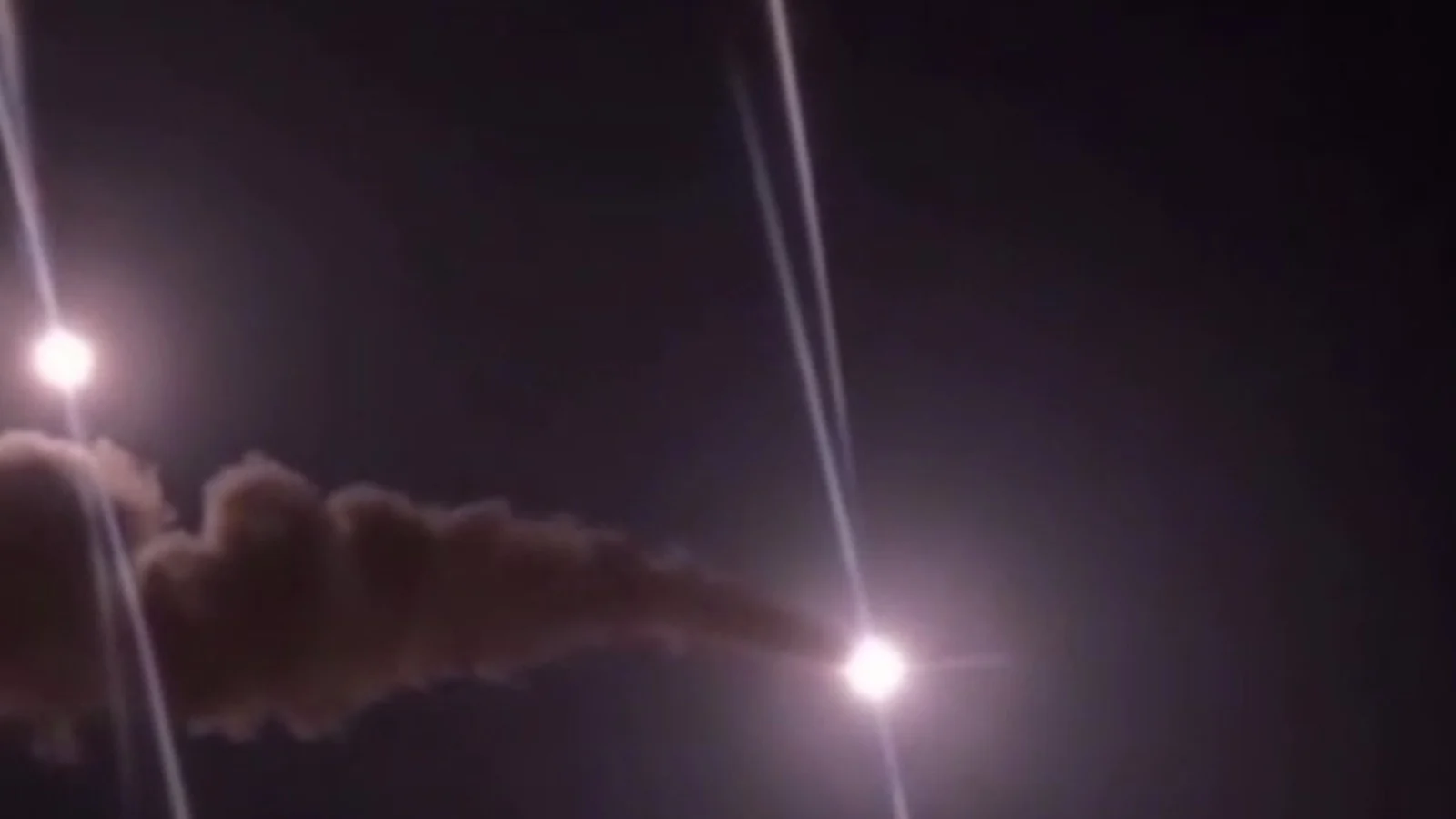
Tehran’s Revolutionary Guards said they responded by firing ballistic missiles at two US military air bases in Jordan, claiming the strikes caused “heavy damage”.
Jordan’s army said it intercepted eight missiles, without stating their origin.
The Guards also said they had shot down a US drone over the Strait of Hormuz.
The exchange followed US announcements that American forces had hit Iranian rocket launchers on a small island in the strategic shipping lane.
Washington said the strikes were intended to stop Iran from deploying additional sea mines in the strait, only days after the US said it had finished clearing explosives from the waterway.
The administration of US President Donald Trump has prioritised ‘economic warfare’ in recent weeks
“US forces took limited, precise action against IRGC (Iran’s Revolutionary Guards’) minelaying forces posing an imminent threat in the Strait of Hormuz,” US Central Command wrote on X.
The Guards said the US strikes caused “casualties” and described their missile attack on Jordan as “in response to the US-Zionist aerial aggression.”
Trump posts AI video of Iran’s Kharg in ‘smithereens’
US President Donald Trump posted an AI-generated video clip that he said showed Iran’s oil hub Kharg Island being “blown to smithereens”.
It was not clear whether Mr Trump’s post was meant as a threat to Kharg Island or whether an attack was under way.
Several hours after the post, there was no evidence Kharg had been attacked.
“Kharg Island being blown to smithereens!!! President DJT,” Mr Trump said on his Truth Social platform, without providing additional details.
Reuters confirmed the accompanying footage, which depicted dramatic explosions, was most likely synthetically generated, based on software that detects AI-manipulated imagery.
Attacking Kharg, which handled 90% of Iran’s oil exports before the war launched by US and Israeli attacks on 28 February28, would severely disrupt its energy trade and put huge pressure on its economy.
‘Not seeking war’
“We are not seeking war, but we will deliver a decisive response to the aggressors,” Iranian President Masoud Pezeshkian said in a statement carried by state TV.
He spoke before travelling to Kyrgyzstan for a summit of a bloc that seeks to act as a counterinfluence to the West, alongside Russia’s Vladimir Putin and China’s Xi Jinping.
The latest round of strikes came shortly after the US-Iran war reached the six-month mark and at a moment when violence had been easing.
In recent weeks, the administration of US President Donald Trump has put the emphasis on “economic warfare” rather than expanding military strikes on Iran.
Iran has effectively blocked the Strait of Hormuz, a critical maritime corridor through which one-fifth of the world’s oil flowed before the United States and Israel triggered hostilities with strikes on Iran on 28 February.
“Last week, CENTCOM completed clearing sea mines from the strait’s international shipping routes,” said Navy Captain Tim Hawkins, a spokesman for US Central Command.
“US forces are monitoring the area closely and remain prepared to protect the free flow of commerce through this essential waterway,” he said.
Unpopular war
Diplomatic efforts, led by mediators including Pakistan and Qatar, have spent months trying to end the fighting.
Although an April ceasefire was agreed and a memorandum of understanding aimed at a final peace deal was signed in June, no lasting accord has emerged, and Washington has since declared “economic warfare” against Tehran.
A US naval counterblockade of Iranian ports is tightening petrol supplies inside Iran during a period of shortfalls in domestic production, as the US increases pressure.
The April ceasefire halted the most intense phase of combat, but sporadic attacks — largely centred on the Strait of Hormuz — have darkened prospects for a final peace agreement.
The Strait of Hormuz carried nearly a fifth of global crude oil shipments before the war
The most recent US strike on Iran before this week was on 29 July, which the US military said was in response to “an attempted surprise attack on US forces” in the region.
Earlier in July, CENTCOM attacked Iran for 13 consecutive nights.
Over the course of the war, Iran has retaliated by striking US facilities and allies across the Gulf, hitting targets in Kuwait, Oman, Saudi Arabia and the United Arab Emirates, among others.
Its closure of the Strait of Hormuz has reverberated globally, contributing to price increases and shortages of fertilizer and energy.
Oil prices climbed after reports of the US strikes on Iran. North Sea Brent crude, the international benchmark, rose back above the symbolic $90 threshold, while West Texas Intermediate moved above $85.
The Iran war has proved deeply unpopular with the US public, with midterm elections looming in November that could overturn Republican control of Congress.
In a statement on Friday, US Senator Jack Reed criticised Mr Trump over the war.
“Six months later, not a single objective has been achieved,” said Senator Reed, the top Democrat on the Senate Armed Services Committee.
“Indeed, he has weakened our position in the Middle East and the world significantly.”