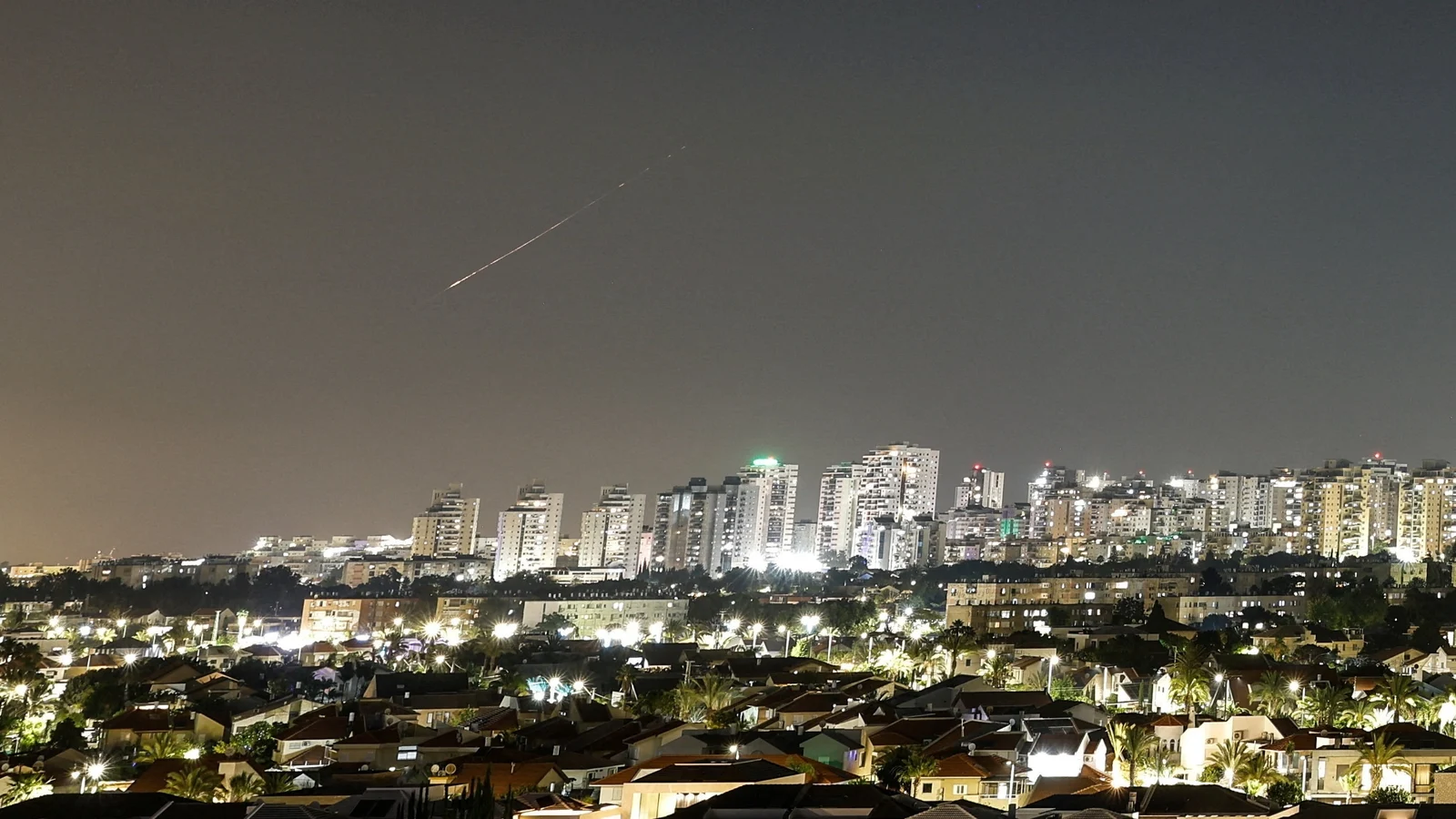
Missiles streaked toward Israel from Iran on Tuesday night in what Tehran’s Revolutionary Guards described as a blunt “warning” prompted by an Israeli strike on Beirut earlier in the day—along with a fresh threat that any further attacks would trigger wider retaliation.
“Tonight’s operation was a warning. If such aggressions are repeated, the responses will be broader and will cover all US-Zionist targets in the region,” the force said.
Israel’s military said it detected two separate salvos launched from Iran in the direction of Israeli territory.
The launches mark Iran’s first strikes against Israel since a truce took effect in April, and they follow Iranian warnings that it would respond if Israel targeted Beirut.
The Israeli military said it had, so far, intercepted every missile fired from Iran.
“The IDF intercepted all missiles from Iran thus far. The IDF has currently identified additional launches fired toward the State of Israel,” the military said.
“The aerial defence array is currently identifying and intercepting threats,” it added.
The ceasefire on 8 April had brought major hostilities between Iran, Israel and the US to a halt. But repeated setbacks in attempts to convert the truce into a broader settlement have left the situation fragile, and the new launches were expected to further undercut already dim prospects for lasting peace.
Iran has maintained that any agreement to permanently end the war must also stop the parallel conflict in Lebanon, where Israel is conducting a campaign against Hezbollah.
Iran’s military central command said Israel’s strike on Beirut had “crossed all red lines”.
“The Israeli army must stop its attacks on southern Lebanon and the suburbs, and if it expands its attacks to that region or responds to Iran’s action, it will face more devastating and regrettable blows,” General Ali Abollahi said.
US President Donald Trump said he would call Israeli Prime Minister Benjamin Netanyahu to urge restraint and prevent further escalation after the Iranian missile strikes, Axios reported.
“I am going to call Bibi right now and tell him not to retaliate,” Mr Trump was quoted as saying by Axios journalist Barak Ravid in a phone interview, using the Israeli leader’s nickname.
“Each of them had their fun. Israel had its strike and Iran had its strike. We don’t need another one,” Mr Trump said, according to excerpts of which Ravid posted on X.
Inside Israel, the military’s Home Front Command announced nationwide school closures for tomorrow as it tightened restrictions.
“Following an assessment of the situation, the Home Front Command has decided to modify the instructions and place the entire country under a restricted activity level.
“No educational activities may be conducted,” it said in a statement.
Hezbollah said it also carried out an attack, saying it launched a drone at an army post in northern Israel in response to Israel’s strike on Beirut.
Iran has committed ‘grave mistake’ – Israel
Israel’s military said Iran had made a “grave mistake” by firing what it described as a barrage of missiles at the country.
“The Iranian terrorist regime has made a grave mistake by once again choosing the path of terror,” military spokesman Brigadier General Effie Defrin said.
After the salvos, Iran moved to shut down air travel over part of the country, announcing the closure of western airspace.
“Due to safety and security assessments… the western part of the country’s airspace was declared closed until further notice,” said Majid Akhavan, the spokesman for the National Civil Aviation Organisation, in a statement carried by the news agency IRNA.
Iraq and Syria also suspended flights as a precaution, citing the missiles’ path over their territory on the way toward targets in Israel.
In a brief statement, the Iraqi Civil Aviation Authority reported the closure of Iraqi airspace for 72 hours.
Syria’s authority closed the country’s “southern air corridors” for 12 hours.