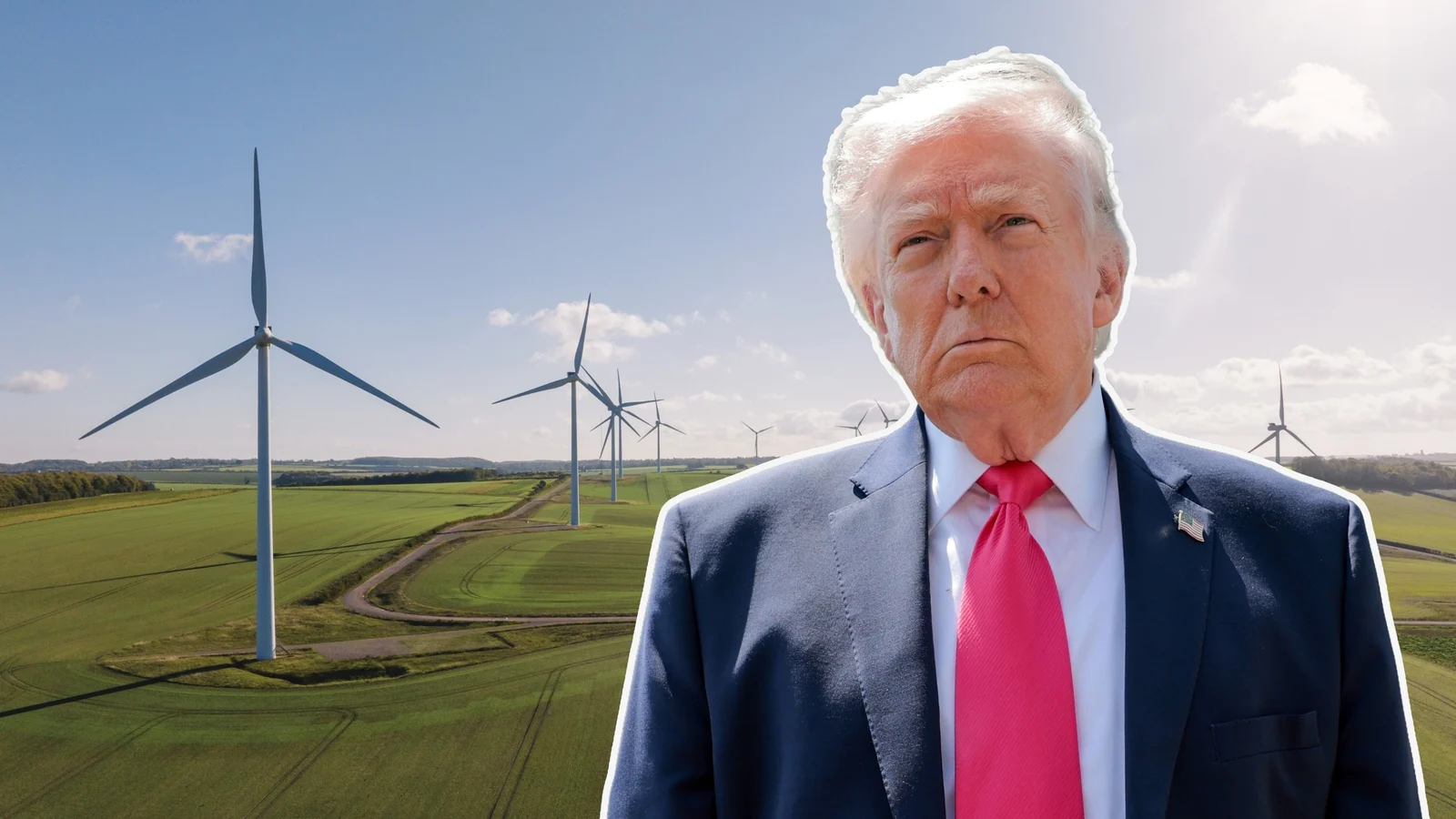
Donald Trump has never hidden his hostility to wind power — a feud that was reportedly sparked when turbines appeared within view of his Scottish golf course — and his return to the White House has turned that long-running grievance into federal policy.
The president has repeatedly derided wind turbines — which he calls “windmills” — branding them “ugly,” “noisy” and “expensive,” while also claiming they kill birds.
“Want to see a bird graveyard?” he said.
Wind turbines do kill some birds, but the toll is far lower than the number killed by cars, cats and collisions with building glass, according to the American Bird Conservancy.
Still, Trump’s animus toward wind, paired with his insistence that climate change is “a hoax”, has driven an aggressive effort to pull apart America’s wind power buildout.
That campaign is beginning to land blows.
The tax breaks and investment incentives introduced during the Biden years to accelerate cleaner energy are no longer in place.
In their place, the administration’s “drill, baby, drill” push has steered federal dollars toward fossil fuels — including deals that effectively compensate companies for walking away from wind projects already underway and redeploying that money elsewhere.
One of the most high-profile examples was a “pay-not-to-play” arrangement in which the government reimbursed French energy firm TotalEnergies about $1 billion (€866m) for offshore wind farm leases.
US Attorney General Pam Bondi said the agreement “prioritises affordability for hardworking American consumers over the prior administration’s ideological, ineffective energy policies”.
Federal officials argued the move would strengthen US national security and help reduce household bills.
French energy giant TotalEnergies agreed to abandon offshore wind project
As part of the agreement, TotalEnergies committed to steering the reimbursed funds into oil and gas development.
“Considering that the development of offshore wind projects is not in the country’s interest, we have decided to renounce offshore wind development in the United States, in exchange for the reimbursement of the lease fees,” said Chairman of the Board of Directors and Chief Executive Officer of TotalEnergies Patrick Pouyanné.
The administration has also managed to stop the Golden State Wind project off central California and Bluepoint Wind off New Jersey, again with payouts in the region of $1 billion to the companies involved.
Those moves, however, triggered swift political blowback from Democrats.
New York Governor Kathy Hochul publicly pressed the White House to justify its rationale.
“When I heard this, I said one thing: I’m the governor of New York, if there is a national security threat off the coast of New York, you need to tell me what it is – I want a briefing right now,” she said.
“Well, lo and behold, they had no answer,” she said.
On Tuesday, New York Attorney General Letitia James filed a lawsuit on behalf of seven Democrat-run states — Connecticut, Maine, Massachusetts, New Jersey, New York, Rhode Island and Vermont — seeking to overturn the TotalEnergies agreement.
“This administration cooked up a sham deal to pay a foreign energy company hundreds of millions of taxpayer dollars to abandon offshore wind and invest in oil and gas instead,” Ms James said in a statement.
Donald Trump has pursued an energy policy of ‘drill, baby, drill’
“We are fighting back to stop this illegal agreement that threatens to erase over a thousand union jobs and cheat millions of New Yorkers out of clean, affordable energy.”
In California, the state’s Energy Commission opened an investigation into why Golden State Wind was shelved.
Michael Colvin, who directs the energy programme at the state’s environmental defence fund, condemned the arrangement as a “wasteful deal” that would ultimately hit taxpayers.
“As families face soaring bills driven by fossil fuel price spikes and as power demand from data centres, industry and homes keeps rising – we need to bring more reliable clean energy onto the grid with stable, predictable costs,” he said.
As in other corners of the administration’s agenda, much of the fight has shifted to the courts, where a growing stack of lawsuits is challenging federal stop-work — or, as critics frame it, stop-wind — orders.
Federal judges, meanwhile, have repeatedly moved to block the administration’s efforts on five offshore projects along the East Coast.
“The administration has tried different legal approaches to stop these projects, and so far the courts have rejected each one,” said Hillary Bright of Turning Forward, an offshore wind campaign group.
“Federal judges have allowed all five projects that received stop work orders in December 2025 to continue construction, and three of those five are now delivering power to American homes and businesses,” she said.
Fuel prices continue to surge in the US
Yet wind power’s political footprint in the United States doesn’t fit neatly into a red-versus-blue narrative.
Some of the most rapid growth in clean energy over recent years has unfolded in Republican-led states.
Texas — long defined by oil wealth and ten-gallon hats — now stands as the nation’s clear wind powerhouse, producing roughly a third of US wind-generated electricity.
Iowa, Oklahoma and Kansas also rank near the top, all deep in the Republican heartland.
And even as offshore plans are cancelled, major onshore developments continue to move forward.
New Mexico is poised to bring online what is expected to be the largest wind farm in the country so far.
The SunZia wind project, with enough capacity to supply electricity to about three million people, is due to start operating in the coming week.
Industry figures suggest 2026 could still shape up as wind’s strongest year since 2022, as developers race against the clock.
“Over eight gigawatts have been installed,” David Groarke of consultancy Indigo Advisory told RTÉ News, pointing to a last-minute sprint to qualify for Biden-era tax credits before they run out.
“There’s an incentive to move quickly, and that’s why we’re having a record year,” he said.
But Groarke warned the momentum is unlikely to hold.
“The Trump administration and various other factors are hampering the growth of wind,” he said.
“Right now, wind is about 10% of US electricity, and it’s going to stay at that figure roughly through 2030,” he said.
For an industry that must plan years — often decades — ahead, the uncertainty itself can be destabilising, leaving developers and investors wary.
The latest first-quarter update from American Clean Power showed solar and battery deployment climbing steadily, while wind slowed.
“The pipeline for land-based wind has stagnated, and offshore wind has plummeted by 35%,” the report found.
“Early and-mid-stage land-based wind projects have struggled to secure approvals from federal regulators, and offshore wind continues to weather permitting roadblocks and uncertainty,” it said.
Ms Bright said the financial consequences of delaying or cancelling wind projects could ultimately flow back to households, particularly at a time of “load growth” on the grid driven largely by the expansion of data centres.
China produces more than half of the world’s wind power
Even when projects are later allowed to restart, she said, “the construction pause has cost developers millions of dollars and, along with Trump’s sustained attacks on renewable energies of all kinds, injected uncertainty and additional risk into future projects”.
“Such delays also mean additional costs for ratepayers,” she said.
Globally, the US approach increasingly stands apart.
China has made wind a central plank of its energy strategy and now generates more than half of the world’s wind electricity capacity.
Brazil and India are also accelerating turbine installations.
Meanwhile, smaller nations have pushed wind to a major share of their electricity mix — including Denmark at 58% and Ireland at 35%.
“Other developed economies have consistent policy across administrations,” Mr Groarke said, “and that leads to a good marriage of economic incentives and certainty in the market, and the ability for developers to plan long range”.
He said that kind of continuity is missing in the United States.
Instead, fossil fuels have regained political favour. On Thursday, Trump announced $700 million (€606m) in new federal funding for the coal industry, and two new coal plants are set to be built.
The shift marks a sharp break from the previous administration’s direction.
“What’s happening in the US is it’s primarily an economic argument that’s been made for energy, and there’s inconsistency at the federal policy level,” he said, “which means that the energy build out here is primarily being built on market forces”.
“Which is very American when you think of it,” he added.