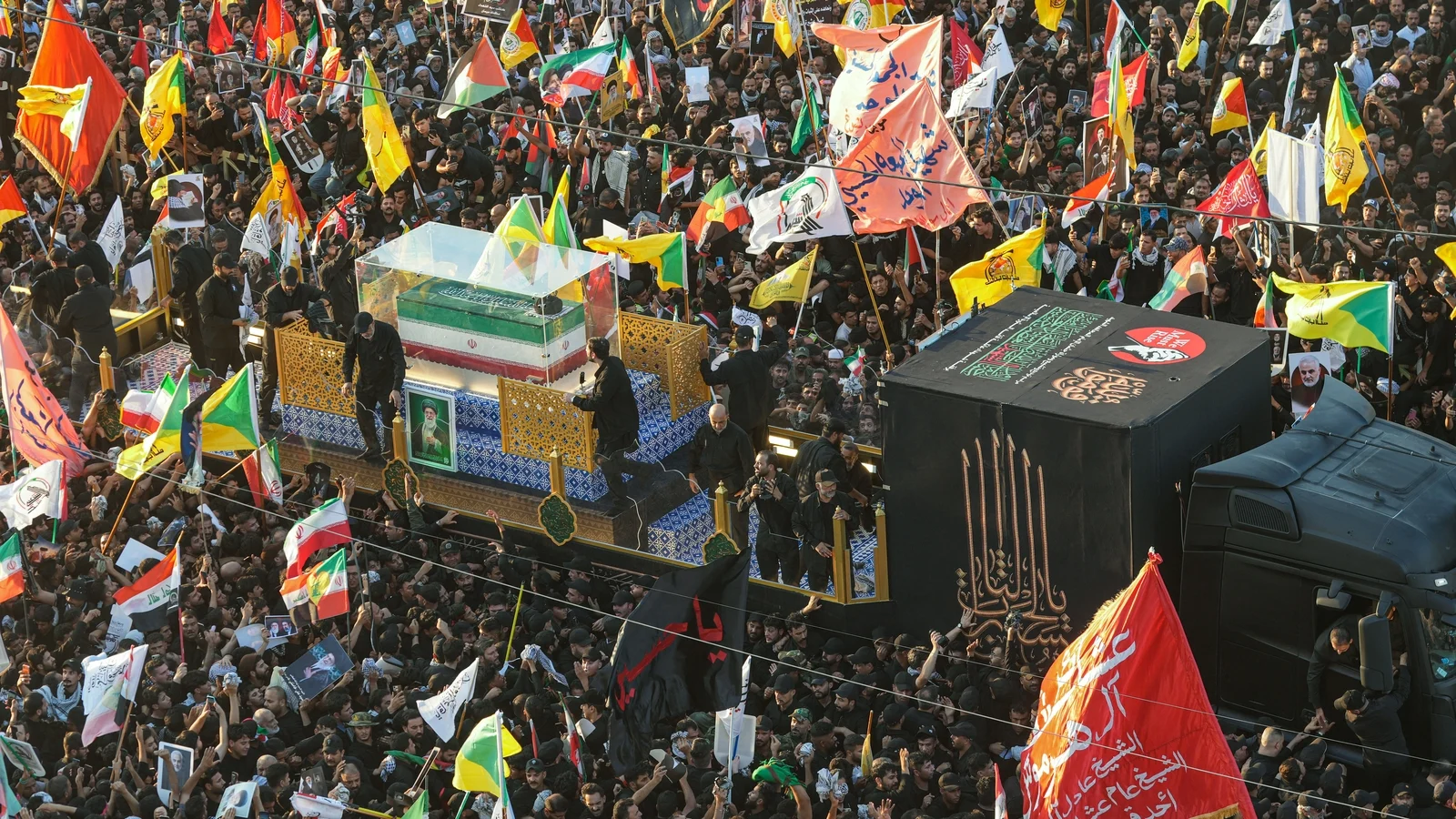
Najaf’s streets filled wall to wall on Saturday as the coffin of Iran’s supreme leader Ali Khamenei was carried through the Shia holy city, turning a day of mourning into a regional display of faith and politics centred on Iraq’s most revered shrines.
Iran has launched six days of public funeral ceremonies for Khamenei, with one day set aside for neighbouring Iraq — a country with longstanding ties to Tehran.
Tehran hopes the high-profile commemorations will underscore strength and unity in the wake of the Middle East war that erupted after US-Israeli strikes killed Khamenei and several relatives on 28 February.
Following a huge procession in Iran’s holy city of Qom, Iraqi officials and senior politicians took receipt of Khamenei’s remains last night at Najaf international airport, with Iranian President Masoud Pezeshkian present.
Iraqi authorities designated today a public holiday, and ceremonies were scheduled to begin at 6am local time (4am Irish time) in Najaf.
People carry Ali Khamenei’s coffin after landing at Najaf International Airport
Iraqi authorities declared today a public holiday
Officials anticipated vast crowds in Najaf and Karbala. Along the routes, large portraits of the late leader appeared beside Iranian flags and images of other slain commanders from Iran’s “axis of resistance”.
Khamenei’s final burial is due tomorrow in his hometown of Mashhad in northeast Iran.
In Najaf, mourners are expected to take part in a 6km procession that will end at the towering shrine of Imam Ali — the Prophet Muhammed’s son-in-law and the first Shia Imam.
Najaf is regarded as the heart of Shia religious seminaries and is also home to Grand Ayatollah Ali Sistani, Iraq’s highest Shia religious authority.
The city has long drawn senior Shia clerics to study, teach and live, including Ayatollah Ruhollah Khomeini, Khamenei’s predecessor.
Iranian President Masoud Pezeshkian and Iraqi Prime Minister Ali al-Zaidi attend the welcome ceremony at Najaf International Airport
For many Shia Muslims worldwide, Najaf is also a sought-after place of burial.
After the Najaf events, Khamenei’s body will be flown about 60km north to Karbala for another procession, set to culminate at the shrines of Imam Hussein and his brother Abbas.
The seventh-century death of Hussein, the third Shia Imam, remains a defining event in Shia history and continues to draw millions of pilgrims each year to Karbala and Najaf from around the world.
In both cities, hundreds of volunteer-run stalls lined the routes, offering food and drinks to mourners.
‘Spiritual bond’
Iraq and Iran — both Shia-majority states — share a relationship shaped by religion and politics, and the funeral events have placed that connection on full view.
Iranian state media cited Esmail Qaani, the head of the Quds Force in Iran’s Revolutionary Guards, saying: “The extensive planning for this historical event by the Iraqi government and people show the depth of the spiritual bond between the two great nations of Iraq and Iran to the whole world.”
The relationship has not always been close. During the 1980s, Iraq’s late ruler Saddam Hussein, who repressed Iraq’s Shia population, waged war against the Islamic republic.
But ties tightened after Hussein was toppled in a US-led invasion in 2003, and as Shia-dominated governments rose to power in Baghdad.
Today, Iran supports influential politicians as well as armed groups in Iraq. Some of those groups entered the Middle East war after Khamenei’s death in support of Iran, launching attacks on US facilities in Iraq.