Israel’s government has vowed a sweeping crackdown in Hebron after a deadly checkpoint attack near the West Bank city left two Israeli soldiers dead, prompting Prime Minister Benjamin Netanyahu to threaten house-to-house searches and home demolitions.
The Israeli military said Palestinian attackers killed the two soldiers at a military checkpoint close to Hebron. It said its forces killed two attackers, and that another three soldiers were lightly wounded.
Arriving in Hebron following the assault, Mr Netanyahu said Israeli forces would move into the attackers’ neighbourhood and displace residents.
“We will evacuate the residents, we will go from house to house, we will also seize the weapons there, and all the terrorist infrastructure will be dealt with and destroyed,” Netanyahu said, according to his office.
He said he and the defence minister were weighing an expanded operation across the West Bank.
“The defence minister and I are considering a very extensive IDF (army) operation in Judea and Samaria, such as has not been carried out since the Six Day War,” Mr Netanyahu added, referring to the 1967 Arab-Israeli war.
An Israeli soldier aims his weapon as Israeli security forces patrol the area in Hebron
Israeli soldiers at the northern entrance to Hebron
“The IDF is ready to execute it and we will set the timing, but it is on the way.”
Mr Netanyahu said the military would replicate an approach previously used in refugee camps in the northern West Bank. A large-scale military operation dubbed “Iron Wall” launched in January 2025 forcibly displaced tens of thousands of people across several refugee camps, according to the UN rights office.
As of July this year, 33,362 Palestinian refugees displaced from the three camps had not been permitted to return, according to the UN.
Nearly two years later, Israel’s military continues to operate inside Jenin refugee camp — an area that, before Iron Wall, was seen as a stronghold for armed Palestinian militants fighting Israeli occupation.
Israeli forces also remain stationed in two refugee camps in the nearby city of Tulkarem.
The military said that across all three camps it demolished dozens of houses in the dense warren of alleys to make it easier for troops and armoured vehicles to move, and established operational centres for soldiers inside residents’ homes.
Two armed men were shot dead by Israeli forces at a checkpoint near Hebron
“The Jenin refugee camp model is on its way to Hebron,” Israeli Defence Minister Israel Katz said on social media.
“Every clan neighbourhood in Hebron from which the terrorists emerged today will be evacuated of its residents, and the terror infrastructure in the neighbourhood will be addressed and dismantled,” he said, referring to the large families, or clans, that hold much influence in the city of Hebron.
Human Rights Watch later issued a report saying the mass expulsions amounted to war crimes and crimes against humanity.
Israel responded by saying it needed to demolish civilian infrastructure so it could not be exploited by militants. It did not say when residents could return.
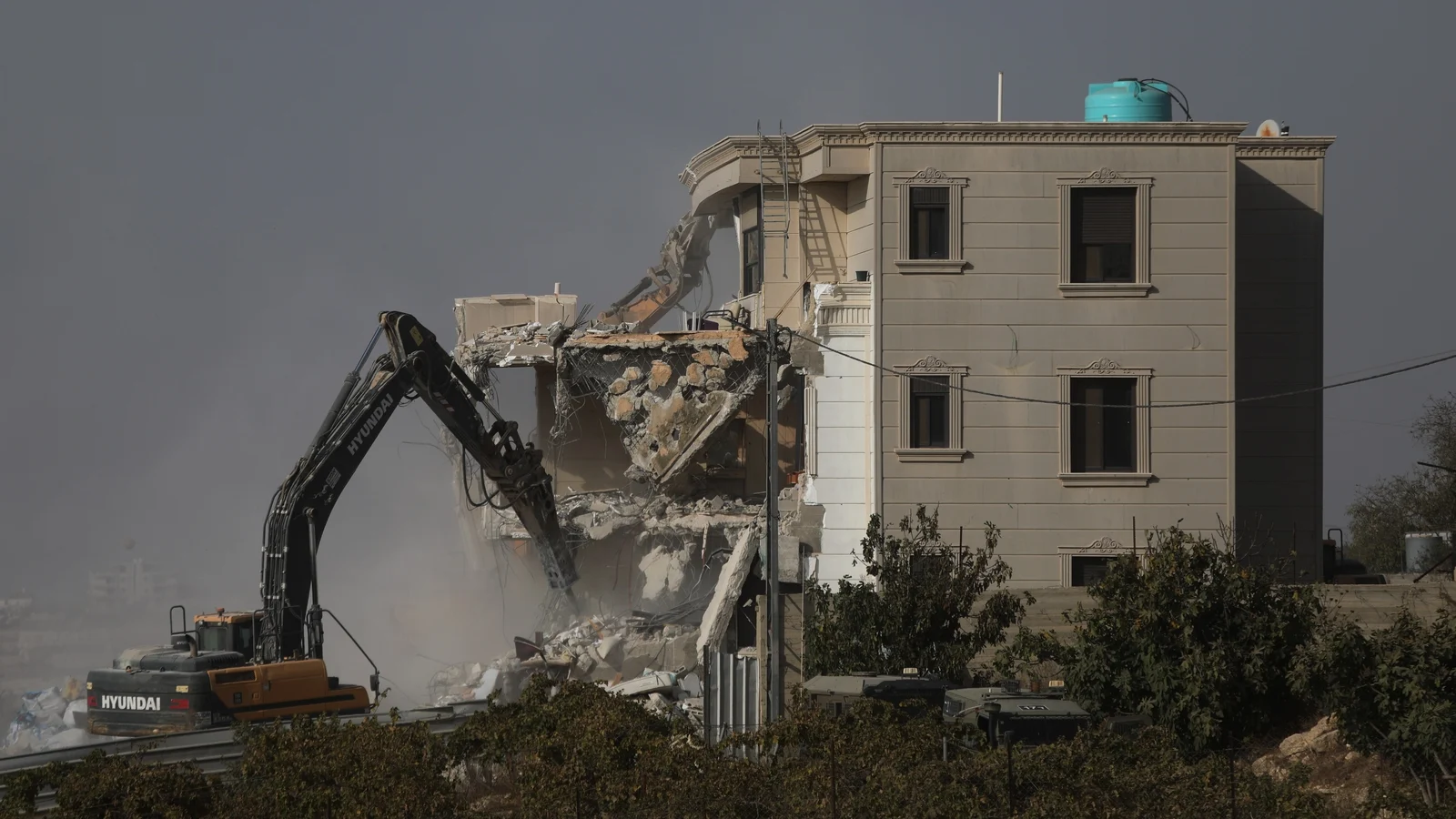
A Reuters reporter documented Israeli bulldozers starting to demolish homes in Hebron near the site of the shooting.
Local residents said the homes had no connection to the attackers.
The demolitions began after Israeli Finance Minister Bezalel Smotrich said on social media that he had ordered the immediate demolition of Palestinian buildings near the attack site.
Israel’s far-right National Security Minister Itamar Ben Gvir urged the dismantling of the Palestinian Authority and called for all Palestinians in the West Bank to be barred from travelling by road.
The violence unfolded ahead of an Israeli election next week, with Mr Netanyahu and his right-wing coalition campaigning on expanding Israeli settlements and opposing the formation of a Palestinian state.
Read more: Gadi Eisenkot – Israel’s ‘not Netanyahu’ candidate
The Hebron attack comes as tensions climb across the West Bank, where Israeli settler violence has surged in recent weeks.
In remarks after the attack, Mr Netanyahu praised Israeli settlers in the West Bank, calling them “heroic” and saying they were “standing in the breach”.
Under Mr Netanyahu, settlement growth has accelerated.
UN bodies and most countries deem Israel’s settlements on land occupied in war illegal under international law regarding military occupations.
Israel rejects this, describing the territory as disputed rather than occupied.
A crowd gathered after a fatal Israeli drone strike in Gaza
Israeli strikes kill four in Gaza
Meanwhile, Israeli strikes and gunfire killed at least four people in Gaza in separate incidents yesterday, health officials in the enclave said.
In Gaza City, medics said a strike on a car killed at least one person. They earlier said there had been two deaths.
Photos from the scene showed a crowd gathering around the burning wreckage as emergency crews in orange vests sprayed it with water.
Medics said other strikes killed a Palestinian man riding a bike in the southern city of Khan Younis and another man near Nuseirat refugee camp in central Gaza, while gunfire killed a woman near the Jabalia refugee camp in the north.
Israel’s military said it struck Hamas militants in Khan Younis, Nuseirat and Gaza City, but said it was not aware of the reported incident in Jabalia.
The Hamas-led Interior Ministry in Gaza said an Israeli airstrike hit a vehicle returning from an assignment in the Tel al-Hawa neighborhood, killing a non-commissioned officer and wounding another officer from the drug control police department.
Israel, which says the Hamas militant group has been rearming and launching attacks in violation of a year-old ceasefire, has increased strikes on the group in recent weeks.
Hamas has denied trying to carry out attacks or rebuild its arsenal, and accuses Israel of weakening the Gaza peace deal.
Last year’s US-brokered ceasefire calls for eventual reconstruction of the territory.
But talks have made little headway, with negotiators unable to agree terms for Hamas to disarm and for Israel to withdraw its troops.
Israeli airstrikes have continued.
At least 1,500 Palestinians have been killed in Gaza since the ceasefire, according to the territory’s health officials, while Israel says four soldiers have been killed.
Palestinian authorities say more than 74,000 people have been killed in Israel’s assault on Gaza, launched after Hamas-led fighters killed about 1,200 people in southern Israel three years ago.