A blank parchment signed in haste on 14 May 1948 still haunts Israel’s politics — and, as voters head to the polls on Tuesday, the unresolved arguments of the country’s birth are again shaping its future.
That day, members of the People’s Council of Israel put their names to what was meant to be the new state’s Declaration of Independence, formally announcing the creation of a Jewish state in Palestine.
At the centre of the scene at the Tel Aviv Museum of Art was David Ben-Gurion, the Zionist leader about to become Israel’s first prime minister.
Yet the ceremony moved so quickly, and the final wording was agreed so late, that there was no time for calligraphy. The signatories wrote their names on an empty scroll, and only later were the declaration’s words penned above the signatures.
It was a state assembled at speed — and Ben-Gurion, who helped set its direction, went on to define it for decades.
He remained prime minister for about 13 years, leaving a lasting stamp on Israel’s institutions, its military and its national identity.
On 14 May 1948, Israel’s Declaration of Independence was signed
No other leader matched his tenure for generations. That changed in 2019, when Benjamin Netanyahu surpassed him.
Mr Netanyahu first entered office in 1996. Across three separate stints, he has now spent close to two decades as prime minister — long enough that many younger Israelis have scarcely experienced another national leader.
Along the way, he has carefully fostered a story about himself: that he is uniquely qualified, and that no alternative can safely steer the country.
On Tuesday, that self-made legend meets its toughest challenge in years.
But the contest is not just a referendum on one man. It is also about questions that were never settled at Israel’s founding in 1948 — and remain hotly contested now.
The Declaration of Independence committed the new state to adopting a constitution “not later than the 1st October 1948”.
That deadline passed. No constitution followed.
The body elected to write one became mired in disputes, especially over religion’s place in public life.
In 1950, leaders chose a workaround: instead of a single constitution, Israel would assemble one over time through a set of so-called Basic Laws.
Some 75 years on, the project is still unfinished.
David Ben-Gurion was the longest-serving prime minister of Israel until Benjamin Netanyahu surpassed him in 2019
And many of the Basic Laws that do exist can be changed or repealed with a simple parliamentary majority.
With no full written constitution, Israel’s Supreme Court has ruled since a landmark decision in the 1990s that it may strike down legislation that conflicts with those Basic Laws.
In 2023 — just weeks after Mr Netanyahu returned to power for a record sixth term, heading the most right-wing government in Israel’s history — the country’s constitutional ambiguity erupted into open confrontation.
His coalition advanced plans to limit the court, including a mechanism that would allow parliament to override Supreme Court rulings by a simple majority.
The response was immense. Hundreds of thousands joined demonstrations, marching for 39 consecutive Saturdays.
A 40th protest was scheduled for 7 October 2023.
It never took place.
Now, three years later, Israelis are voting in the first election since that date — the deadliest day in the country’s history.
And beneath the ballot lie three foundational disputes, still running through Israeli society like fault lines first exposed in 1948.
In 2023, thousands of Israelis took to the streets to protest judicial reforms
The wound
The first is accountability.
In Israel, virtually every election turns on what citizens often call simply “security”.
In other places it might be described as defence. Here, it carries existential weight, bound up with the belief that the state’s survival is never guaranteed.
That idea reaches back to Israel’s first hours. When the declaration was signed, fighting between Jewish and Arab forces had already been underway for months.
That night, Ben-Gurion wrote in his diary: “Jewish independence was declared and the state was founded. Its fate is in the hands of the security forces.”
The next day, the armies of five Arab states invaded.
Israel’s security forces prevailed. The outcome felt, to many, against the odds — even miraculous, with some seeing divine intervention.
Ever since, Israelis have placed extraordinary trust in the institutions charged with protecting them.
On 7 October 2023, that trust collapsed.
The breach — and the question of who bears responsibility — hangs over the vote.
The Nova music festival site, where hundreds of Israelis were killed on 7 October
Hamas-led gunmen killed about 1,200 people in southern Israel within hours and abducted more than 250.
Much of the violence was recorded, and some of it was broadcast live by the attackers themselves.
“It’s traumatised an entire nation,” Tal Schneider, a political correspondent for the Times of Israel, told me.
For much of the past three years, Mr Netanyahu has insisted the failures that allowed the attacks were not his responsibility.
His allies say Israel’s security services did not warn him.
That argument was jolted last month by a Haaretz report stating that the ruler of the United Arab Emirates had personally warned Mr Netanyahu before the attack.
Mr Netanyahu’s office dismissed the report as “an absolute lie”.
Still, it cut into the core of the prime minister’s defence.
Israel has an established model for confronting disasters of this scale.
Almost exactly 50 years before 7 October, Egypt and Syria launched a surprise assault on Yom Kippur, the holiest day on the Jewish calendar.
Israel was caught off guard and ill-prepared. More than 2,500 Israeli soldiers were killed before the war ended.
Israeli forces were caught unaware on what became known as the Yom Kippur war
A state commission of inquiry was appointed within weeks.
It placed responsibility squarely on the military.
Golda Meir, the prime minister at the time and Israel’s first and only woman to hold the office, was not blamed.
Even so, she stepped down shortly after the commission issued its first report.
Mr Netanyahu has resisted a similar state inquiry into 7 October for three years.
Backers of the prime minister say such a commission would be arranged to prejudice him.
His critics argue he fears what an investigation would uncover.
Last night, families of those killed or abducted on 7 October gathered in Hostage Square in Tel Aviv, calling for a state inquiry.
The square became the hub of the push to bring captives home; for 24 months, rallies were held there every Saturday.
Even after the last living hostages were freed a year ago, the demand for accountability has endured.
“Why would you do everything in your power not to investigate something that you are responsible for?” asked Karen, one of those in the crowd.
As many as 100,000 people gathered in Hostage Square in Tel Aviv to demand a state inquiry of 7 October
Yet the country is far from united on what justice looks like.
Supporters of Mr Netanyahu acknowledge the attack occurred on his watch and that he carries some responsibility.
But they argue he should be judged equally on what followed: the war against Hamas and the strikes carried out against Hezbollah in Lebanon and Iran.
“I think he was able to convince some of the people that he came to his senses on 8 October,” Ms Schneider said.
“I’m not convinced by that, but, you know, some people are convinced.”
On Tuesday, voters will decide which date weighs heavier: 7 October, or 8 October.
The world
The second fault line is Israel’s position internationally.
Toward its conclusion, the Declaration of Independence appealed to the United Nations to “receive the State of Israel into the comity of nations”.
Nearly 80 years later, Mr Netanyahu’s main challenger is campaigning on a promise to bring Israel back to what he calls “the community of nations”.
Intentional or not, the overlap is striking.
Gadi Eisenkot, a former head of the Israeli military, has become the most prominent face of that argument. His son was killed fighting in Gaza in December 2023.
New to frontline politics, he leads Yashar, a party he founded last year.
Gadi Eisenkot greets attendees of a rally held to demand an inquiry into the 7 October attack
His message begins with a blunt claim: Israel is increasingly isolated.
Gaza sits at the centre of that isolation.
More than 74,000 Palestinians have been killed in Gaza, and large areas of the enclave lie in ruins.
Mr Netanyahu is the subject of an International Criminal Court arrest warrant over alleged war crimes, which he rejects.
Israel is also defending itself at the International Court of Justice in a case brought by South Africa alleging genocide.
Last year, an independent UN commission of inquiry concluded that Israel had committed genocide in Gaza.
Israel has rejected both allegations outright.
In the Occupied West Bank, continued rapid growth of illegal Israeli settlements and a rise in settler violence against Palestinians have further strained Israel’s standing.
Even Israelis who feel removed from diplomacy sense the shift.
“When they get into a cab in Europe now, they’re embarrassed to admit that they’re from Israel,” said Professor Yael Sternhell, a historian at Tel Aviv University.
More than 74,000 Palestinians have been killed in Gaza by the Israeli military
Yet the subject has barely broken through as an election issue.
Many Israelis — particularly on the right — view global criticism as proof the world judges Israel by a different standard, rather than as a verdict on the government’s decisions in Gaza or the West Bank.
For them, isolation can even read as resolve: a leader refusing to bend.
“It’s the first time in my life that I feel that someone is putting Israel first,” said Lilach Elgrably, who runs a dog grooming salon on Dizengoff Street in Tel Aviv.
“I feel that someone is putting Israel first and showing the world that, with you or without you, we’re going to defend ourselves.”
Mr Netanyahu has long highlighted his relationship with Washington. Few US presidents have been closer to him than Donald Trump, who has endorsed his re-election.
But outside the White House, political currents are changing.
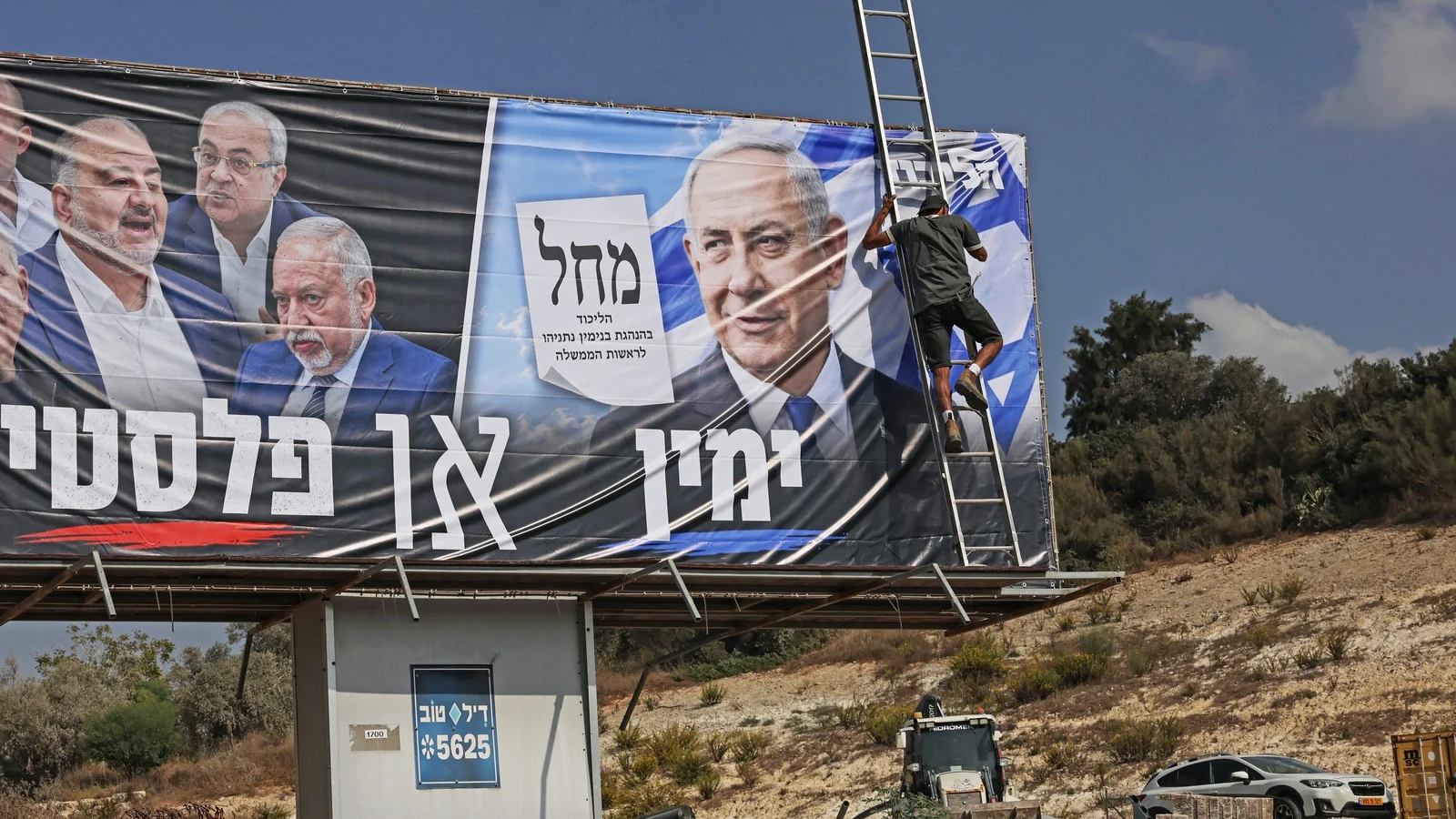
In Tel Aviv, one measure of that shift towers above the Ayalon Highway, among Israel’s busiest routes.
A Likud billboard displays Iran’s Supreme Leader, Turkey’s president and the head of Hezbollah alongside Zohran Mamdani, the mayor of New York.
An election campaign billboard by Mr Netanyahu’s party featuring New York City Mayor Zohran Mamdani
“They want Netanyahu to lose,” it reads.
“Don’t let them win.”
Mr Mamdani, a sharp critic of Israel’s war in Gaza, was elected last year to lead the city with the largest Jewish population outside Israel.
Concern about Israel’s standing is also spreading beyond the political left.
A New York Times poll in May found nearly a third of potential Republican voters believed Mr Trump had been “too supportive of Israel”.
Some of the strongest cautions are now coming from figures once counted among Mr Netanyahu’s firmest allies.
“You’ve lost the Democratic Party, and you’re losing the Republican Party,” Ronald Lauder, President of the World Jewish Congress, said on Friday.
Speaking to Haaretz, Mr Lauder ended years of public silence to warn against another Netanyahu victory.
“If Bibi is elected,” he said, “Israel stands to lose badly.”
He described Mr Netanyahu as “a one-person show”.
Mr Netanyahu at the White House in 1996, when he was first elected prime minister
Gaza itself has been largely missing from the campaign.
And opposition to Mr Netanyahu does not necessarily translate into support for a Palestinian state.
Few leading Jewish parties advocate one, and after 7 October the concept commands little backing among Israeli voters.
The divide
The third fault line runs through religion — and the question of who fully belongs.
Even one of the declaration’s most resonant lines emerged from bargaining.
Religious members of the People’s Council pressed to reference God directly. Secular members resisted.
The compromise was “the Rock of Israel” — a phrase elastic enough to satisfy both camps.
Other bargains have proven harder to sustain.
In 1949, Ben-Gurion agreed that ultra-Orthodox yeshiva students could be exempt from military service so they could focus on religious study.
There were about 400 such students then.
By 1963, he wrote to his successor that he believed he was “in part responsible” for what the exemption had become.
Most Jewish Israelis are drafted at 18 — men for nearly three years and women for two — and many return repeatedly as reservists.
Supporters of Mr Netanyahu’s Likud party celebrate in 1996 after it became clear it had won the election
Today, tens of thousands of ultra-Orthodox men do not serve.
After three years of war, few topics provoke more anger.
The dispute has pushed the current government toward crisis more than once, because Mr Netanyahu depends on ultra-Orthodox parties to keep his coalition intact.
The Declaration of Independence also pledged “complete equality of social and political rights to all its inhabitants irrespective of religion, race or sex”.
Arab citizens comprise about a fifth of Israel’s population.
Arab parties are polling at around 14 seats — potentially enough to determine the next governing coalition.
An Arab party has joined a government before, in the brief 2021 coalition that temporarily removed Mr Netanyahu from office.
But Mr Netanyahu’s campaign has cast Tuesday’s decision as “right or Palestine”, suggesting any non-right government would open the door to a Palestinian state.
Mindful of reinforcing that narrative, Mr Eisenkot — like most opposition figures — has avoided saying whether he would cooperate with Arab parties.
The tension has seeped into the texture of daily life.
The Israeli election has been marked by a low-key campaign
“Even in families in Israel, there is a difference of opinion and people are not speaking to each other,” Limor Dvir, who runs Yashar’s election-day operation in the city of Modi’in, told me.
At Hostage Square last night, a man named David used fewer words.
“Everybody hates everybody,” he said. “It’s unbelievable”.
Polling echoes the divide in arithmetic.
In the last surveys published before a legal blackout took effect on Friday night, Mr Netanyahu’s bloc and the opposition parties aligned behind Mr Eisenkot were separated by only a handful of seats.
Neither side was close to the 61 seats required for a majority in the 120-member Knesset.
Israel is, in the plainest sense, split down the middle.
That makes the most unexpected feature of this campaign stand out even more: its subdued mood.
For an election described as the most consequential in Israel’s history, waged across profound divisions, there have been few rallies and little street advertising until the final days.
“There’s a kind of weird quiet here right now,” Prof Sternhell said.
The hush may benefit Mr Eisenkot, a former soldier offering steadiness rather than showmanship, and who has taken care not to provide Mr Netanyahu’s base with a rallying cry.
On the stump, Mr Eisenkot has drawn on the country’s past.
Gadi Eisenkot, a former army chief, sells calm, not charisma
Speaking to supporters on Wednesday, he argued this election could be measured against Israel’s first — held months after independence — when, he said, “the foundations of Israeli democracy were laid”.
It is a sweeping comparison.
That first vote, in January 1949, elected an assembly charged with writing Israel’s constitution.
It never succeeded.
The Tel Aviv Museum of Art where the declaration was signed later relocated.
Its former building on Rothschild Boulevard, where Ben-Gurion read the text aloud, is now itself a museum: Independence Hall.
In 1971, the museum opened a new site about two kilometres away.
The plaza outside has since become known as Hostage Square.
Last night, with the election less than 48 hours away, as many as 100,000 Israelis gathered there to demand what they believe their state owes them.
Nearly eight decades after the founders signed a blank scroll, the country remains locked in an argument over what the words written above their names were meant to promise.