Midnight in the Pacific: A Homecoming That Felt Like a Small Miracle
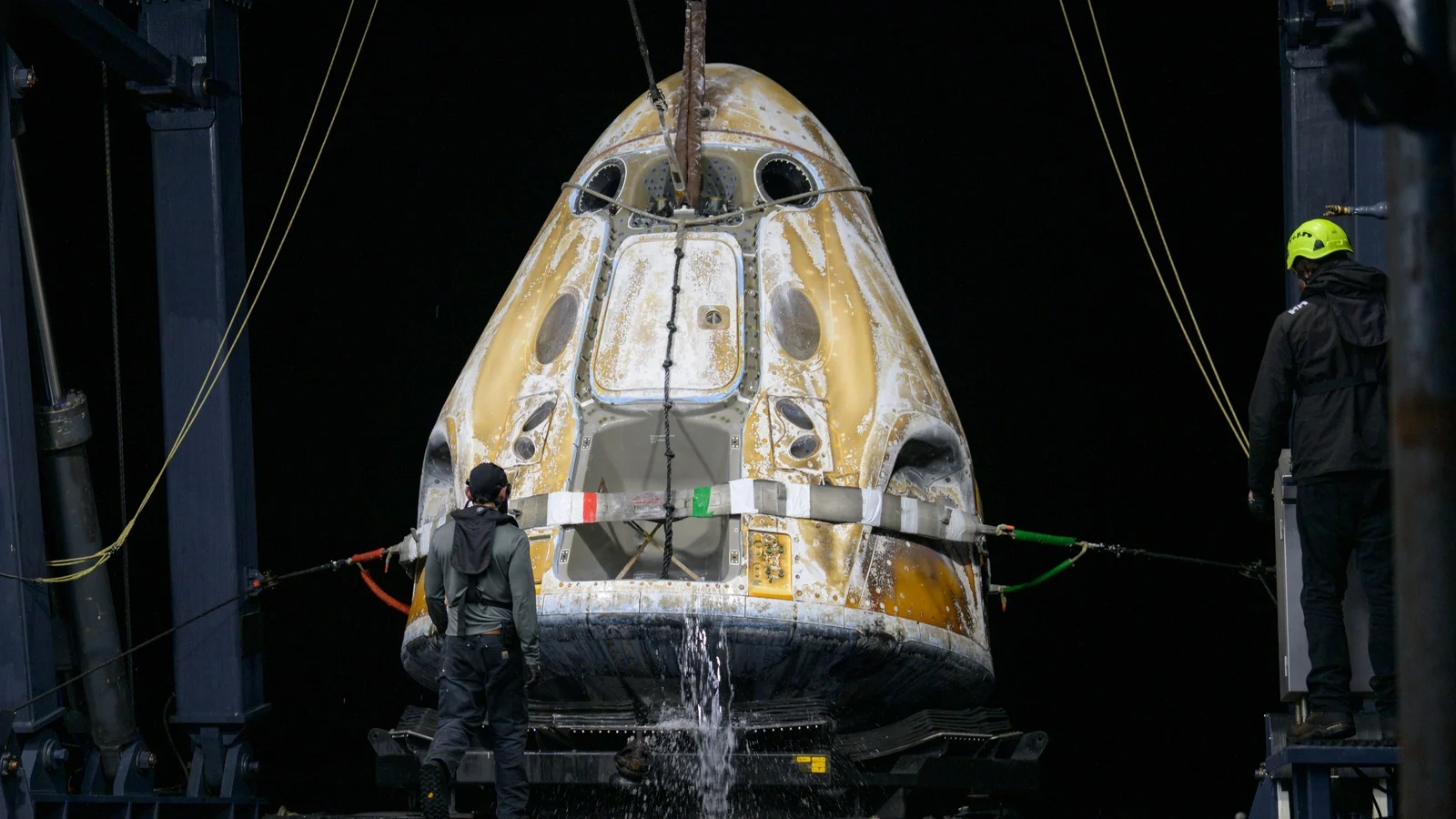
The sky above the Pacific off San Diego was a velvet bowl when the capsule came down — a bright, battered teardrop slipping through the last thin fingers of night and into a glassy sea. Parachutes bloomed, cords sang, and a craft named Endeavour eased into the water with a soft splash that belied the violence of the journey it had just survived.
“It’s good to be home,” Commander Zena Cardman said over the radio, her voice breathing relief into the chilly predawn. The three words landed like a benediction for everyone who had been watching: family on the ground, NASA and SpaceX teams who had been awake for hours, and strangers on nearby boats who had drifted into the dark to bear witness.
Four astronauts, one emergency
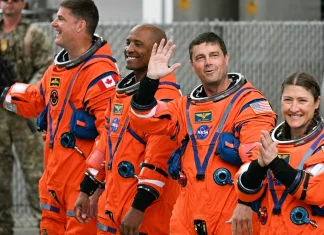
Onboard were four people whose lives are lived in inches — inches of airlock seals, inches of EVA tether — yet today their return was measured in miles, hours and the fragile calculus of human health. Mike Fincke, a veteran of multiple spaceflights and a retired Air Force colonel; Kimiya Yui, an experienced Japanese astronaut who brings calm and meticulousness into every operation; Oleg Platonov, a Russian cosmonaut with a laugh that cuts through radio static; and Cardman herself, the 38-year-old astronaut-geobiologist who had logged months aboard the International Space Station.
The mission, originally planned for roughly six months, ended after 167 days in orbit. The crew’s expedited descent was triggered by what U.S. officials described as a “serious medical condition” affecting one of the astronauts — a situation rare enough that NASA has said it’s the first time a crew’s stay on the ISS was cut short for medical reasons. For privacy reasons, officials have not disclosed who was ill or the nature of their condition, and that silence has shaped much of how the story has unfolded.
A controlled, fiery descent
The return was textbook in choreography but tense in mood. Re-entry turned the capsule’s outer shell into a glowing corona as it slammed into the atmosphere, shedding heat and speed. Infrared video fed through a joint NASA–SpaceX webcast showed two sets of parachutes peeling out from the capsule’s nose and unfurling like flowers, trimming the descent to around 25 km/h before Endeavour kissed the Pacific.
The trip from the space station to the splashdown point took about ten-and-a-half hours — a long, humming corridor of checklists, systems checks and careful piloting. Then, after a decade of travel between Earth and orbit, the ocean welcomed them back with a peaceful, humanizing tableau: dolphins circled, dorsal fins cutting through the dawn like punctuation marks, and a few pelicans drifted, indifferent, as if the event were a curious ripple in their normal day.
Why bring everyone home?
Mission leadership determined that evacuating all four crew members at once reduced risk and complexity. “In situations like this, the chain of care on the ground matters,” a recovery team leader said on condition of anonymity. “You can’t deliver the same level of diagnostics and treatment in orbit as you can at a major medical center.”
That prudence reflects a broader truth about human spaceflight: the farther we travel from Earth, the more we confront the fragility of the human body. Microgravity erodes muscle and bone, radiation numbers climb, and even a routine infection can become complicated when confined to a tin can circling the planet. For decades mission doctors and engineers have built layers of redundancy and trained crews to handle emergencies; still, the threshold at which a mission is curtailed for medical reasons is high.
Canceling the spacewalk — a reminder of limits
The crew had been scheduled to perform a spacewalk that would have lasted more than six hours to install new hardware on the station. That EVA was canceled last week after the medical concern first surfaced. “It was the right call,” a former flight surgeon told me. “You cannot risk a prolonged vacuum exposure or an activity that might exacerbate an unknown condition. The risks aren’t worth it.”
Whether this episode becomes a policy inflection point or remains an isolated incident will depend on how mission leaders and medical teams parse it in the days to come. For now, it’s a stark reminder: as humans push missions longer and farther — toward the Moon, Mars and commercial space habitats — medical preparedness is as important as rockets and robotics.
Human faces in an international endeavor
Beyond the technicality of the return lies something more resonant: the image of four people, citizens of different countries, returning to Earth together because one among them needed help. Cardman, Fincke, Yui and Platonov represent a patchwork of training philosophies, languages and cultures, yet they share the same oxygen and the same urgent need for care.
“There’s a camaraderie up there that doesn’t disappear when there’s a political storm on Earth,” an ISS flight controller said. “You live or die by the person next to you, and that makes cooperation not just practical but visceral.”
What the public saw
Onshore, ordinary mornings continued: fishermen hauled nets, surfers readied for dawn sets, and a handful of early commuters blinked awake to the news alerts. Yet people who lingered at the shoreline spoke of the splashdown like a small choreography they’d been privileged to see. “I didn’t expect to cry,” said one woman who watched from a public pier. “But seeing them come home — it reminded me we’re all fragile and brave in our own ways.”
The larger picture
This event invites us to ask bigger questions. What happens to medical privacy in an era where livestreamed missions turn every procedural decision into public drama? How should space agencies balance transparency with the need to protect crewmembers’ confidential health information?
And perhaps more pressingly: as commercial companies and more nations enter human spaceflight, are we ready for the medical burden that comes with more people in orbit? Current protocols rely heavily on telemedicine, preflight screening and conservative mission design. But longer missions and denser traffic will inevitably require more onboard capability — better diagnostics, surgical contingency planning, and perhaps novel ways to stabilize a patient for rapid return to Earth.
Closing thoughts
For now, the capsule floats. Recovery divers will approach, help the hatch open, and bring four astronauts back to a world of air thicker than they’ve breathed for months. A medical team will meet them on the tarmac; families will gather with cautious relief. And somewhere, a child watching a livestream will add “go to space” to a long list of possible futures, unaware that space is not only where we demonstrate our technological prowess but also where our most human vulnerabilities are laid bare.
What does it mean to send people into orbit if we cannot fully care for them while they’re there? How much risk are we willing to accept for the reward of exploration? These are not just questions for flight surgeons and mission planners; they are questions for all of us as we collectively decide how far, and how fast, humanity should go.