A Medal, a Meeting, and the Muffled Drums of a Hemisphere in Flux
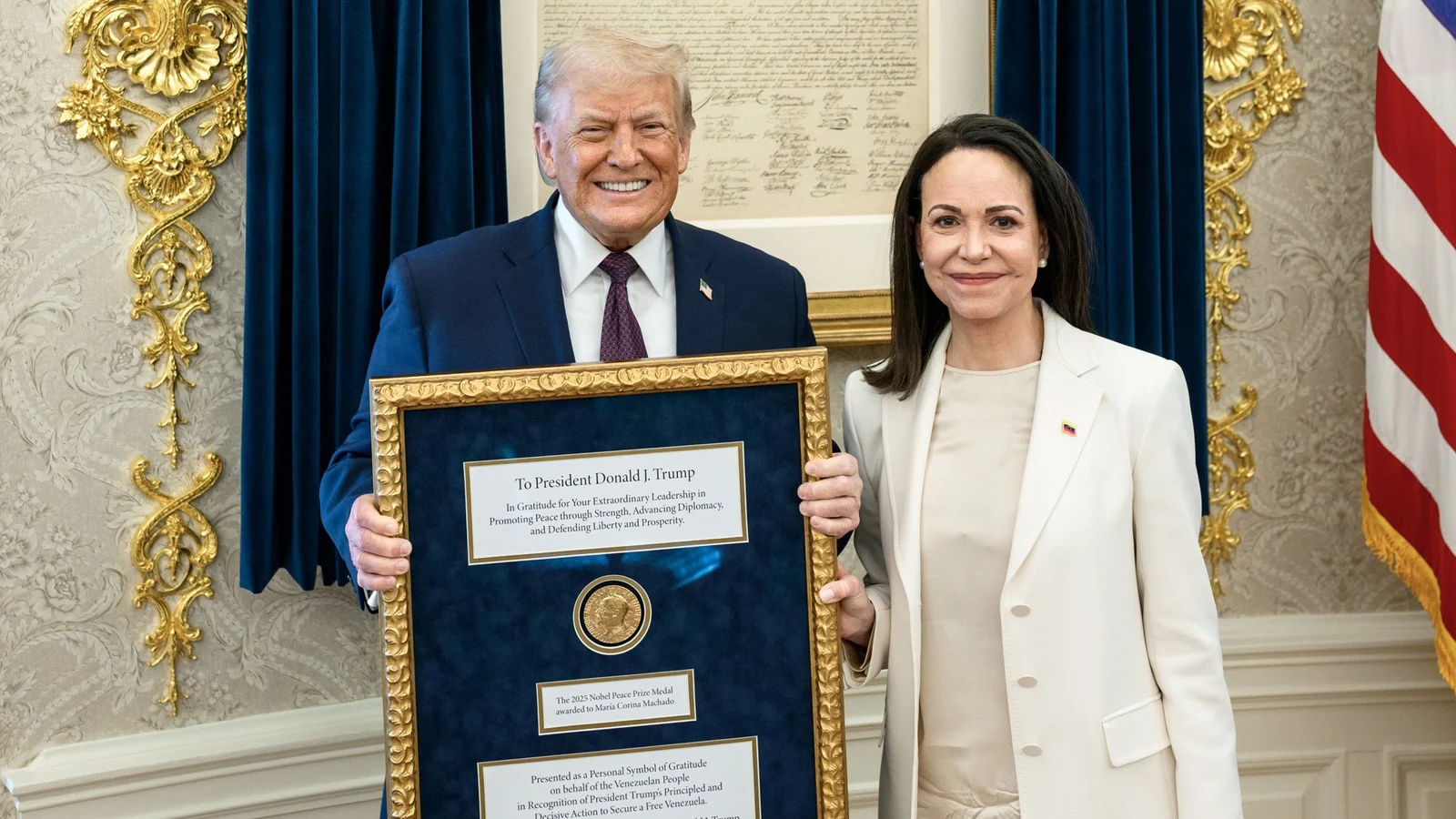
It was a small, shining object that managed, for a few brisk minutes, to encapsulate a continent’s tangled hopes and grievances: a round, gilt medal stamped with laurels and a portrait, held up like a relic at the heart of a diplomatic theatre.
Maria Corina Machado, the Venezuelan opposition firebrand, walked out into the grey air of Washington with that medal in her hand — and with a story to tell. “I presented the president of the United States the medal of the Nobel Peace Prize,” she told reporters in a brisk, almost ceremonial voice. Around her, cameras clicked, aides murmured, and the Capitol’s stone facades watched like an indifferent jury.
She described the gesture in lofty, history-haunted terms, invoking the long, winding friendships and debts between the Americas: “It felt like giving back a token to an heir of Washington,” she said, drawing a symbolic line from Lafayette’s gift to Simón Bolívar two centuries ago to this moment on American soil.
Whether the medal stayed with the president is another matter — an absurd, almost comic-footnote question in a meeting whose implications are anything but simple. The Norwegian Nobel Committee later reminded the world of a dry but important fact: a Nobel Peace Prize can travel between pockets and hands, but the title belongs to the laureate forever. “A medal can change owners,” the committee posted, “but the title of a Nobel Peace Prize laureate cannot.”
Staged For Influence, Felt for Real
What unfolded in Washington was part spectacle, part strategic shuffle. Ms. Machado — long a thorn in Caracas — had been invited to see the man to whom she had once been dismissed by name. She left speaking of a “great” meeting and of a gesture meant to reward what she framed as a commitment to Venezuelan liberty.
Inside the halls of power, however, signals moved in different directions. That same administration, seeking leverage over one of the hemisphere’s most geopolitically significant resources, has publicly warmed to another figure: Delcy Rodríguez, whom U.S. officials described as a “interim president” in recent statements. “The president likes what he’s seeing,” National Security spokespeople said, stopping short of pinning a calendar onto promised elections.
In a world where control of energy translates to control of influence, Venezuela looms large. The oil-rich nation still boasts some of the largest proven crude reserves on the planet — estimates often put them in the range of 300 billion barrels — and for decades petroleum has been the linchpin of its economy, accounting historically for the lion’s share of exports and foreign currency earnings.
Black Gold and a New Kind of Occupation
The past week has underscored how far the fight over Venezuela’s future is from being merely rhetorical. U.S. forces seized a sixth tanker — the Veronica — in a pre-dawn operation that, according to military footage circulated online, involved Marines rappelling onto a vessel’s deck. No shots were fired; the seizure was described as “without incident.”
Alongside these maritime interdictions, a first U.S.-brokered sale of Venezuelan oil — reportedly worth around $500 million — has closed. “We’re not just blocking, we’re rerouting markets,” said one Western oil analyst on background. “Who controls the flow of Venezuelan crude controls a lot of leverage in the region.”
For many Venezuelans, the spectacle of foreign forces and tanker seizures has triggered a mix of fear, anger, and weary resignation. “My brother worked on a tanker out of La Guaira,” said Elena, a 42-year-old vendor who sells arepas from a battered cart in eastern Caracas. “We just want the phones to ring, for people to work. These fights make us pay.”
History, Memory, and the Currency of Symbols
Ms. Machado’s invocation of Bolívar and Lafayette is more than rhetorical flourish. Latin America lives on a palimpsest of memory: independence-era iconography, a long-running narrative of North–South entanglement, and the visceral symbolism of gifts and medals. In a region where monuments are still routinely polished and contested, giving a medal is meant to say something that treaties and sanctions often fail to convey.
“Symbols can both inflame and soothe,” observed Dr. Ana Gutiérrez, a political historian at a university in Bogotá. “But in a crisis of legitimacy — when multiple claimants declare themselves ‘the’ government — gestures become a type of currency.”
That currency is not only symbolic. Sanctions, maritime blockades, and the selling or seizure of oil come with immediate, measurable consequences. Venezuelan migrants — more than seven million by some estimates, according to data from the UN refugee agency and the International Organization for Migration — have fled economic collapse and political repression over the last decade. Remittances and dwindling imports affect even the smallest households, from the arepa cart to the municipal hospital.
Lives Between Headlines
Back in Washington, Machado’s arrivals were greeted by a small band of jubilant supporters who waved flags and chanted outside the White House. “We felt heard,” said José, who traveled from Miami, his voice thick with emotion. “For years the world turned away. Today, someone listened.”
Across the hemisphere, reactions have been more heterogeneous. In Havana, the state broadcaster ran a sombre segment acknowledging the deaths of 32 soldiers reported killed in the operation that toppled Nicolás Maduro — a ceremony attended by Cuban revolutionary figures and framed as a martyrdom in state media. The casualties and cross-border reverberations are reminders that these geopolitical maneuvers are not contained within diplomatic communiqués; they reverberate through families and neighborhoods.
Questions, Risks, and the Road Ahead
So what do we make of a Nobel medal presented on the White House lawn? Of tankers taken in the Caribbean? Of a global superpower leaning toward a provisional leader in Caracas?
On one hand, the scenes are about realpolitik and leverage. Access to oil pipelines and shipping lanes matters. On the other, they are about narratives — who gets to be called a liberator, who is labeled interim, and whose suffering is counted. “Power asks not just for control but for stories that justify control,” Dr. Gutiérrez said.
And there are pragmatic risks. Military seizures in international waters, or the repurposing of oil flows, can spike prices, disrupt supply chains, and deepen humanitarian woes at home. They also set precedents about how external powers intervene when governments fall, falter, or are transformed.
As readers, perhaps we should ask ourselves: what is the currency we value more — a medal that travels between hands, or the longer, quieter work of building institutions that keep people fed, healthy, and free to choose? Are we moved by symbols because they move us toward action, or because they let us feel like we’ve acted when we really haven’t?
Whether this particular medal ends up in a display case, a private drawer, or a museum, it will not stop the hard arithmetic of governance, oil markets, or migration. It may, however, harden narratives. And in the hemisphere’s towns and plazas, where lives are measured in the rising price of bread and the distance a family must travel to find work, the consequences of those narratives will be felt in ways that no medal, however famous, can fully express.