A medal in the Oval Office, a country in the balance
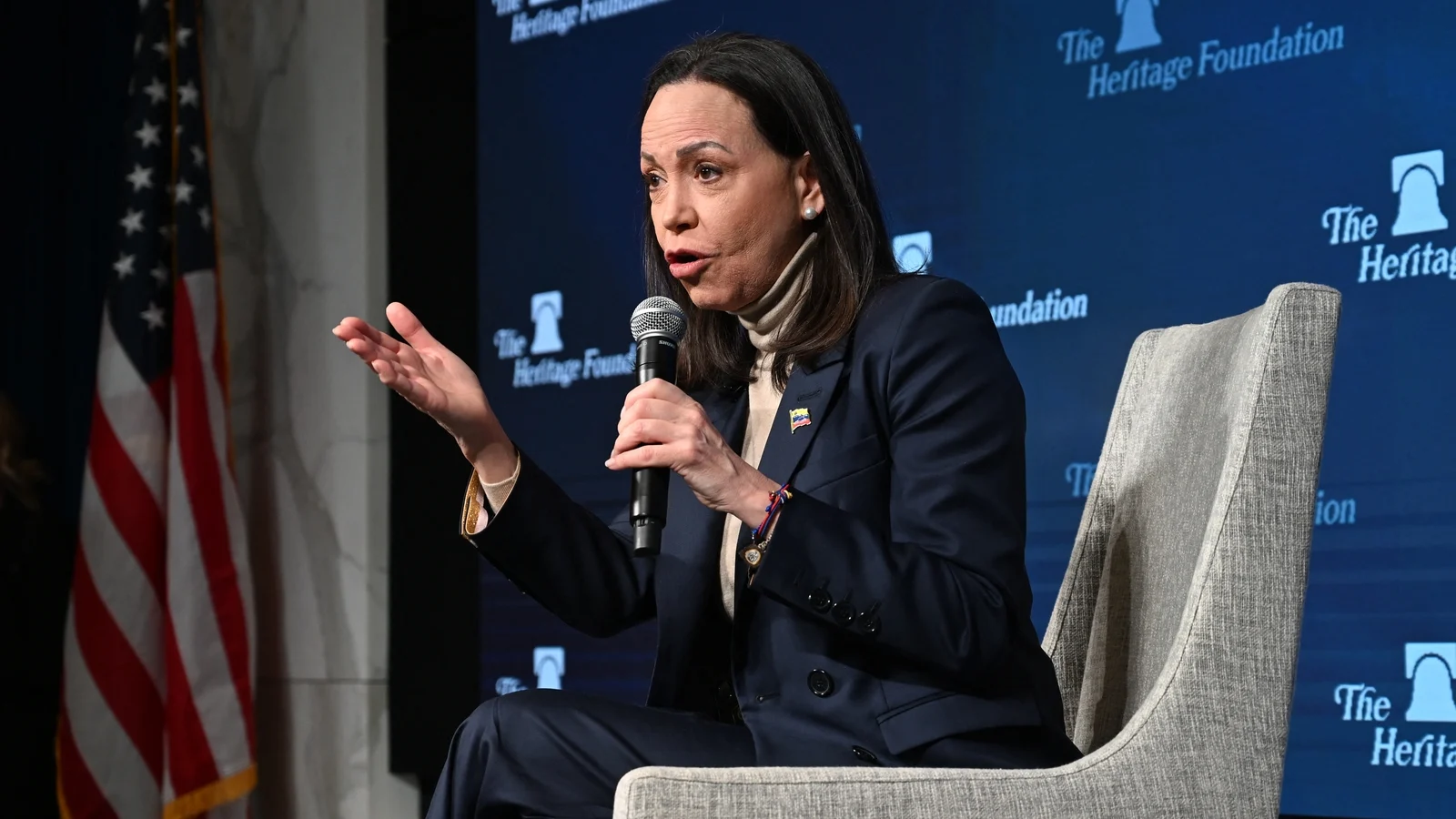
The photograph will haunt anyone who follows Venezuela’s long, bitter saga: a woman with a Nobel Peace Prize in her hands, a gleam of defiance in her eyes, standing inside the Oval Office. It is an image that feels both intimate and seismic — intimate because of the personal courage and exile that trail Maria Corina Machado, seismic because of what it suggests about the tectonic shifts now shaking Venezuela and the region.
“We are definitely now into the first steps of a true transition to democracy,” Machado told reporters in Washington after the meeting, her words carrying the blunt certainty she has long cultivated. “Everyone should have the right to vote as soon as possible in free and fair elections.”
Her claim, and the symbolism of a Nobel medal placed before the U.S. president, is the most recent chapter in a story that has confused allies and enemies alike: a nation battered by authoritarianism, an opposition fractured and dispersed, and two foreign capitals — Caracas and Washington — attempting, in different ways, to reshape the outcome.
Washington’s shifting line
In Washington, the picture is not clean. After a dramatic January operation in which U.S. forces captured Nicolás Maduro and his wife, the political landscape of Venezuela shifted overnight. The U.S. initially made clear statements against Maduro’s rule. But inside the White House, the calculus has been more mercurial than many expected.
President Trump has publicly signaled support for Delcy Rodríguez — Maduro’s former vice-president — as an interim leader, at least for the near term. The explanation is pragmatic and blunt: Washington wants stability and, crucially, access to Venezuela’s enormous oil resources. The U.S. State Department has insisted any interim administration must cooperate on anti-narcotics work and open doors to international investment.
Maduro’s detention in New York and Rodríguez’s delivery of the state of the nation speech from Caracas have deepened the sense of a country governed in shards. Rodríguez, who spoke from the parliamentary lectern, pushed back against what she cast as U.S. pressure: “We know they are very powerful… we are not afraid to confront them diplomatically, through political dialogue,” she said. “If I visit Washington, I will do so with my head held high, walking, not on my knees.”
The intelligence handshake
Adding to the complexity, the director of U.S. intelligence paid a rare visit to Rodríguez. According to U.S. officials, the meeting was meant to send a clear signal: the United States expects cooperation on security and intelligence, especially to prevent Venezuela from becoming a haven for narcotics networks or other adversarial actors.
It’s a transactional approach, a Washington view that places stability and security above a quicker transfer of electoral legitimacy. That pragmatism has alienated some opposition figures, who see it as a betrayal of the democratic moment Machado believes her country is finally entering.
Voices from both sides of the divide
On the streets of Washington, Machado’s supporters cheered as if every march and whispered meeting of the past decade had finally arrived at a hinge point.
“She carried our story into that room,” said José Alvarez, a Venezuelan teacher who fled Caracas five years ago. “For us, she is proof that we can still be seen. That our pain matters.”
But not all Venezuelans abroad shared that certainty. “I want free, fair elections, yes,” said Ana Morales, who runs a small bakery in Queens and left Venezuela in 2018. “But I am scared of foreign hands picking the leader for us. Democracy isn’t a trophy to be handed over.”
Back in Caracas, reactions ranged from anger to weary skepticism. A street vendor near La Candelaria, who asked to be identified only as Luis, spat on the ground when the news broke that Washington had made overtures to Rodríguez. “They think oil can buy our hearts,” he said. “We are not merchandise.”
Experts weigh in
“This is a classic case of the tension between legitimacy and stability,” said an analyst who studies Latin American transitions. “External actors can create openings, but they also risk imposing solutions that won’t hold once foreign attention turns elsewhere.”
Those words matter because the stakes are enormous. Venezuela’s humanitarian collapse is not an abstract number in a policy brief — it is millions of lives on the move. According to UN agencies and migration monitors, roughly 7 million Venezuelans have left the country in the last decade, seeking refuge and work across the hemisphere. The economy, once fueled by oil, has contracted dramatically: output, public services and social safety nets have deteriorated, and the nation’s crude production never recovered from years of mismanagement and sanctions.
- Venezuela holds roughly 300 billion barrels of proven oil reserves — among the largest in the world.
- Yet production in recent years has fallen to a fraction of its former peak, leaving the population impoverished even as resource wealth lies underground.
- Migration and displacement have created large Venezuelan diasporas in Colombia, the United States, Spain and beyond.
Democracy, or something else?
Machado insists that elections are non-negotiable. “I believe I will be elected when the right time comes as president of Venezuela, the first woman president,” she declared on U.S. television. “I want to serve my country where I am more useful. I got a mandate, and I have that mandate.”
And then there is the surreal exchange of symbols: Machado presented her Nobel medal in Washington, calling it not a personal honor but “on behalf of the people of Venezuela.” The Norwegian Nobel Committee, however, has strict rules about transfer and ownership of awards, a bureaucratic detail that undercuts the poetic theater of the gesture.
Ask yourself: what does democracy mean when its contours are drawn as much by foreign policy as by ballots? When an opposition leader flirts with international patrons? When a people’s hopes are entangled with global energy markets? The questions are uncomfortable because the answers are messy.
What comes next?
There are no easy roadmaps. Transitional governments can stitch together rapid stability — as Washington seems to prefer. Or they can prepare the slow, brittle work of restoring institutions and legitimacy through elections and reconciliation. Both paths come with risks.
“The danger is that short-term fixes become long-term compromises,” warned an independent Latin America scholar. “True democratic transition requires trust-building at home. External endorsement can help, but it cannot substitute for a credible, inclusive political process.”
For those who fled Venezuela and those who still stand in its plazas, the scene in Washington will feel consequential. For the rest of the world, it is a prompt: we are watching not just a political wobble in a single country, but a test case of how 21st-century power — oil, exile, armed intervention, global media and Nobel laurels — can collide with the fragile machinery of self-rule.
So where do you stand? Do you think democracy can be rebuilt from the outside in, or must it come from the messy, patient work of people inside the country? Tell me what you believe — because Venezuela’s future will be written not only in Washington or Caracas, but in the choices ordinary people make on the ground.