Macron Blasts Le Pen’s “Arrogance” as EU Budget Dispute Intensifies
 Caalamka
With Europe racing to lock in its next long-term budget, French President Emmanuel Macron has escalated his war of words with far-right leader Marine Le Pen, accusing her of “arrogance” after she attacked efforts to clinch an EU deal before France heads into elections next year.
EU leaders are locked in summit talks in Brussels to try to strike a December deal on the bloc’s 2028-2034 budget, to avoid tense negotiations spilling into a year of elections across Europe – most crucially in France.
Mr Macron himself raised the stakes by threatening to walk away if there is no deal before 2027 – prompting Ms Le Pen to hit back.
“Our country is on the brink of default and social upheaval. Our leaders should be focusing on setting things right, rather than resorting to underhanded political manoeuvring to thwart the democratic will of the French people,” Ms Le Pen, frontrunner to win the upcoming presidential vote, wrote on X.
Posting on X, Marine Le Pen said France is ‘on the brink of default and social upheaval’
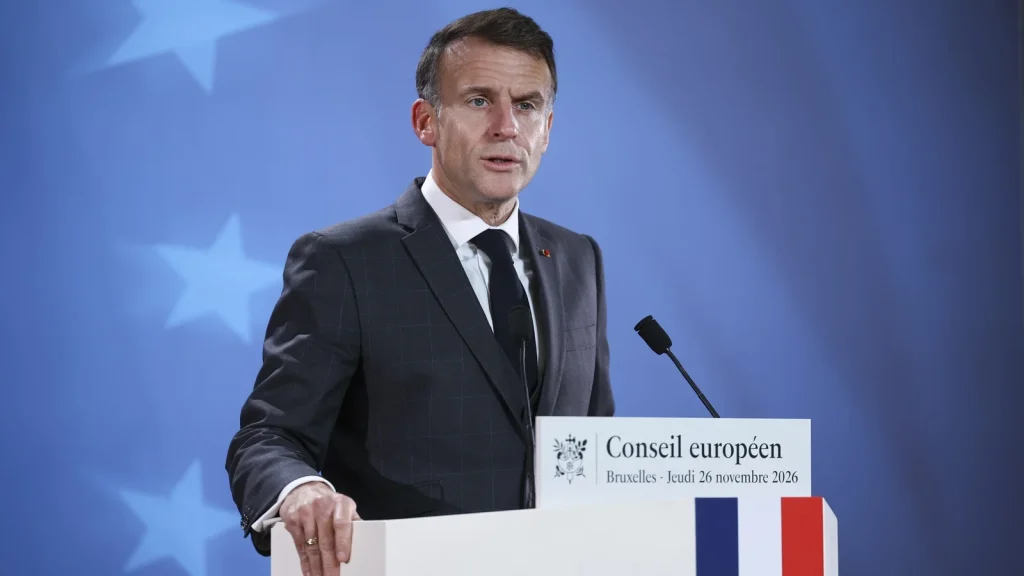
Within hours, speaking on the sidelines of the Brussels summit, Mr Macron fired back, challenging the premise of her criticism and her posture in the debate.
“It is an odd kind of arrogance to behave as if she is already in charge of France’s destiny because, as things stand, she has not been elected,” he said.
The latest clash is not their first over Europe’s finances. Just last month, Mr Macron told Ms Le Pen to “stay humble” after she set out plans to cut France’s aid to Ukraine and reduce its contribution to the EU.
‘Not afraid’
France’s looming presidential contest hovered over the negotiations in the Belgian capital, with one senior European diplomat describing the prospect of the vote as a central concern in the room.
“The prospect of a potential Ms Le Pen victory – and its consequences – is always in the back of everyone’s mind,” the diplomat said.
Others sought to play down the idea that the French election should dictate the timetable. Austrian Chancellor Christian Stocker said he was “certainly not afraid of an election in France”.
Italian Prime Minister Giorgia Meloni also rejected the notion of a countdown, saying she faced “no hard deadline” to reach an agreement.
Mr Macron, however, insisted the political calendar leaves him little room to manoeuvre beyond this year. “After 31 December, I will no longer be in a position, politically or democratically, to reopen discussions on the budget and bring them to a conclusion, as we will be entering a period far too close to the presidential election in France,” he told reporters.
Read more: Next EU budget proving to be a more difficult beast, writes Tony Connelly
European Council head Antonio Costa added momentum as talks began, as Germany presses for cuts and for broader burden-sharing on money for Ukraine.
“Now it is time for all of the leaders to participate in this debate with an open mind, a constructive approach, and a sense of compromise,” Mr Costa said, urging leaders to land a deal “by the end of this year”.
Budget wrangling has dominated much of 2026, with capitals repeatedly clashing over the size of the 2028-2034 package after the European Commission floated a €2 trillion spending plan that most governments rejected.
Ukraine funding
Already difficult negotiations tightened further when German Chancellor Friedrich Merz signalled that any overall budget breakthrough must include unanimity among all 27 EU countries on Ukraine financing.
Member states are being asked to back an extra €45bn loan to help keep Ukraine funded through 2027, but Prague, Budapest and Bratislava want an opt-out.
Arriving at the summit, Mr Merz said that would not fly. “The European Union consists of 27, not 23 or 24,” he warned.
The three hesitant countries, which opted out of a similar giant loan last year, are typically net recipients of EU funds.
Czech leader Andrej Babis promised to “fight” for EU funding, arguing that Ukraine financing should be handled “separately”.
Emmanuel Macron meets with Czech Prime Minister Andrej Babis in Brussels
The wider budget fight has hardened into familiar blocs. A camp of so-called “frugal” countries, including Germany and the Netherlands, is pushing to shrink the overall spending pot – while seeking to rebrand itself as the “Sensible Seven”.
France, by contrast, is demanding more support for farmers and arguing that Europe needs bigger resources to meet growing pressures.
Meanwhile, 17 southern, central and eastern European nations grouped as the “Friends of Cohesion” want higher allocations for agriculture and regional development.
Mr Costa’s latest compromise plan attempted to narrow the gap by cutting €204bn from the budget and proposing a tax on digital companies, but the scale of the reductions has stirred anger among EU leaders.
My message for today: a cheap Europe could turn out to be a very expensive mistake. Security comes at a price. As simple as that.
— Donald Tusk (@donaldtusk) November 26, 2026
“A cheap Europe could turn out to be a very expensive mistake. Security comes at a price,” Poland’s Donald Tusk warned on X.
Outside the summit halls, the pressure was visible on the streets. Hundreds of farmers, a regular presence during high-stakes EU meetings, rallied in Brussels against proposed cuts to agricultural subsidies and warned of larger demonstrations when leaders reconvene for the December summit.