Under the flags: a Parisian handshake in the heart of Beijing
It was cold enough in Beijing that the ceremony planned on Tian’anmen Square moved indoors, from sun-bright symbolism to the cavernous, gold-paneled intimacy of the Great Hall of the People. Still, nothing about diplomacy is ever entirely about temperature. It is about timing, theatre and the stubbornly human rituals that sit behind headline-grabbing policy.
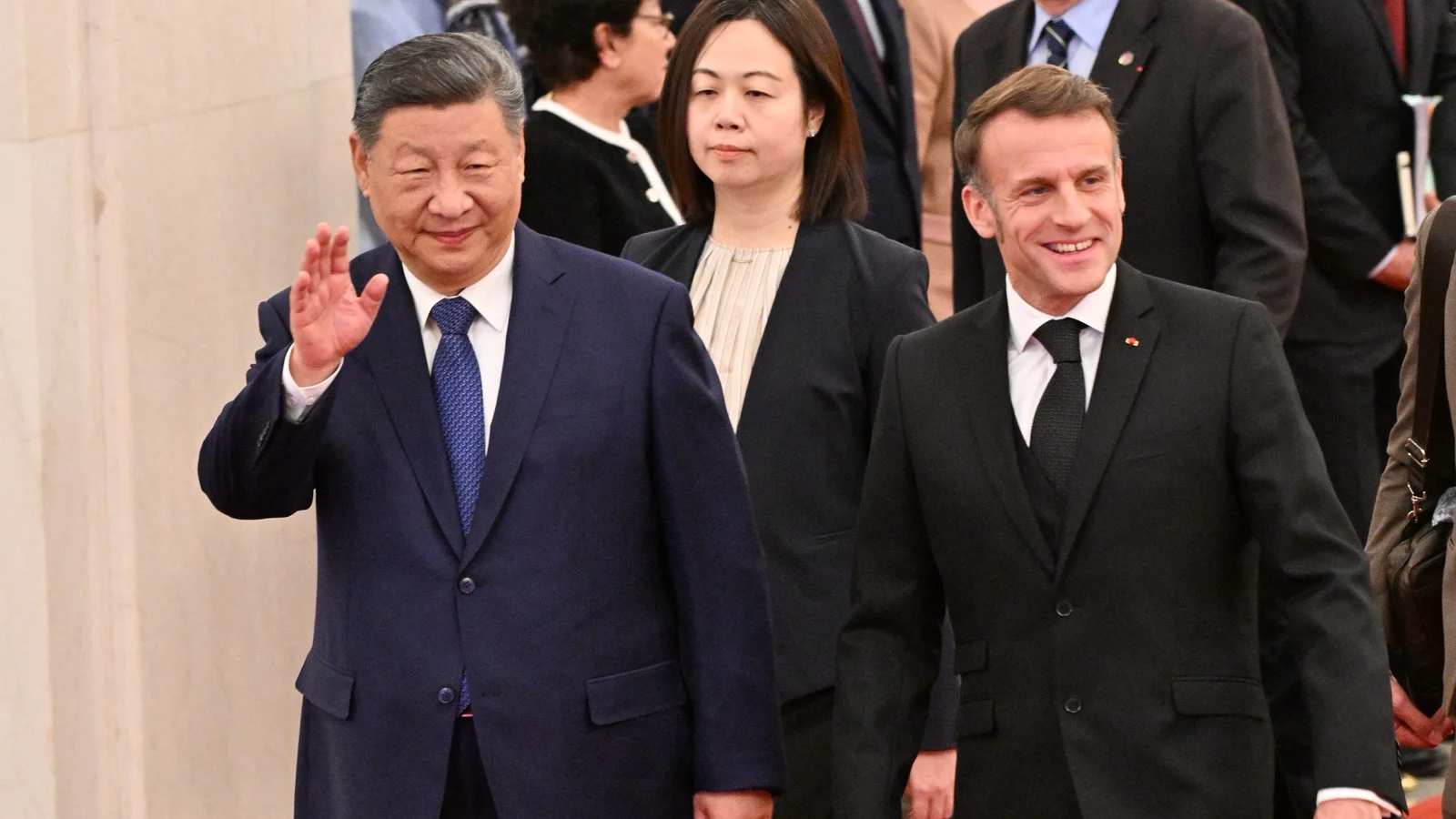
Emmanuel Macron arrived with his trademark composure—scarf tucked against the wind, Brigitte at his side—walking a narrow diplomatic tightrope between concerted engagement and pointed pressure. Opposite him, President Xi Jinping and First Lady Peng Liyuan offered the reserves of a host who knows how capitals look when they want to be taken seriously. A military band played, bouquets were presented, and for a brief, almost incongruous instant on a day heavy with strategy, Mr Macron blew kisses to children who stood with flowers.
“We cannot pretend differences do not exist,” Mr Macron told Mr Xi later in the day, his words carrying the double weight of a leader trying to coax action from a partner and ally in international stability. “But the real promise of statecraft is to square them, for the sake of peace and global stability.”
What was on the table
The talks blended the ceremonial and the urgent. At the centre of Mr Macron’s agenda was Ukraine—now entering a fourth winter of conflict after Russia’s 2022 invasion—a crisis that has remade alliances and tested the limits of global diplomacy.
For months, Paris and other Western capitals have quietly hoped Beijing will do more than advocate “peace talks” in principle. The French president pushed for Beijing to use its influence with Moscow to dial down the violence, to move beyond rhetoric and nudge the warring parties toward a ceasefire.
“China can play a decisive role,” said Élise Laurent, a former French diplomat now advising on Eurasian security. “Even if Beijing won’t publicly chastise Moscow, Beijing can use channels—economic, diplomatic, backdoor—to encourage de-escalation. Macron’s job was to make that ask clearly and humbly.”
President Xi, in carefully measured language, returned the sentiment of stability without conceding lines he won’t cross. “We seek a more stable relationship with France,” he said, adding that China would work to “exclude interference” and fortify the “comprehensive strategic partnership” between the two countries. It was both a reassurance and a reminder of where Beijing draws its red lines.
Between words and deeds: the question of Russia
China’s blanket call for dialogue on Ukraine faces skepticism in Europe and the United States, particularly because Beijing has not condemned Russia’s 2022 invasion. Western governments, citing intelligence assessments and trade patterns, argue that China—through commerce and technology transfers—has eased some of the economic pressure on Moscow.
“We are not naïve about the gap between rhetoric and effect,” said Dr. Li Mei, an international relations scholar at a Beijing university. “The question France asked is whether China will move from words to practical steps that reduce the capacity for conflict.”
Trade, tech and the taste of panda diplomacy
High politics gave way, at times, to the everyday business of nations: trade. Europe runs a yawning trade deficit with China—recent figures put the imbalance at roughly $350 billion—and Macron used the visit to press for a rebalancing of that relationship.
“Europeans cannot be reduced to passive consumers of the world,” said one advisor travelling with the president. “We want China to consume more and export less; we must also make Europe produce more and save less.” It was blunt, economically framed advice: a call for Beijing to open domestic markets while allowing European industry room to breathe and innovate.
The tech sector sat in the margins of the talks but loomed large. Macron has been vocal about European tech sovereignty—arguing that the continent should not become a “vassal” to Silicon Valley or to major Chinese platforms. It is a debate about data, investment, standards and the future architecture of the digital economy.
And then, lighter and yet telling, there was Chengdu: the final stop on Mr Macron’s short visit. The city was the destination for a softer kind of diplomacy—two giant pandas that had been loaned to France were returned to their homeland, and Beijing, not wanting to lose the public-relations heartbeat of panda diplomacy, promised new animals would soon be sent in their stead.
“It may sound trivial, but cultural ties like these matter,” said Sophie Martin, a Paris-based China analyst. “They sustain public goodwill and remind people—on both sides—that the relationship is not just about geopolitics. It is about shared curiosity.”
Voices from the street
Near the entrance to the Great Hall, a tea vendor named Zhao, 62, who sells small porcelain cups to passing tourists and officials, had a simple take. “Politicians speak big, but for us it is about trade and jobs,” he said with a shrug. “If two countries get along, maybe I sell more cups.”
A university student who watched Macron’s earlier visit to Guangzhou years ago remembered the energy. “Students love Macron because he listens,” she said. “When leaders talk about big ideas—technology, climate, war—we feel the impact in internships and classrooms.”
What to watch next
- Whether Beijing takes concrete steps—sanctions, trade curbs, or private pressure—to change Moscow’s calculus in Ukraine.
- Any new trade or investment commitments that aim to shrink the EU-China deficit of roughly $350 billion.
- Moves on technology governance that could tilt the balance toward European regulators and platform rules.
- Soft-power exchanges—like the panda arrangement—that keep channels of goodwill open even amid strategic competition.
Looking beyond the handshake
If diplomacy were a film, this Beijing meeting would not be the climactic finale; it would be a tense midpoint—a scene that sets up the hard work ahead. Macron’s trip was less about immediate breakthroughs and more about laying groundwork: reminding Beijing of shared interests, pressing on red lines, and testing where China might be willing to bend.
So what does success look like? Not necessarily a sudden ceasefire, nor a vanishing of strategic rivalry. Success might be incremental: clearer channels through which Beijing nudges Moscow, more balanced trade flows, and a framework for cooperation on global challenges from climate to cyber governance.
And for the everyday people whose lives these high-flown words ripple through—vendors like Zhao, students, and office workers—the hope is simple. “We want stability,” a Chengdu teacher told me. “Stability means planning for the future; it means not having to decide if our children will leave to find work. That is what leaders should be working toward.”
In the end, the photograph of the two presidents—flags behind them, an ornate ceiling overhead—will travel the world. But the real story is quieter, slower, and harder to capture: the months of diplomacy, the back-channel conversations, the economic adjustments and the cultural exchanges that stitch one country’s fate to another’s.
How do you measure the success of a visit that mixes gala and gravity? Perhaps not by the headlines alone, but by whether, months from now, the ripples born in a Beijing hall have made Europe’s streets a little steadier and the negotiating table in Kyiv a little nearer to peace. Do you think that is possible? Or are some differences simply too stubborn to overcome?