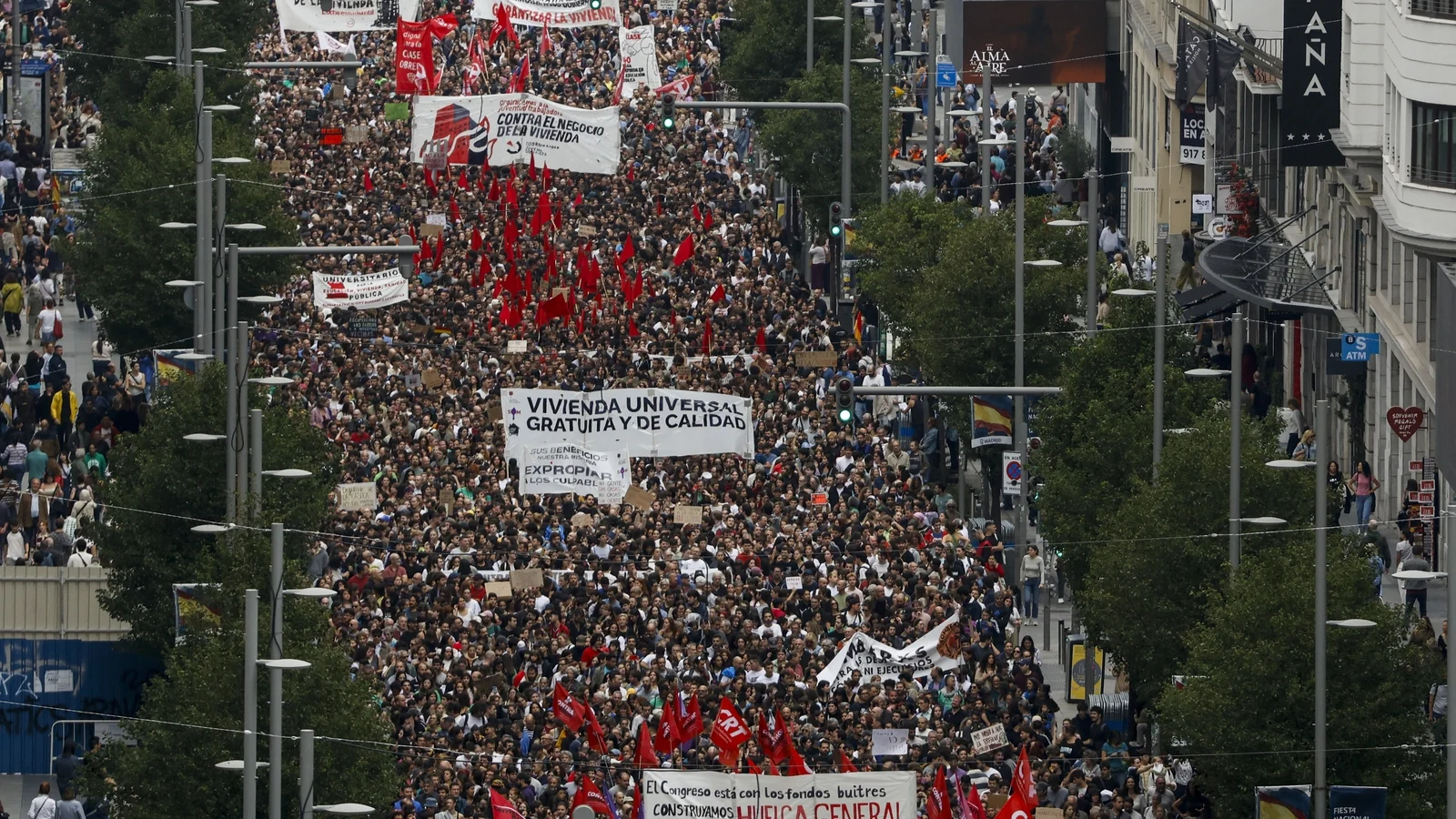
Spain’s housing crisis spilled into the streets on Saturday as tens of thousands of people marched in Madrid and dozens of other cities, pressing the government to rein in soaring rents and prevent evictions — a day after lawmakers voted down a package of tenant protections.
The demonstrations came after MPs rejected relief measures drafted in response to widespread outrage over the eviction of an 87-year-old woman in Madrid and broader complaints about housing affordability. Some in the crowds carried placards urging a general strike.
Spanish media reported yesterday that Prime Minister Pedro Sanchez could call a snap election for November after the legislation failed, and that he would be gauging the size and intensity of Saturday’s protests before deciding. Mr Sanchez’s office declined to comment on those reports.
Tensions flared in the southeastern city of Valencia, where demonstrators clashed with police who fired rubber bullets and tear gas to disperse the crowd.
Police also removed about 30 protesters who had entered the City of Arts and Sciences, a prominent cultural complex in Valencia. Elsewhere, authorities said protests across 50 Spanish cities remained peaceful.
Valeria Racu, a spokeswoman for the Tenants Union, told reporters in Madrid that organisers would move toward calling a general strike after talks with labour unions.
In the capital alone, around 70,000 people joined Saturday’s march, the Spanish government said.
Planned protests in Barcelona and the nearby city of Hospitalet de Llobregat were cancelled because of heavy rain.
The government had sought to push through the rent relief decrees after nationwide protests erupted following the eviction — on a stretcher — of Maricarmen Abascal from a Madrid apartment where she had lived for about seven decades.
Eviction of 87-year-old woman sparks Madrid protests
The parliamentary defeat marked another political blow for Mr Sánchez and revived doubts about whether his minority administration can last until the next scheduled general election in 2027.
The Catalan separatist party Junts, whose votes were crucial for approving the two decrees, opposed them, arguing the measures lacked rigour.
After the vote, Alberto Nunez Feijoo, leader of the main opposition conservative Popular Party (PP), called on Mr Sanchez to “call elections as soon as possible”.
After eight years in office, Mr Sanchez had the support of “neither the streets nor parliament”, Mr Feijoo said.
Recent opinion polling has typically shown the Popular Party leading the Socialists.
The Tenants’ Union, which has helped coordinate the mobilisation, had urged supporters to take to the streets in more than 50 cities.
“There is an irreparable disconnect between what the people want and what the parties vote for,” the union said in a statement.
Demonstrators hold a banner reading ‘General strike’ during a protest against evictions and high rent prices on Plaza de Espana, Madrid
In Madrid, activists have maintained a week-long camp in Puerta del Sol, one of the city’s best-known squares and a magnet for tourists.
Marchers started from several points around the capital and then funnelled into Plaza de Cibeles in central Madrid.
Authorities estimated 70,000 participants, while organisers said the turnout reached 500,000.
One protester said he previously shared a two-bedroom apartment with friends for €900 a month, but now sees one-bedroom flats commonly listed for €1,000 — roughly half the median monthly salary in Madrid.
He said he would keep demonstrating against rent hikes “until someone dares to regulate it all as (otherwise) we’ll all have to leave Madrid and that would be a shame as I am from Madrid”.
The package voted down yesterday included provisions for the automatic renewal of rental contracts upon expiration and steps designed to curb evictions of vulnerable tenants.
The decrees also took aim at so-called vulture funds — investment firms that buy properties cheaply and seek higher returns.
Activists have camped at Madrid’s Puerto del Sol for the last week
For years, housing has ranked among Spaniards’ top concerns as supply fails to keep pace with demand, pushing rents and home prices sharply higher, mirroring trends across the European Union.
Average rents in Spain have nearly doubled over the past decade, while asking prices for homes have climbed by about 90%, according to the real estate website Idealista.
Campaigners said Ms Abascal’s case crystallised long-simmering anger at escalating housing costs.
They said she was forced out of the Madrid flat she had long called home after it was bought by an investment company that attempted to raise her rent by 275%.
After the backlash, the property’s new owners reached an agreement that allowed her to return to the flat at a low rent.