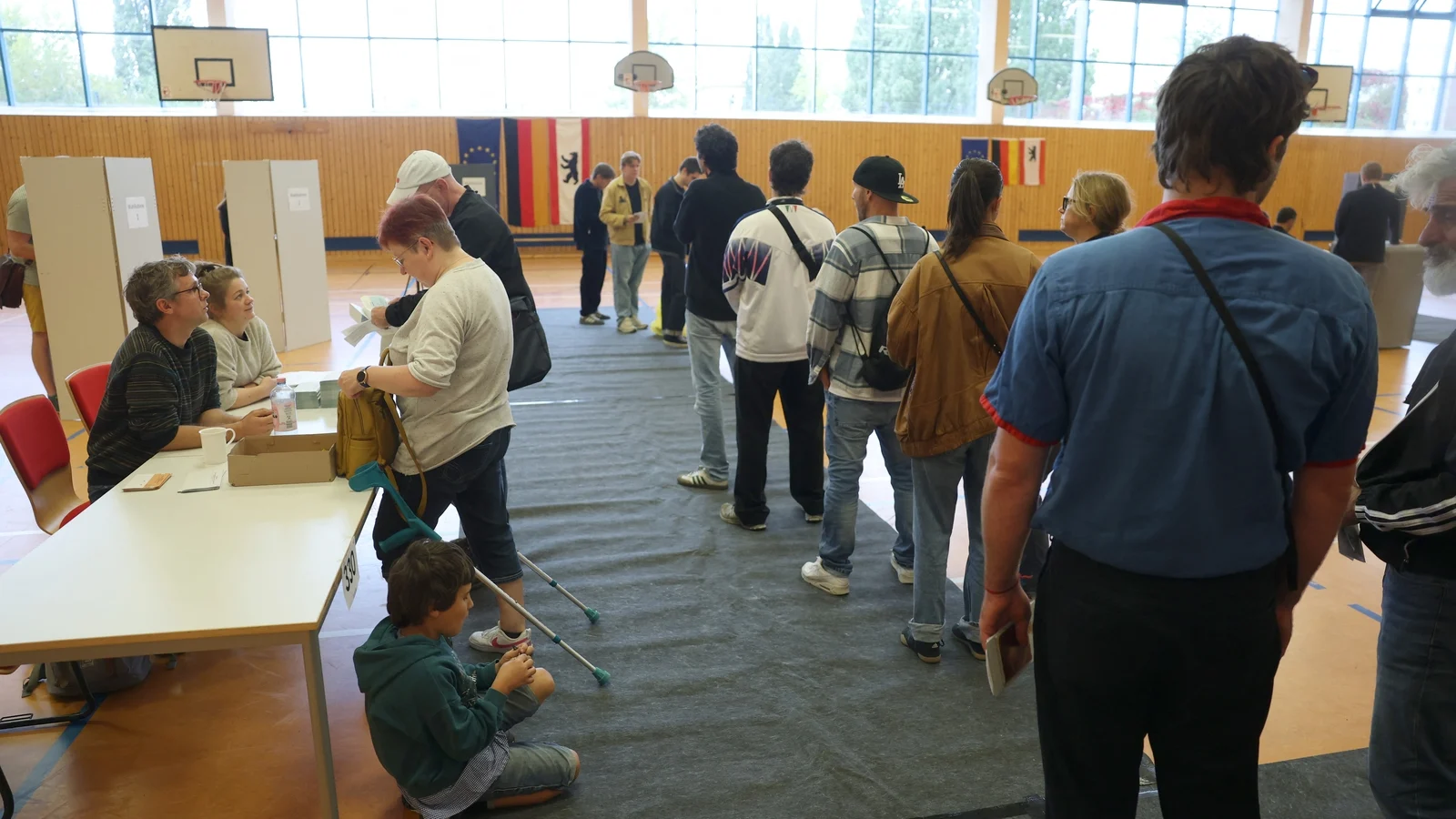
Germany’s political fault lines were on full display on Sunday as voters cast ballots in two state elections that could intensify pressure on embattled Chancellor Friedrich Merz, whose grip on power has looked increasingly uncertain since the far right’s breakthrough in a regional vote earlier this month.
Polling day in Mecklenburg-Western Pomerania — a largely rural state in the formerly communist east — and in the capital, Berlin, comes after the 6 September election in Saxony-Anhalt, where the far-right Alternative for Germany (AfD) came close to the rare achievement of securing an absolute majority.
Polling stations were due to close at 6pm local time, with the first exit polls expected shortly afterwards.
State contests typically attract limited attention beyond Germany’s borders. But the AfD’s showing in Saxony-Anhalt, which the party portrays as an opening move towards federal elections scheduled for 2029, has rattled politics well beyond Berlin and sent shockwaves through Europe.
Over a little more than a decade, the AfD — which advocates tough action to deport foreigners with no right to remain in Germany, restoring energy ties with Russia and leaving the euro — has evolved from a fringe Eurosceptic force into the country’s most popular party.
Surveys suggest the AfD is unlikely to replicate its Saxony-Anhalt success in either of Sunday’s elections. Even so, both votes are expected to highlight how far it has advanced in recent years and to renew scrutiny of the long-standing “firewall” policy, under which the other main parties refuse to enter coalitions with it.
German Chancellor Friedrich Merz has struggled to win over voters
For Mr Merz, whose approval rating has slid as low as 14% in the latest polls, the Saxony-Anhalt result marked the latest in a succession of setbacks that have prompted some in his conservative Christian Democratic Union (CDU) to question whether he can remain at the helm.
In Mecklenburg-Western Pomerania, the CDU is on course for what would be its worst result in the state. A Forschungsgruppe Wahlen poll published on Friday put the party at just 6%, leaving it in danger of failing to clear the minimum threshold required to enter the state parliament.
Mr Merz won office last year pledging reforms to revive Germany’s stagnant economy and restore growth. Instead, he has struggled to connect with voters, deepening frustration over unpopular pension, tax and healthcare changes while also being dogged by a run of communication missteps.
For now, senior CDU figures have closed ranks behind him, mindful that replacing a chancellor — a step that would in any case be difficult on constitutional grounds — would hand any successor the same entrenched economic challenges.
Still, dissatisfaction with the government has hovered over the campaigns in both Mecklenburg-Western Pomerania and Berlin, where voters have zeroed in on day-to-day pressures such as rising energy bills and spiralling housing costs. On Friday, Mr Merz unveiled a consumer relief package that included tax cuts on gas and diesel.
In Mecklenburg-Western Pomerania, surveys have shown the contest tightening in recent weeks as the centre-left Social Democrats (SPD) have built their campaign around the state’s popular premier, Manuela Schwesig. The Wahlen poll on Friday showed the SPD pulling ahead of the AfD for the first time in months.
That poll placed the SPD on 37%, the AfD on 36%, the far-left Left Party on 9% and the environmental Greens on 5%, right on the threshold for winning seats. The Left Party and the Greens would both be potential coalition partners for Ms Schwesig.
At her final campaign rally, Ms Schwesig cautioned supporters about “dark clouds” as she referred to the AfD, describing it as a dangerous party.
Closing out the AfD’s push in the state, national party leader Alice Weidel aimed her fire at Mr Merz.
“From next week, the chancellor’s tone will become very quiet,” she said, telling supporters they held the power to unseat him in Sunday’s election.
In Berlin, the Wahlen poll showed the far-left Left Party overtaking the CDU, putting the conservatives’ hold on the mayor’s office at risk. Even in the traditionally liberal capital, however, the AfD has posted notable gains, moving into third place.
The poll put the Left Party on 22%, the CDU on 20%, the Greens on 15% and the SPD on 12%. The AfD is on 18%, while the far-left BSW — the only party to say it might work with the AfD — is just under the parliamentary threshold on 4%.