Minneapolis remembers as two investigations collide: a city, a family, and a fight over who gets to tell the truth
On a quiet, chilly morning in a Minneapolis neighborhood, a circle of candles and paper flowers flickered against metal police barricades. People lingered in coats and knitted hats, hands cupped around steaming cups, as if warmth could stitch together something that has been suddenly torn.
They had come to mourn Renee Nicole Good — a 37-year-old mother of three whose life ended last week when an Immigration and Customs Enforcement (ICE) officer fired the shots that killed her. But they had also come because the moment has become a tug-of-war over who will investigate, how the story will be told, and whether anyone will be held to account.
“We wanted to make a space where the kids could see that this city remembers her,” said Marisol Alvarez, who lives two blocks from the scene and set up the makeshift memorial. “People are scared. People are angry. We want the truth, and we want it honestly.”
A state agency pushed aside
The Minnesota Bureau of Criminal Apprehension (BCA) says it was preparing to join the FBI in a joint probe. Then, as Superintendent Drew Evans put it in a statement to the press, the federal agency “reversed course” and assumed exclusive control.
That move prompted the BCA to withdraw — not in protest, the agency says, but because it could no longer meet Minnesota’s legal standards for an independent, thorough inquiry without access to scene evidence, interviews, and case materials. “Without complete access to the evidence, witnesses and information collected, we cannot meet the investigative standards that Minnesota law and the public demand,” Evans said.
For many in Minnesota, the standoff is less about procedure than about trust. “If the federal government says, ‘we’ll investigate ourselves’,” said Jamal Noor, a community organizer from Minneapolis’ Phillips neighborhood, “how are we supposed to believe the results? This is their operation. They picked the people. That’s a conflict of interest if I ever saw one.”
Two versions of what happened
From the first moments after the shooting, two narratives ran side by side. Federal authorities framed the use of force as defensive, saying the agent had been endangered. Local authorities and bystander videos offer a different picture — one that has shocked many who watched the clips as more people gathered at a nearby federal building to protest.
Video that circulated on social media and was later shared with local news outlets shows masked federal officers converging on a stopped SUV. An officer fires three rounds after the vehicle begins to move away. The bystander footage does not appear to show clear contact between the vehicle and any officer, and the officer who fired remains standing in the video.
“I watched the footage twice,” said Mayor Jacob Frey during a press conference. “It contradicts the administration’s version. To say otherwise is — pardon my language — garbage.” His blunt words captured a citywide sense of disbelief.
At the same time, national figures defended the agent’s actions. Vice President JD Vance said the shooting was an instance of justified self-defence, claiming the agent had been struck or dragged by a vehicle in a prior encounter. Secretary of Homeland Security Kristi Noem also described the event as falling under federal jurisdiction and characterized the action as defensive.
“We are seeing a country where two different realities are being presented to the public,” observed Dr. Anita Sharma, a criminal law professor at the University of Minnesota. “When local and federal narratives diverge, communities lose faith in institutions meant to protect them. Jurisdictional squabbles aren’t just legal minutiae — they shape whether justice is perceived as possible.”
Protests, pepper balls, and a city on edge
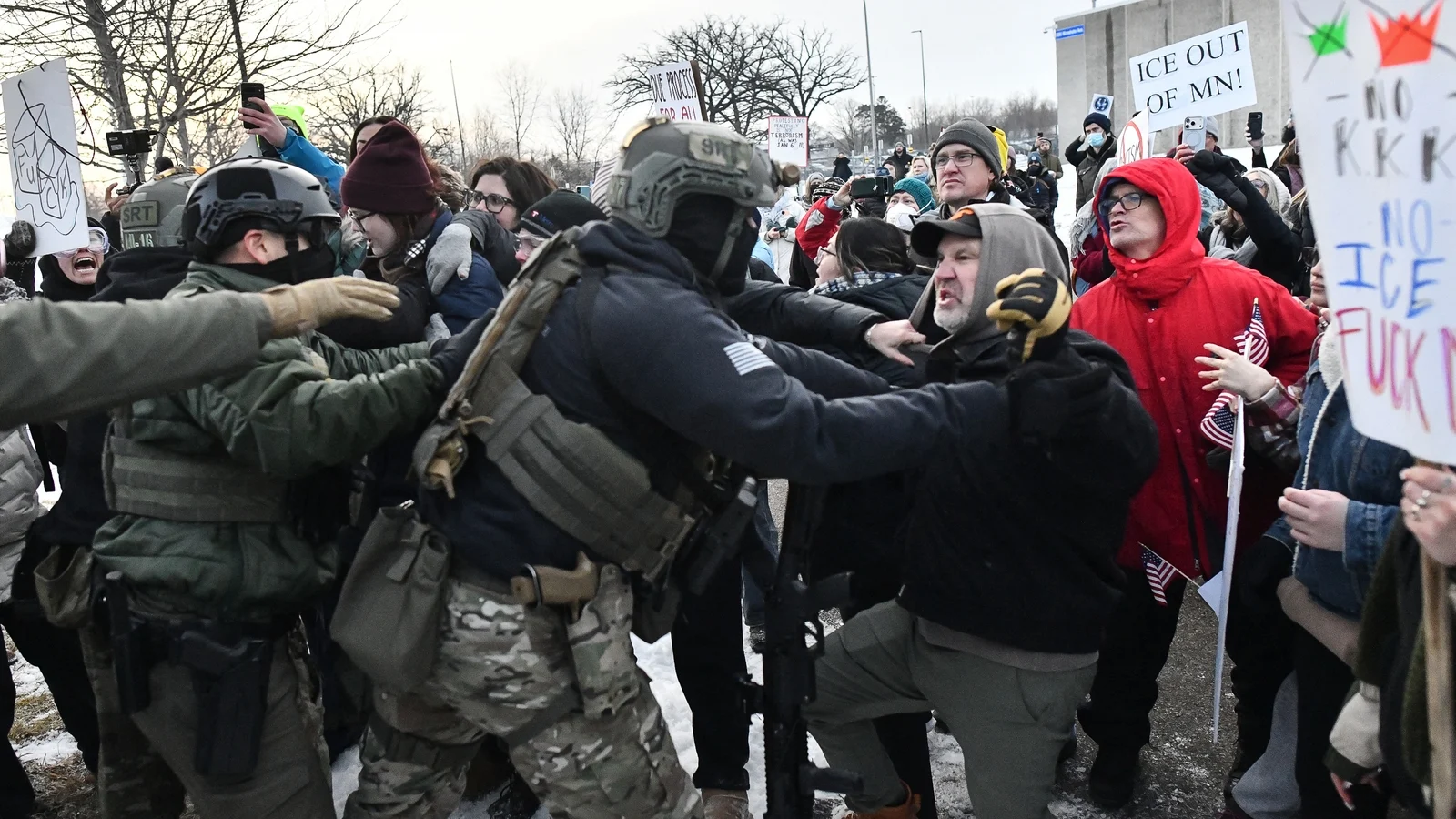
About a thousand people gathered outside the downtown federal building that houses an immigration court, chanting “shame” and “no justice, no peace.” Witnesses said some demonstrators were met with tear gas and pepper balls fired by masked federal officers. Parents sheltered children in their cars as the crowd swelled; school districts closed classes the following days as a precaution.
“My phone has been blowing up,” said 17-year-old Addie Flewelling, who joined the vigil after schools were closed. “You can feel the fear. Last week they raided a high school near us. If you’re a student with parents who are undocumented, where do you go? This makes me scared to go to class.”
Nationally, the episode is the latest flashpoint in a broader escalation by the federal administration — described by the Department of Homeland Security as the “largest DHS operation ever” in the region — that brought roughly 2,000 federal officers to the Minneapolis area. The operation followed a politically charged probe into alleged fraud in some Somali-led nonprofit organizations; at least 56 people have pleaded guilty so far in that wider federal investigation.
What the family says
Renee Good’s family and friends painted a picture of a woman whose life was centered on caregiving and creativity. She graduated from Old Dominion University in 2020 with a degree in English, co-hosted a podcast with her late husband, and was described by her mother, Donna Ganger, as “extremely compassionate” — the kind of person who would check on neighbors and entertain her children with movie marathons and messy art projects.
“She had these little rituals with her kids,” Ganger said at a vigil. “She would make pancakes with sprinkles on Saturdays. She loved poetry. She was not the kind of person who would go to war with officers.”
Those personal details have concentrated the public’s grief into a real face. “This was a mother,” said Pastor Luis Ramirez at a downtown service. “This was a daughter. This was a neighbor. We are not just protesting an event; we are grieving a life that mattered.”
Beyond Minneapolis: what this moment says about power, policing and immigration
At stake are questions that stretch far beyond a single shooting: Who investigates federal officers? How do communities maintain oversight when enforcement is increasingly militarized? And how does the rhetoric from the top shape on-the-ground decisions by agents in tense confrontations?
“We’re seeing the federalization of local public safety,” said civil liberties attorney Nadine Kaur. “When federal deployments bypass local oversight, accountability evaporates. That has a real impact on civil rights and on the social fabric of communities where trust is already frayed.”
These controversies come amid a fraught national climate over immigration enforcement. The political polarization is acute: supporters of the administration often endorse aggressive enforcement as necessary to restore order, while opponents see a deliberate strategy of intimidation that imperils domestic peace and civil liberties.
“This is not abstract politics — it’s about whether people in our neighborhoods feel safe,” said Noor. “When you bring armed agents into communities and then refuse local scrutiny, you create a cycle of fear that doesn’t go away with one press release.”
Questions for the reader
What do you think justice looks like in a case like this? Who should be trusted to investigate alleged wrongdoing by those charged with enforcement? When does public safety become public harm?
These are not easy questions. They do not admit tidy answers. They require communities, courts, and elected leaders to weigh power against accountability — and to decide whether systems built for safety still serve the people they are meant to protect.
Closing — a city waits
Back at the memorial, a neighbor read aloud a poem Renee once posted on her podcast — lines about small mercies and the stubbornness of sunrise. The light from the candles was steady, though the wind insisted on upsetting it from time to time.
“We will keep asking,” Marisol Alvarez said, wrapping a scarf tighter. “We will keep showing up. If nothing else, her children will know we remembered. And that matters.”
For now, Minneapolis waits for an answer from a federal agency that has taken control of the inquiry. The BCA has stepped back. The family waits. The city watches. And the country watches, too — because how this unfolds may ripple into debates over jurisdiction, force, and the meaning of accountability in an era of heightened federal enforcement.