They Came Back: Sailboats, Solidarity, and a Sunlit Havana Reunion
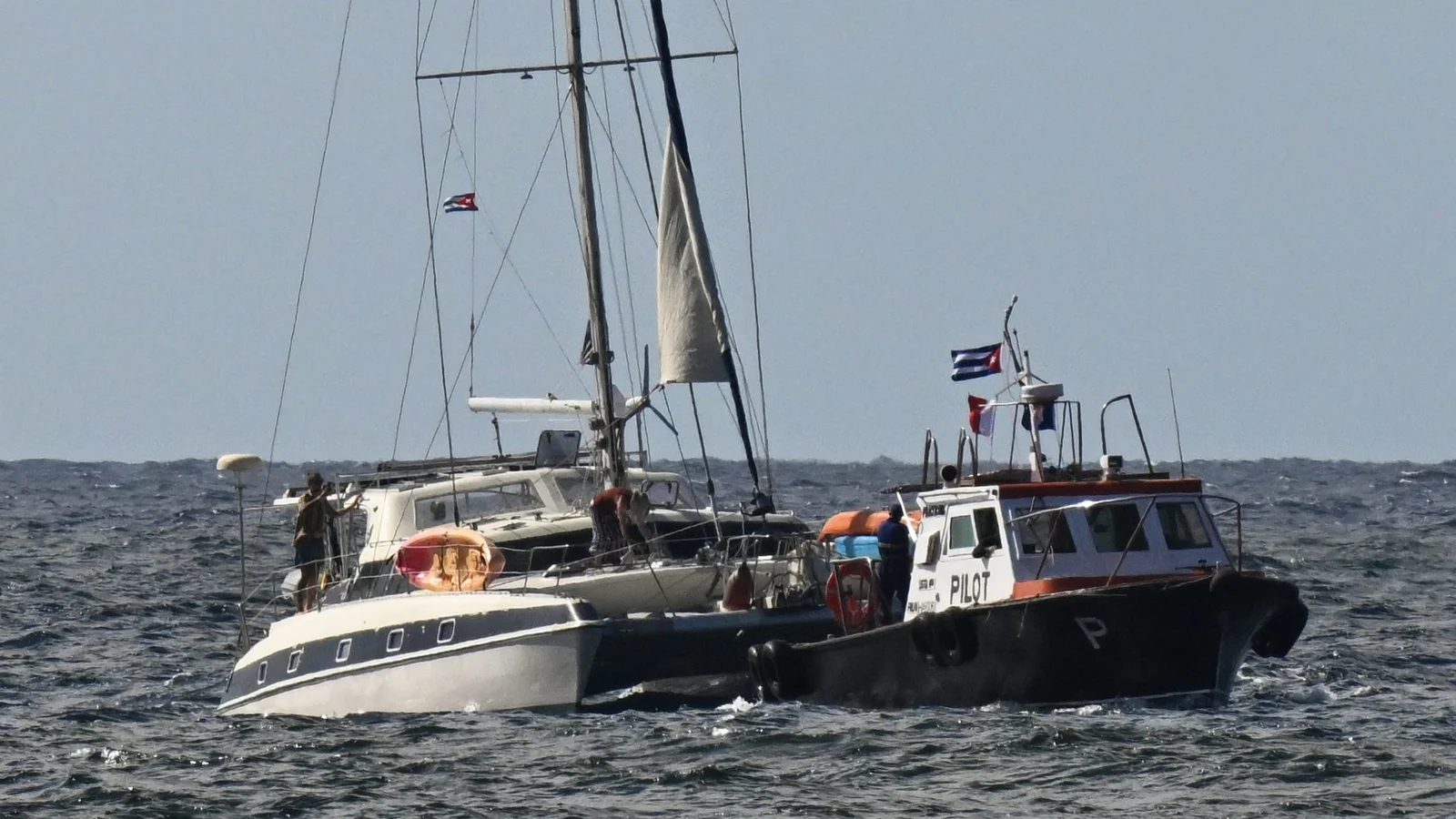
When the two small sailboats eased into Havana’s harbor yesterday, the crowd that had gathered at the Malecón felt like it had been holding its breath for days—and then let out a collective exhale. The Friend Ship and Tiger Moth, their white hulls bright against a late-afternoon sky, tied up under cheers and the looping strains of a street musician’s trumpet. Flags fluttered. People shouted slogans, some joyful, some angry—“¡Viva la revolución!” and “Down with imperialism!”—a chorus that folded into the ocean breeze.
On board, nine people smiled, waved, and offered thumbs-up signs as if they had returned from a long, ordinary trip. Among them were citizens of the United States, France and Germany, and a single, unabashedly proud four-year-old who, by all accounts, took to life on deck as if he’d been born with salt on his lips.
“We’re relieved, of course,” said Adnaan Stumo, the 33-year-old American who coordinated the sailing convoy. “But relief doesn’t erase how many people we met who are exhausted. Bringing these supplies felt like bringing oxygen to a room that’s been held under water.”
How a Humanitarian Mission Became a Mini-Sea Drama
The boats set off from the Yucatán Peninsula on March 20. Their voyage was not supposed to be enigmatic: organizers planned a small, symbolic flotilla to deliver the final leg of what they call the Our America Convoy—an international, grassroots effort to supply Cuba with food, medical supplies and solar panels amid mounting shortages.
Instead, a routine crossing turned into a national talking point when communications with the vessels went dark and the Mexican Navy launched a search-and-rescue operation. A navy aircraft later spotted the sailboats roughly 80 nautical miles northwest of Havana and directed a ship to provide support.
“We’re very sorry to make people worry,” Stumo told a cluster of reporters, his jacket damp with sea spray. “But really: we were never in any real danger. We ran into strong easterly winds and chose a more northerly route. Small boats, small satellite link—sometimes the pieces don’t all cooperate.”
A Mexican Navy spokesperson said the Navy’s plane located the boats late Friday and that the sailors were in good health. “Our priority is always the safety of mariners,” the spokesperson added in a brief statement.
What happened at sea
The technical problem, Stumo explained, was simple and human: the small satellite uplink used by the boats “was on the fritz.” Without constant contact, neighbors and relatives on both sides of the Gulf wondered if the worst had happened. Organizers reported the good news early Saturday: the boats were found, the crews were safe, and the mission continued.
“We were not worried at all,” Stumo said, with a kind of sailor’s shrug. “That’s not the same as saying others weren’t. We’re very thankful the Mexican Navy came out and looked for us.”
The Cargo: Practical Help, Symbolic Weight
The two yachts carried a modest but meaningful haul: around 50 tonnes of supplies in total arrived with the wider convoy, including medical kits, food, hygiene products and solar panels. Hospitals, clinics and local communities were among the recipients. A fishing boat retrofitted for the mission had arrived earlier this week, escorted part of the way by Mexican authorities.
- 50 tonnes of combined aid delivered by the convoy
- Medical supplies, food, water, hygiene kits
- Solar panels intended for community clinics and local grids
“A box of antibiotics can be the difference between a clinic keeping its doors open and shutting for a week,” said a nurse at a Havana hospital who asked not to be named. “These are small things, but they mean life.”
Voices on the Wharf: Hope, Critique, and Politics
The welcome was not uniform. Among the crowd was Gerardo Hernández, a former Cuban intelligence officer who is well-known in the island’s modern lore. “They scared us a little because we kept wondering, ‘When will they get here?’” he told the assembled crowd, speaking with a smile and a seriousness that quieted a portion of the cheers.
Elsewhere, Cuban exiles in cities like Miami and critics in the U.S. contend that shipments touching Cuban ports can end up reinforcing the government more than helping ordinary families. That argument underscored much of the debate surrounding the convoy: is the act of aid neutral, or inevitably political?
“We aren’t naive about politics,” said Lucia Alvarez, a Havana community organizer who helps coordinate local food distribution. “But when a clinic runs out of sterile dressings, people don’t ask about ideology. They ask if the bandage will stop the bleeding.”
The geopolitical backdrop
This mission unfolds against a backdrop of tightened restrictions on energy and trade that have left Cuba’s electricity system under intense strain. The island of roughly 11.3 million people has experienced frequent power outages; residents and officials alike have spoken about rolling blackouts that have affected hospitals, refrigeration and daily life.
Internationally, governments and activists are arguing over how best to support civilians while navigating complex diplomatic pressure—and that debate has only sharpened in recent months.
Why This Voyage Matters Beyond the Harbor
At first blush, two sailboats with a handful of volunteers may feel like a splash. But think about the metaphor: a small crew fighting wind and bureaucracy to bring light—literal solar panels, metaphorical goodwill—into neighborhoods where both have been in short supply. In an era where supply chains are global but attention spans short, these small acts can ripple.
“This is about more than boxes,” said an independent energy analyst in Mexico City. “It’s about civil society stepping in when systems falter—whether because of economic mismanagement, sanctions, or the simple cruelty of weather and wear. The panels are a long-term investment in resilience.”
Resilience. Solidarity. Politics. All of it threaded together under a Caribbean sun. The convoy’s organizers say they will keep working, and some Cubans on the quay say they want more such gestures—organized, transparent, and aimed directly at neighborhoods and clinics.
What do you think—are volunteer missions like this a meaningful tool of solidarity, or a political lightning rod that risks helping the wrong hands? Is there a way to ensure aid reaches those who need it most without feeding conflict? These are the questions that linger as the tide slides back out and the harbor returns to its usual rhythm.
After the Cheers
By nightfall, the harbor had settled. The sails were furled, the drums of celebration dwindled, and the volunteers moved quietly among crates and small children, passing out toothbrushes and tiny packets of soap. Long-term solutions—the kind that require policy shifts, infrastructure investment, and diplomatic conversation—were not solved by a weekend of heroic seamanship. But for a clinic that got new solar panels or a family that opened a tin of food, the temporary relief felt indelible.
“We came because people were hurting,” Stumo said as he watched the boy who had been on board run along the promenade. “We came because small things matter. We’ll be back if we’re needed. Maybe next time we’ll bring a larger crew, maybe a bigger boat. For now, we’ve brought what we could.”
And as the city lights blinked into being—some powered by fragile grids and some now, perhaps, empowered by a few more solar cells—the people on the quay dispersed into a Havana night that, for a few hours, felt a little less dark.