Tonight, the Moon Gets a New Chapter: Artemis II Prepares for the Longest Human Journey from Earth in More Than Half a Century
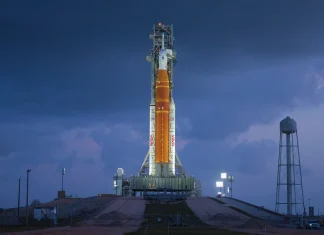
Salt air clings to the skin along Florida’s Space Coast as a crowd gathers beneath a sky the color of forged steel. Children clutch foam rockets. Grey-haired veterans of a bygone space age trade stories about Saturn V engines. Farther down the fence line, a cluster of college students scroll live telemetry feeds on their phones, eyes reflecting the towering silhouette of a rocket that already feels, somehow, both ancient and brand-new.
At the center of that silhouette stands the Space Launch System — 98 meters of humming, humming potential, its Orion crew capsule perched at the tip like a promise. Tonight, if all goes to plan, four astronauts will climb inside and begin a nearly 10-day voyage that will take them farther from Earth than any human has been in more than 50 years.
What’s at Stake
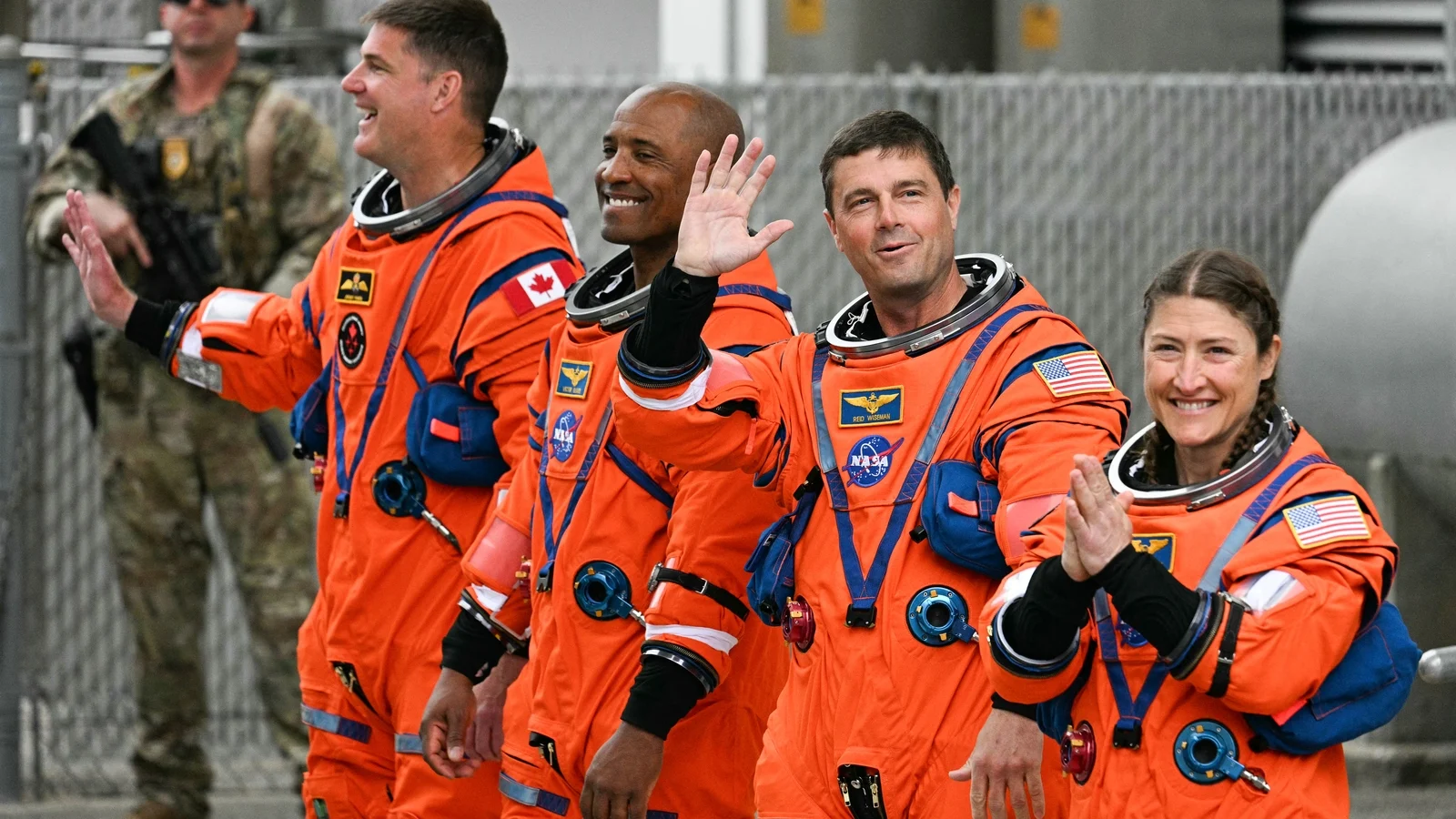
Artemis II is more than a headline. It is a live test, a bet on engineering, diplomacy, and the idea that humanity can again step beyond the boundary of low Earth orbit. The crew — NASA’s Christina Koch, Victor Glover and Reid Wiseman, joined by Canadian astronaut Jeremy Hansen — have spent two weeks in quarantine, rehearsing contingencies, sleeping in pre-launch bunks and, this past weekend, stealing quiet moments with family at Kennedy Space Center’s beach house.
They were awake early this morning for a breakfast of rituals, a weather briefing, and the final checks before a 2 p.m. transfer to the pad. Mission controllers began loading the SLS core with 733,000 gallons of super-cooled propellant — the liquid that will feed the four RS-25 engines and, for a breathless stretch, all of human hope for returning to lunar exploration.
“Everything is going very well right now,” Jeremy Graeber, NASA’s assistant launch director, said during the fueling operation, his voice steady over the radio. Launch director Charlie Blackwell-Thompson added later, “Certainly all indications are right now, we are in excellent, excellent shape as we get into count.” The words were short and deliberate, like the final knots in a rope of confidence.
A Patch of Good Weather in a Two-Hour Window
Forecasters were smiling. NASA’s official launch window opens at 6:24 p.m. Eastern and the odds of the weather breaking the mission stood at only 20 percent — a buoying figure when storms and gusts commonly rearrange launch plans. If wind or lightning forces a scrub, controllers have a handful of backup days: a try on Friday and then a stretch of opportunities through April 6, with another window reopening at the end of the month.
But weather is only one of many wrinkles. The mission has already weathered a slip: an earlier hydrogen leak prompted a rollback to the vehicle assembly building for scrutiny, nudging the timetable back from a planned February lift-off, then March. Scrubs can be technical, bureaucratic, and painstakingly human; they are where patience becomes a mission-critical virtue.
A Journey to the Far Side of Human Reach
If launched, Artemis II’s crew will trace a looping path around the Moon and back, traveling roughly 406,000 kilometers (about 252,000 miles) from Earth — edging past the distance traveled by the troubled Apollo 13 crew in 1970, which set the modern record for farthest human flight. Humans have not broken Earth’s orbital leash since Apollo 17 in 1972. For many, tonight is the end of a decades-long pause; for others, it is only the beginning.
Orion’s job on this flight is measured and vital. Its life-support systems, interfaces and communications will be stressed and logged. The crew will practice taking manual control of the spacecraft about three hours after launch — a crucial redundancy if onboard automation fails. It’s a dress rehearsal with stakes: future lunar landings depend on the lessons learned here.
The Architecture Behind the Ambition
Artemis II is built on an industrial chorus. Lockheed Martin assembled Orion; Boeing and Northrop Grumman have shepherded the SLS development since 2010. The RS-25 engines, pickup-truck-sized and storied, were once the heart of the Space Shuttle and are now entrusted with this new era of heavy lifting. The program has come under scrutiny for cost — analysts estimate between $2 billion and $4 billion per launch — but for engineers on the pad, budgets are serious background, not the present tension.
Meanwhile, the lunar lander race is global and frenetic. Private outfits like Elon Musk’s SpaceX and Jeff Bezos’ Blue Origin are vying to build the vehicles that will put astronauts down on the Moon’s surface. NASA hopes to return humans to the lunar south pole in the second half of the decade — a complex geopolitical finish line many see as a race with history itself, and with other nations, including China, which eyes a crewed lunar landing around 2030.
Voices from the Ground
On the beach, a local teacher named Ana Rodriguez cradled a thermos and an eight-year-old’s foam helmet. “My father brought me to Apollo launches,” she said, voice threaded with both nostalgia and impatience. “We fell asleep with engine noise in our dreams. I want my son to know that same awe.”
A retired NASA technician, who asked not to be named, wiped his hands on a rag and laughed. “You don’t get used to this,” he said. “You just get to enjoy it more. The SLS looks different from the old rockets, but when the plume lights up, it’s the same feeling — small and enormous at the same time.”
Dr. Meera Patel, a space policy analyst at a Washington think tank, offered a sober reminder: “Artemis II is a technological test, yes. But it’s also a statement of intent, about the U.S. role in deep space and the public-private partnerships that will define the next decades. How we manage costs, international collaboration, and safety will shape whether this is a single drama or a sustained program.”
Why This Night Matters — and What Comes After
Ask people along Florida’s fence lines whether tonight is about patriotism, science, spectacle, or economic strategy and you’ll get a dozen different answers. The truth is all of them matter. The mission ties together human curiosity, national investment, and a global ecosystem of industry and innovation.
And it asks a question that keeps echoing: what kind of future do we want in space? Will the Moon be a place of transient triumphs or the scaffold of sustainable presence? Will we work with partners across borders, or compete in zero gravity the way nations sometimes compete on Earth?
For now, the countdown is where our patience gathers. The launchpad waits, the engines are primed, and four people — three Americans and one Canadian — are about to carry our species a little farther into the dark. Whether the sky holds tonight or a scrub brings us back to the waiting rhythm, the arc of the story is clear: humanity’s gaze is upward, and the Moon is no longer only a memory of the Sixties and Seventies. It is a destination again.
So stand under the sky for a moment and ask: when the rocket’s flame cuts a new line into the night, what will we take with us, and what will we leave behind?