Dawn and thunder: watching America’s moonshot roll to the pad
They moved the rocket before sunrise, like a sleeping giant eased onto its feet.
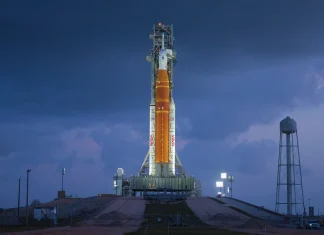
At Kennedy Space Center the air smelled of salt and sunscreen, a Florida dawn smeared in orange light. A low, mechanical rumble rolled across the vehicle assembly building as Crawler-Transporter 2 inched forward, carrying the Space Launch System and its Orion capsule four miles toward Launch Pad 39B. Technicians in bright vests walked alongside like midwives, checking bolts, whispering into headsets. Tourists stopped their cars and craned their necks. A coffee vendor on the causeway handed out free black coffee—“For the long watch,” she said with a grin.
This slow-motion procession marks the final choreography before Artemis II’s opening launch window on 6 February. If all goes to plan, a four-person crew will loop around the Moon and return to Earth on a roughly ten-day voyage—the first time humans have left low Earth orbit and visited lunar distance since Apollo 17 in 1972.
Why this flight matters
Artemis II is not a joyride. It is a proof point and a statement: that after decades of robotic missions, international partnerships, and a new era of commercial spaceflight, humans are ready to travel beyond the gravity well again. NASA frames Artemis as a program to explore the Moon for science, test technologies for sustained exploration, and lay groundwork for human missions to Mars.
Consider the arithmetic: more than half a century has passed since the last humans walked on the Moon. Artemis I—an uncrewed test flight—completed its mission in 2022, validating Orion’s systems. Artemis II now brings crew back into the equation. The stakes are technical, logistical, and symbolic. A successful flyby will demonstrate Orion’s life-support, navigation, and reentry systems under the stresses of a full lunar trajectory—data that planners will lean on before attempting Artemis III, which aims to land humans on the lunar surface.
“This flight is the bridge between testing and presence,” a veteran NASA systems engineer told me, watching telemetry numbers scroll on a laptop. “It’s one thing to send hardware alone; it’s another to keep people safe at lunar distances and bring them home.”
What the mission will do
- Launch vehicle: Space Launch System (SLS), the agency’s heavy-lift rocket.
- Spacecraft: Orion crew capsule, carrying four astronauts.
- Duration: about 10 days, with a free-return or near-free-return trajectory around the Moon.
- Recovery: Pacific Ocean splashdown, with U.S. Navy recovery forces standing by.
The crew—the human dimension
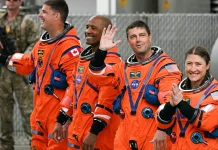
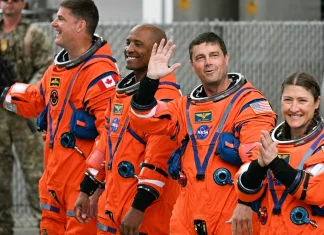
Four names lead the mission manifest: Reid Wiseman, Victor Glover, Christina Koch, and Jeremy Hansen of the Canadian Space Agency. Together they represent decades of training, flights in low Earth orbit, and a blend of personalities that NASA hopes will thrive when the unexpected inevitably arrives.
“You don’t go into deep space expecting only what you rehearsed,” a flight surgeon explained. “Adaptability is the real skill. You practice, yes—but you also practice not panicking when a system behaves slightly off.”
On the tarmac outside the astronaut quarters, I spoke to a retired fighter pilot from nearby Titusville who had worked on flight simulations. “They’ve trained for so many contingencies they dream about them,” he said, laughing. “But there’s awe, too. My grandson keeps pointing his little telescope at the Moon every night now—he says it’s our turn again.”
Jeremy Hansen, who grew up under Canadian skies as a fighter pilot, has described the mission to fellow Canadians as “good for humanity”—a reminder that enthusiasm for the Moon is not confined to one nation. For many observers, Artemis is a collaborative endeavor: international partners provide instruments, astronauts, and complementary capabilities that turn a national program into a global enterprise.
Precision, propellant, and rehearsal
The crawler’s lumbering procession is more than symbolism. Once the stack is secured to the pad, teams will perform a wet dress rehearsal: loading the cryogenic propellants—liquid hydrogen and liquid oxygen—running the countdown clock, and simulating abort scenarios. These rehearsals are designed to stress the systems in near-flight conditions without actually igniting the engines.
Loading cryogens is a careful ballet. One wrong valve sequence or a misreadtherm could scrub a launch. Engineers who work these operations speak of a peculiar kind of calm—an intense focus born from repetition. “You watch a hundred parameters,” said one propellant systems lead, “but you also pay attention to the weather and the ocean surface—the whole environment changes how we operate.”
On long missions, autonomy becomes a partner to humans. Robotic rovers and autonomous landers will scout terrain and prospect for resources—water ice, volatile minerals—that could make long-term presence possible. “The Moon is our proving ground,” a space policy analyst told me. “We’ll test autonomy, in-situ resource utilization, new power systems. These lessons will ripple into Mars plans and beyond.”
Local color and global questions
At a diner near Cape Canaveral, a waitress named Maria pictured the mission in plain terms: “If they bring back something useful—like a new way to power things, or a discovery—we tell the kids that we were here.” She sipped her coffee, glanced at a small TV showing archival Apollo footage, and added, “But also, I wonder—how much is all this costing? Could that money fix a lot of things on Earth?”
That tension—between exploration and earthly priorities—follows every ambitious space program. Artemis supporters point to jobs created in aerospace and spin-off technologies; critics raise questions about budgets and social needs. Both views matter. Good exploration, many argue, should be ethical, equitable, and transparent.
“We have to think about who benefits from these missions,” said a university ethicist who studies space policy. “The technology, the data, the opportunities—how do they translate into broader gains for humanity?”
Looking forward: the Moon as mirror and roadmap
When the Orion capsule arcs around the Moon and re-enters Earth’s atmosphere, the images and data will be pored over by scientists, engineers, and children with telescopes. The Moon holds a record of the early solar system—its surface a witness plate to planetary formation, asteroid impacts, and solar history that Earth has mostly erased through erosion and tectonics. Studying it, as Christina Koch has said in previous communications, may tell us more about where we came from and whether life could arise on planets elsewhere.
Artemis II is a waypoint, not an endpoint. Artemis III aims to land crew on the lunar surface, and beyond that lie ambitions of a sustained presence—habitats, rovers, and industry that could support exploration of Mars. How quickly and how equitably we get there will depend not just on rockets and robotics but on politics, international collaboration, and public imagination.
So as the crawler finishes its last turn toward the pad and mechanics fasten the last cover, take a moment and look up. What do you see when you look at the Moon these nights? Do you see a destination, a mirror, a mystery—or perhaps a new chapter for humankind? The slow roll toward the pad is only the beginning of an answer we’ll all write together.