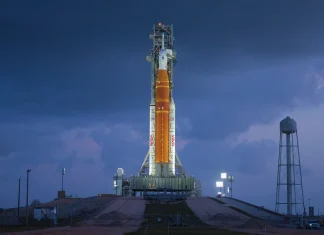
Countdown, again: Cape Canaveral’s restless vigil for a return to the Moon
Before dawn at Cape Canaveral, the horizon holds a pale promise. The Atlantic breathes in slow, salty gusts. Coffee cups steam on picnic tables. Lawn chairs line the sand like a congregation waiting for a sermon they have practiced praying for—rockets, not rain. In the small hours, the Space Coast becomes a chorus of watchful eyes, radios, and the low hum of generators warming up like beasts before a hunt.
On paper, NASA has given the mission a target: 6 March as the earliest the Artemis II crew could ride the Space Launch System (SLS) into a lunar flyby the agency has not attempted with humans in more than half a century.
“We need to successfully navigate all of those but assuming that happens, it puts us in a very good position to target 6 March,” Lori Glaze, a senior NASA official, told reporters—an even-keeled reminder that rockets are unforgiving of optimism without meticulous checks.
After the hold: what happened on the pad
The journey to March has already been punctuated by both drama and relief. Engineers attempted an earlier wet dress rehearsal in early February—a full-fidelity run-through in which tanks are filled with cryogenic propellants and teams practice the countdown under real conditions. That attempt was cut short when a liquid hydrogen leak showed the thin line between triumph and timeout in cryogenic fueling.
Yesterday, though, the story bent toward the hopeful. NASA announced the latest rehearsal proceeded as planned and concluded at “T‑29 seconds” in the countdown—an official pause point that lets teams verify systems before committing to ignition. It was a technical, sober success: the SLS towering over Launch Complex 39B at Kennedy Space Center was fueled, exercised, and then conservatively held.
“A dress rehearsal is exactly that,” said a NASA pad engineer who asked not to be named. “You practice the choreography so that when the curtain goes up for real, everyone knows their part. We don’t wake up the Moon with a surprise.”
Why a wet dress rehearsal matters
On the surface it sounds ceremonial: engineers walk through the motions. But the work is anything but ceremonial. Wet dress rehearsals are the moment when liquid oxygen and liquid hydrogen—substances cold enough to make metal brittle and invisible leaks maddeningly hard to detect—are loaded into tanks. Valves, sensors, avionics, ground support equipment, and emergency procedures all face scrutiny.
Liquid hydrogen, in particular, is a slippery adversary. It finds the tiniest seam and, owing to its small molecules, can creep through flaws that other fuels cannot. That’s part of why the February leak halted the practice: safety, not spectacle, dictated the pause.
Four humans, one small capsule, a vast ambition
The mission will not be a long lunar stay. Artemis II is a crewed flyby: four humans—three Americans and one Canadian—will ride the Orion spacecraft on a roughly ten-day circuit that will send them farther from Earth than any human has traveled in decades.
Orion is compact but capable: a roughly five-meter-wide crew module that must cradle life, stow birthing supplies for the mission’s duration, and bring four astronauts home alive and relatively comfortable after a high-speed return through Earth’s atmosphere. This is intimate, high-stakes travel—more akin to a cramped explorer ship than the sprawling capsules of science fiction.
“I told my granddaughter that her bedtime story might one day be ‘The Night Grandpa Was Past the Moon,’” said Teresa Alvarez, a retired schoolteacher from Cocoa Beach, her voice steady with the kind of pride that comes from living next to rocket history. “She asked if she could bring a stuffed animal. These things matter to people.”
Context and gravity
There is a historical weight to this mission. The United States last sent humans around the Moon in 1972 with Apollo 17. The Artemis program is not just nostalgia; it is a deliberate pivot toward sustained exploration: to learn how humans live and work beyond low Earth orbit, to test systems that will someday carry people to Mars, and to build partnerships that make lunar return a global enterprise.
The SLS itself is a flagship of that ambition: NASA calls it the most powerful rocket it has ever flown, with Block 1 producing about 8.8 million pounds of thrust at liftoff and standing roughly 98 meters tall—an echo of Saturn V in both scale and symbolic weight. The Orion capsule, carrying a crew of four, is the habitable heart of the mission.
- Mission type: crewed lunar flyby (free-return trajectory)
- Crew: four astronauts (three American, one Canadian)
- Vehicle: Space Launch System (SLS) + Orion spacecraft
- Key milestones before launch: final pad work, flight readiness review, dress rehearsal analysis
Lives on hold, hopes on the pad
For the people living in the shadow of the launch towers, a launch date is more than a technical milestone. It is jobs, small businesses, tourism calendars, and ritual. The diner on A1A keeps a board that reads “LAUNCH DAY SPECIAL”—pancakes stacked like recovery buoys. Local tour operators have learned the rhythms of delays: they print t‑shirts with “We Came for T‑29 Seconds” jokes.
“You learn patience here,” said Eddie Morales, who runs a bait-and-tackle shop that doubles as an impromptu visitor’s center. “But you also learn what it does to people to see something leave the ground. It loosens something inside them.”
Engineers and mission managers, meanwhile, live inside a matrix of checklists, timelines, contingency plans, and simulations. The step between a successful rehearsal and actual launch is not glamour; it is repetitive, rigorous, and intentionally conservative work.
“We’re not counting down to one person’s dream,” said Dr. Amina Khatri, a spaceflight systems analyst. “We’re doing the work to make sure four people can be safe when they go farther than any of us in living memory. That’s why the checklist is sacred.”
What comes next, and why you should care
If March 6 holds—and the rehearsals, reviews, and pad work align—the world will watch four humans slip Earth’s safety net and chase a horizon we visited at the dawn of spaceflight. Whether you live in a coastal town that sells launch-viewing passes or in a city whose kids study rocket equations on frayed textbooks, there is a cultural resonance here.
What does it mean to invest billions in exploration while climate change, inequality, and geopolitical tensions press on Earth? The answers are complex. For advocates, missions like Artemis catalyze technology, inspire STEM careers, and drive international cooperation. For skeptics, they are an expensive reach. Both perspectives matter in the conversation about priorities and the future of public investment.
So, will you be watching if rockets pierce the Florida sky on 6 March? Will you bring a picnic and a folding chair? Will you feel the small and profound thing that people have felt when machines carry them beyond known horizons—a mixture of pride, fear, and hope?
At Cape Canaveral, the countdown is as much about community as computation. The wet dress rehearsal is no certificate of certainty, but it is a promise kept: systems tested, lessons learned, the human orchestra warmed up. If the march to March continues, the world will have front-row seats to a scene that both remembers the past and reaches for what comes next.