Negotiators Rush to Finalize Deal as COP Summit Nears Conclusion
 Caalamka
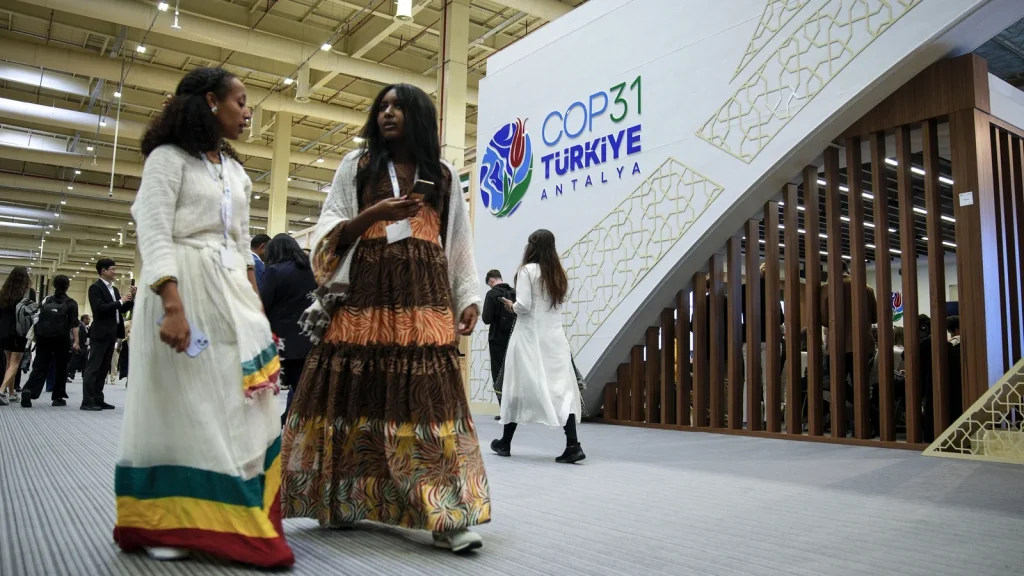
With the clock ticking toward the end of COP31 in Antalya, negotiators are bracing for a fresh draft of the summit’s agreement text — a document expected to offer the sharpest view yet of what nearly 200 countries can live with on the future of fossil fuels.
Alongside the fight over oil, gas and coal, the text is set to spell out how much support richer countries are willing to provide to poorer nations grappling with a warming world.
The talks are due to finish tomorrow.
Monday’s first draft ran to 18 pages and contained options that had already drawn outright opposition from some delegations.
The next iteration — the so-called “cover decision” — is anticipated as a clearer signal from the summit’s leaders about where compromise may actually be possible.
One of the biggest questions is whether the 35% figure remains. That number reflects the Turkish presidency’s push for electricity to account for 35% of global energy used by households, businesses and transport by 2035, up from roughly 23% today.
The European Union endorsed a voluntary pledge tied to that goal on Tuesday.
Attention now turns to whether the target can survive the hard test of unanimity — a final agreement that every country at the summit is able to support.
In practical terms for an Irish household, meeting such a shift could translate into stronger pressure to swap an oil boiler for a heat pump, or replace a diesel car with an electric model.
Each change chips away at the volume of oil being burned.
But the emissions benefit also hinges on what is producing the electricity in the first place.
Monday’s text called for clean electrification — electricity generated from renewables such as wind, hydro and solar, or from nuclear energy.
At the same time, it acknowledged that moving to electricity can bring benefits even when the power comes from other sources.
The EU is pushing to ensure any proposal built around a 35% electricity target includes an explicit commitment to “clean power”.
A separate — and more politically explosive — debate centres on what happens next for coal, oil and gas.
Three years ago in Dubai, countries agreed to “transition away from” fossil fuels in their energy systems.
Two back-to-back paragraphs in Monday’s draft underline how unsettled that language remains.
The first calls on countries to speed up the Dubai commitment.
Read the latest stories from COP31
The paragraph that follows goes further, urging accelerated action to “phase out” fossil fuels completely.
Because “transitioning away” and “phasing out” are not the same thing, either formulation could yet be dropped in the next version of the cover decision.
Climate finance is also heading into the final stretch with a familiar argument: what does it mean to triple funding when there is no agreed baseline?
At COP30 in Belém last year, countries urged efforts to at least triple climate adaptation finance by 2035.
That funding is aimed at helping developing nations manage climate impacts — from protecting coastal communities against rising seas to keeping water supplies secure during drought.
Monday’s draft suggests setting a collective target of at least $120 billion for climate adaptation and calls on developed countries to spell out how they would meet it.
The $120 billion number remains under negotiation.
The EU is resisting a new financial commitment. It says it will honour existing climate finance pledges and argues the poorest countries and small island states should be able to access the money faster.
For countries on the front lines, the pace of delivery and the overall scale of support can be decisive.
The UN Environment Programme estimates developing countries will require around $305 billion annually for climate adaptation by 2035.
Yet public adaptation finance from wealthy nations totalled between $28 billion and $32 billion in 2024 — only a fraction of what is now being discussed.
That gap leaves Ireland’s Climate Minister Darragh O’Brien and his European counterparts facing a tough balancing act in COP31’s closing days.
They want developing nations to rally behind a stronger deal on clean energy. But many of those same countries are pressing Europe for a firmer answer on how the costs of protecting people from warming already under way will be covered.