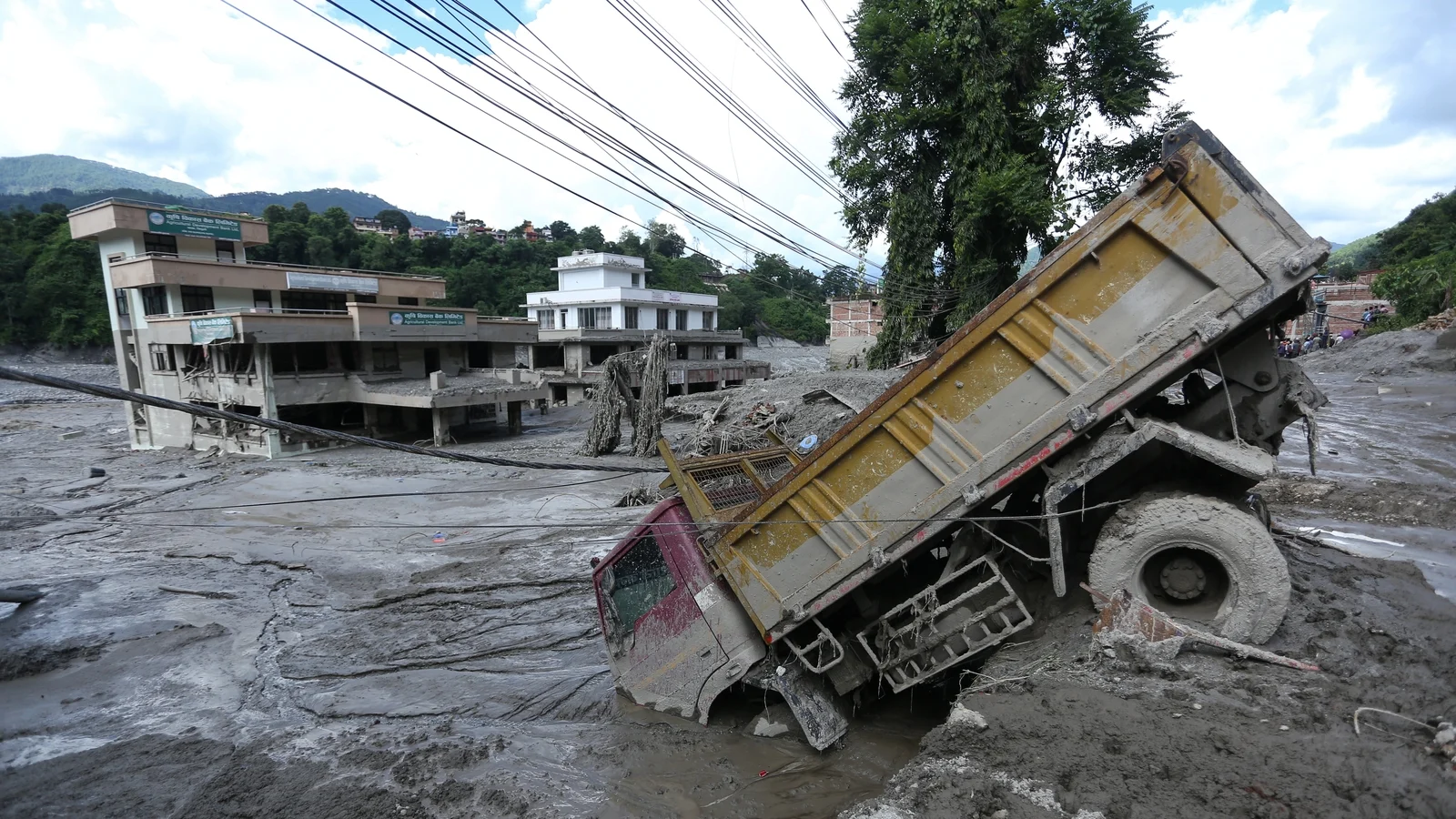
In Nepal’s battered mountain towns, rescuers have turned to excavators and other heavy machinery to claw through thick mud and tangled debris, racing against time two days after a catastrophic flash flood even as hopes of finding survivors begin to dim and officials scramble to head off a second wave of flooding.
The confirmed death toll in Nepal stood at 469 people this morning, with almost 1,000 more reported missing there and in neighbouring Tibet, near where a glacier collapse on Wednesday morning unleashed a massive torrent of rock, ice, mud and debris that tore down Himalayan river systems.
That surge carved a destructive path through villages and valleys, wiping out power stations and smashing roads and bridges along a key route linking Kathmandu with Lhasa in Tibet — a corridor widely used by trekkers and pilgrims.
Of those missing, at least 540 are foreign nationals.
In Nepal, authorities deployed helicopters to scour valleys for survivors and deliver emergency supplies to thousands stranded in cut-off communities. On the ground, emergency services — some working with sniffer dogs — recovered dozens of bodies carried downstream into the plains.
Dibga Tamang was among the last people pulled alive from the devastated town of Rasuwa yesterday, when he and three others were airlifted to an army camp in Nuwakot.
“All of our people have gone. They are dead,” he said.
“I have no one left waiting for me. Everything and everyone is gone. The end.”
Officials warn the disaster could still deepen, with the volume of water and debris now raising fears of further flooding.
Nepal’s disaster management authority said a lake created when debris blocked the Bhotekoshi River at the flood site was swelling and could burst. Across the border, China said about three million cubic metres of water — the equivalent of about 1,200 Olympic-sized swimming pools — was expected to pour into an already dammed lake over the next three days.
Chinese state media, citing the water resources ministry, said the risk of a breach was high, with peak flow expected around 1 September.
“The volume of water is continuing to increase, and so is the risk,” Zhu Jinfeng, a researcher at the ministry’s hydrology department, told state broadcaster CCTV.
A man observes the swollen river following flash floods in Devighat, Nepal
Torrent tore through border crossing
On the China-controlled side of the border, rescuers had still not reached the hardest-hit area at the Gyirong border crossing by yesterday evening, according to state media, as crews worked to clear debris choking the main access road.
The Gyirong border port is a strategic node in China’s Belt and Road network connecting the country to South Asia, with logistics zones and parking lots built there over the past decade.
Video captured on Wednesday showed a roaring wall of muddy water and debris ripping through structures at the crossing in seconds, engulfing people who tried to flee.
Read more: Devastating floods on Nepal-Tibet border described as ‘apocalyptic’
How a glacier collapse may have caused Nepal-Tibet floods
In Tibet’s Gyirong County, Chinese state broadcaster CCTV said 558 people were missing, including 260 foreign nationals. On the Chinese side, three deaths have been confirmed so far.
China’s Premier Li Qiang, the country’s second in command, travelled to Gyirong yesterday afternoon, the state-run Xinhua news agency reported.
The trip underscored that Beijing is treating the catastrophe as a top national priority.
‘Exploded like a bomb’
In Nepal’s Devighat, survivor Janak Bahadur said the floodwater arrived without warning and “came in suddenly and exploded like a bomb.”
“The river looked small from a distance but it suddenly started overflowing and swept through.”
Nepal said the missing foreigners come from more than two dozen countries, and nations including India, Australia and South Korea have dispatched aid and rescue teams.
Two Irish citizens are among those unaccounted for.
More than 30 British nationals are among hundreds of people missing and feared dead.
Security personnel unload relief supplies from a helicopter in Nepal
US President Donald Trump said the United States had offered support.
“Nobody’s ever seen anything quite like that, where very powerful, strong, well-built buildings were wiped out like they were toothpicks. It’s a terrible thing. We are sending aid and we’ve spoken to the leadership and we let them know anything they want, they’ll have.”
Across the world, families of the missing waited anxiously for word, searching for any detail that might explain what happened to loved ones caught in the flood zone.
Vasanthi Muniandy, whose sister Vennila was travelling with a Hindu pilgrimage group from Malaysia, said she last heard from her after she crossed into Tibet from Nepal.
“I am totally broken. My sister is very important to me,” said Ms Muniandy said.
“I really want her to come back. I don’t have anyone but her. I just want her to come back home. I want her to be safe.”
Ganesh Aryal, the administrator of Chitwan district, said officials had recovered 103 bodies from the river system in his district — roughly 100km away in the plains from the worst-hit Trishuli region.
With local hospitals overwhelmed and unable to accommodate the dead, he said authorities were erecting tents and organising procedures so families could claim relatives.
Nepal’s Prime Minister Balendra Shah, who toured flood-hit Nuwakot yesterday, said the emergency remained difficult.
“All the state agencies are operating at full capacity. Our first priority now is to save life of each citizen, search and rescue of the missing, treat the injured and provide immediate relief to the affected families,” he said.
The catastrophe poses a major early test for Shah’s five-month-old government. Still, officials said Nepal has systems in place and experienced personnel who have navigated mass-casualty disasters before, including the 2015 earthquake that killed nearly 9,000 people.