Next EU budget negotiations are shaping up to be a tougher challenge
 Caalamka
Forging a deal on the EU’s seven-year budget is rarely straightforward — and this time, the stakes have only climbed.
The last marathon negotiation ended in July 2020, as the Covid-19 pandemic battered the global economy and leaders scrambled to use the bloc’s finances to soften the shock.
After four days and four nights, they agreed the Multiannual Financial Framework (MFF) for 2021-27 and, alongside it, built a post-pandemic recovery instrument, NextGenerationEU.
The budget itself came in at €1.07 trillion.
In addition, leaders instructed the European Commission to raise €750 billion on the markets to be channelled — as loans and grants — to member states hit hardest by Covid-19.
It marked a watershed moment for the bloc: joint borrowing, long resisted in parts of Europe, became reality.
That decision continues to reverberate. Interest on the borrowing is already being paid, but repayments of the principal start in 2028. The next MFF — covering 2028-34 — will need to accommodate annual repayments estimated at between €140 billion and €168 billion.
Even before more recent crises, the EU’s financial outlook was set to be tight.
Then came the sequence of shocks since 2020: Russia’s invasion of Ukraine, the energy crunch that followed, the return of Donald Trump to the White House and his swift tariff war, and then the attack on Iran. All of it has reshaped what governments expect from the next long-term budget.
At the same time, borrowing costs are higher, national debt levels have risen, competitiveness has faltered and growth has softened.
With Washington stepping back from Europe and Russia presenting a sharper security threat, negotiators face a central contradiction: the European Commission argues the EU needs a larger, bolder budget to meet these challenges, while national capitals — constrained by tighter public finances — are reluctant to pay more into the pot.
In 2025, the Danish presidency first forged agreement on the budget’s new architecture
The starting point for this cycle already signalled a shift. In 2018, the commission pitched the 2021-27 MFF at €1.14 trillion, or 1.1% of EU gross national income (GNI).
In 2025, its new proposal rose sharply to €1.76 trillion — 1.26% of GNI — including debt-servicing costs for the post-Covid fund equivalent to 0.08% of GNI.
The reaction from a familiar bloc of net contributors was immediate. Germany, Austria, Sweden, Finland, Denmark and the Netherlands — dubbed the “frugals” by critics, though they prefer “modernisers” — demanded “several hundred billion” euro be stripped from the opening figure.
That year, Denmark’s presidency helped secure political agreement on a redesigned budget structure intended to make EU spending more responsive to emerging geopolitical risks.
The new approach tilted priorities toward competitiveness, defence and migration, and away from long-standing heavyweights such as cohesion funding for poorer regions and the Common Agricultural Policy (CAP). In 2021-27, CAP alone represented almost one third of the entire EU budget.
Under the redesign, money that once flowed more directly to farming and cohesion would, in many cases, be channelled through national governments via National Regional Partnership Programmes (NRPPs).
Governments would gain wider latitude over spending choices, though a portion of funds would be protected for farming.
The structure would also be streamlined, shrinking from seven headings to four, with greater flexibility to move spending within headings.
These headings would be:
- Cohesion and Agriculture, as well as the repayment of NextGenerationEU loans.
- Competitiveness, prosperity and security, including the EU Competitiveness Fund (ECF).
- Europe in the World, including development aid for sub-Saharan Africa, the European neighbourhood, the Middle East, north Africa, the Gulf, and Asia, taking in migration.
- The EU’s administration costs.
Once member states accepted the new architecture, the fight shifted to the overall size of the package.
In the first half of this year, the Cyprus presidency trimmed the commission’s plan by 2%.
Ireland then assumed the rotating presidency and, in October, unveiled a revised draft: an 8% reduction from the commission’s opening bid — €141 billion — leaving the package at 1.01% of EU GNI.
That did not satisfy either side. The frugals argued the cuts were still too small, while 17 countries in the “Friends of Cohesion” camp warned that agriculture and regional support were being squeezed.
Yet, in relative terms, the harshest reductions were aimed not at the traditional pillars but at the “modernising” parts of the plan.
Thomas Byrne said there was ‘strong support’ for farm and cohesion spending
The European Commission protested that Ireland’s draft left CAP largely intact — only a 3% cut from the original proposal — while heavier reductions landed on Headings 2 and 3.
That is, the areas focused on defence, security and competitiveness.
Officials also criticised a 55% cut to the Solidarity Fund, designed to provide rapid flexibility for unexpected natural disasters — a pressing concern after the climate-hit years of 2021-26 — and emergency support for member states facing migration pressure at their borders.
Minister of State for European Affairs Thomas Byrne defended the balancing act, saying: “There was strong support for [farm and cohesion spending] from almost all of the member states, including some of the countries who are considered net-contributors, so we’ve had to balance all of the competing demands from the member states.”
Dublin’s position was that its goal was not to craft a document that pleased everyone, but to table a negotiating text capable of triggering genuine talks.
After Ireland produced its draft “Negotiation” or “Nego Box”, responsibility moved to European Council President António Costa, who speaks for the 27 EU leaders.
Following weeks of consultations in capitals, he issued his own Nego Box on Saturday.
Mr Costa’s version went further, cutting the budget to €1.56 trillion — 1.07% of EU GNI.
Mr Costa pointed out funding for competitiveness was going up by 120% compared to 2021-27
As fresh criticism poured in from capitals, Mr Costa sought to reframe the debate: smaller than the commission’s first proposal, he argued, but still roughly €500 billion larger than the current seven-year budget.
He highlighted planned increases compared with 2021-27: competitiveness up 120%, defence up 232%, migration management and border control up 100%, and “Europe in the world” spending up 23%.
“There is a tendency to put upfront the comparison between what the commission initially proposed and the latest situation,” said Jim Cloos, a former senior EU official now with Eurocomment.
He said: “The commission is of course free to propose the figures it wants and it is its job to be more ambitious than the [European] council, which inevitably lowers the ambition somewhat; that is how the system works.
“The more relevant comparison is therefore between the old MFF and the new one.”
Measured that way, flagship programmes grow substantially: Horizon Europe would rise by 57%, Erasmus by 25%, and climate spending would increase by 35% — compared with a 25% increase in the current budget.
Danish Prime Minister Mette Frederiksen said ‘the proposal cannot be a basis for a new MFF’
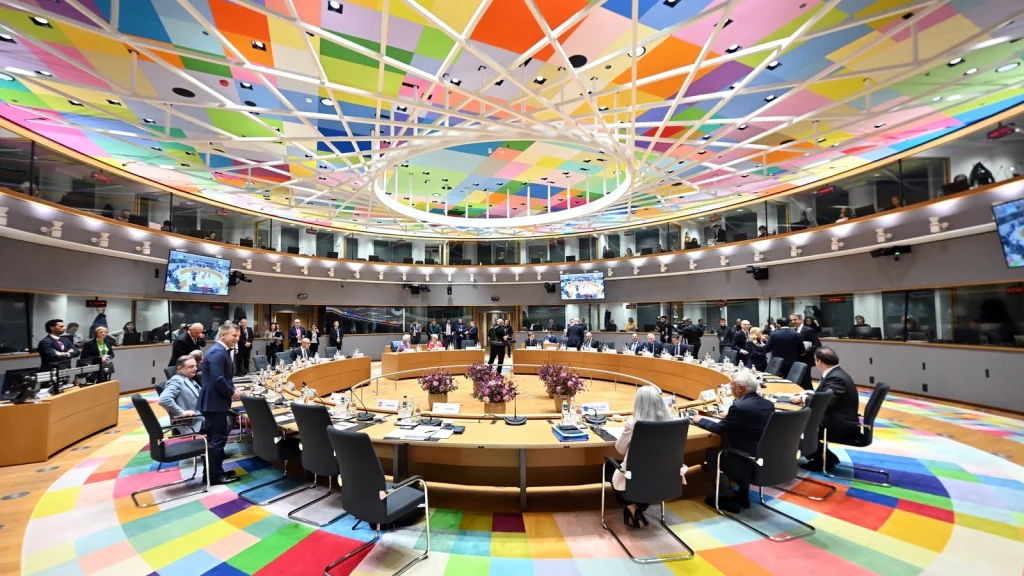
Officials say leaders have now moved into a more serious bargaining phase, even as the frugals came out swinging at today’s summit.
“It’s clear that Europe needs to focus on its security, on competitiveness and on migration, so we also need to have that reflected in the budget,” said Dutch Prime Minister Rob Jetten, a leading Frugal.
He said: “That is of utmost importance to the Netherlands.
“And it needs to be a budget that is downsized.
“If you compare it to the current proposal, this is a proposal that is not acceptable for Dutch taxpayers.”
Danish Prime Minister Mette Frederiksen echoed that stance, saying: “The proposal cannot be a basis for a new MFF.
“The budget is too high and priorities need to change to be more future proof and flexible to tackle any unforeseen situations.”
German Chancellor Friedrich Merz also argued the figures remain excessive: “The budget volume is still too high.
“We need to be able to finance it and don’t want new debt.
“There are a few priorities: a prosperous economy, the internal market and defence capabilities.”
The Latvian Prime Minister Andris Kulbergs took aim at cuts to farm payments
On the other side, Czech Prime Minister Andrej Babiš — aligned with the Friends of Cohesion group — attacked Mr Costa’s proposed cohesion reduction of between €8 and €10 billion.
He said: “Cohesion is really the goal of the EU and the Czech Republic.
“We will fight for this money.
“Thirty-seven years after the Velvet Revolution, we still do not have a highway to Austria.”
Latvian Prime Minister Andris Kulbergs focused on agriculture, warning that farm support was again being pushed down.
He said: “Latvia has been punished for 20 years.
“Our farmers are the least supported in Europe by far.
“This has been acknowledged before and even calculated in the formula.
“It is in the billions.
“Now, when we look at the budget, it is gone.”
The commission estimates new revenue streams could bring in billions annually over the budget
As the summit continued through the afternoon, Mr Costa and his team met groups of member states in search of a workable middle ground.
Ireland was grouped with Finland, Latvia, Slovakia and Romania.
Beyond the battle over spending lines, leaders are also weighing new revenue sources that could reduce the pressure for deeper cuts — and ease demands for higher national contributions.
At present, the EU budget relies on member state payments calculated via a GNI key, along with VAT and customs receipts, European Court of Justice fines, and a plastics waste tax.
The commission estimates that “New Own Resources” could generate €58.2 billion annually across the seven-year period.
Mr Costa has put forward five options:
- A Digital Services Tax targeting big tech corporations, which would be levied at around 3% on the annual turnover from online advertising, monetising data and other digital activities.
- National contributions from levies on tobacco.
- National levies collect on e-waste that has not been recycled.
- Revenue generated by the EU’s Emission’s Trading Scheme.
- Revenue generated through a tax on third countries exporting carbon-heavy goods into the EU.
The Digital Services Tax stands out as the most contentious.
It takes the place of an earlier contender known as CORE — a direct levy on large corporations — which Germany strongly opposed.
France has promoted a digital levy since 2018, and several member states already impose their own versions, a source of anger for the Trump administration.
Arriving at the summit, Taoiseach Micheál Martin made his opposition clear and conveyed it to Mr Costa during an early bilateral meeting.
Micheál Martin said Ireland changed its corporate tax structure over OECD global tax negotiations
Mr Martin said: “We believe this flies in the face of the entire momentum towards increased European competitiveness because we’ve been arguing for quite some time that Europe is reducing competitiveness, and we feel, in principle, a digital tax is sending out all the wrong messages.
“It represents and reflects perhaps an absence of coherence in terms of that competitiveness agenda.”
The Taoiseach also pointed to Ireland’s participation in the OECD global tax talks, the BEPs process, and the domestic changes made in response.
“We participated in the BEPS process in good faith and at that time there was a clear agreement and acceptance that if we participated in the … process and agreed with Pillar One and Pillar Two [of the BEPs process] that a digital tax would not be pursued,” he said.
Even so, the proposal is expected to remain in play. Mr Costa believes it could raise €5 billion a year, while the European Parliament estimates it could bring in up to €25 billion.
With the file now in Mr Costa’s hands, Ireland no longer has to maintain a strictly neutral broker role and has been lobbying for CAP protection.
Under the National Regional Partnership Plans (NRPPs), Ireland is currently set to receive €12.2 billion over seven years.
Of that total, €8.6 billion is earmarked for farm spending and rural development.
Given Irish farmers receive €10.63 billion under the current MFF, that has been flagged as a 24% reduction.
The Irish Farmers’ Association, however, says the final impact could depend on how additional funds are distributed among member states.
After intense farmer protests last year, the European Commission agreed to frontload €45 billion of 2028 funding that otherwise would not have been scheduled until 2031.
Together with a rural expenditure target of 10% — €48.7 billion — proposed by European Commission President Ursula von der Leyen last November, that would add €93.7 billion to the €293.7 billion already ringfenced within the NRPPs for CAP.
The IFA argues that if the extra €93.7 billion is allocated using the traditional CAP key, Ireland’s farm allocation could rise from €8.16 billion to €10.77 billion.
To emphasise, that would surpass the €10.63 billion Irish farmers receive under the current MFF.
If, instead, the €93.7 billion is not included in CAP ringfencing and is distributed via the proposed NRPP allocation key, the increase would be far smaller — to €8.8 billion.
That scenario would leave a €1.9 billion gap versus existing funding.
French President Emmanuel Macron has already backed the first option.
That signal has strengthened IFA hopes that the traditional CAP allocation formula will prevail.
Leaders are not expected to finalise an agreement tonight or tomorrow.
The immediate objective is to narrow differences.
President Macron said he cannot get the EU budget over the line in France after 15 January
Negotiations are then set to intensify, with mid-December — during the final summit of Ireland’s EU presidency — seen as one possible moment to land a deal.
If that slips, 2027 could become fraught.
President Macron has warned he cannot secure passage of the EU budget in the National Assembly after 15 January.
Marine Le Pen, the hard-right front runner in next April’s French presidential election, has vowed to halve France’s EU contribution.
That threat, however, would carry less weight if the MFF is already legally agreed.
“The EU’s internal discussions on budgets are always bitter and bloody, but this round of battles on the seven-year budget cycle is even more difficult than usual because low economic growth has put many member states in a difficult fiscal position,” said Charles Grant, director of the Centre for European Reform (CER).
He said: “To its credit, the commission’s initial proposals sought to modernise the budget, by spending more on competitiveness, defence and foreign policy, and slightly less on farming and cohesion.
“But the forces of conservatism are working hard to unpick many of the commission’s proposed reforms.
“An agreement to increase the EU’s ‘own resources’ – taxes levied directly by the EU – could pave the way to a compromise that every member-state can live with.”