A Medal Made of Gold, a Moment Made of Politics: When a Nobel Crossed an Ocean
On a bright, almost theatrical morning at the White House, a gold disc changed hands and the world watched the choreography of grievance, gratitude and geopolitical theater play out in miniature.
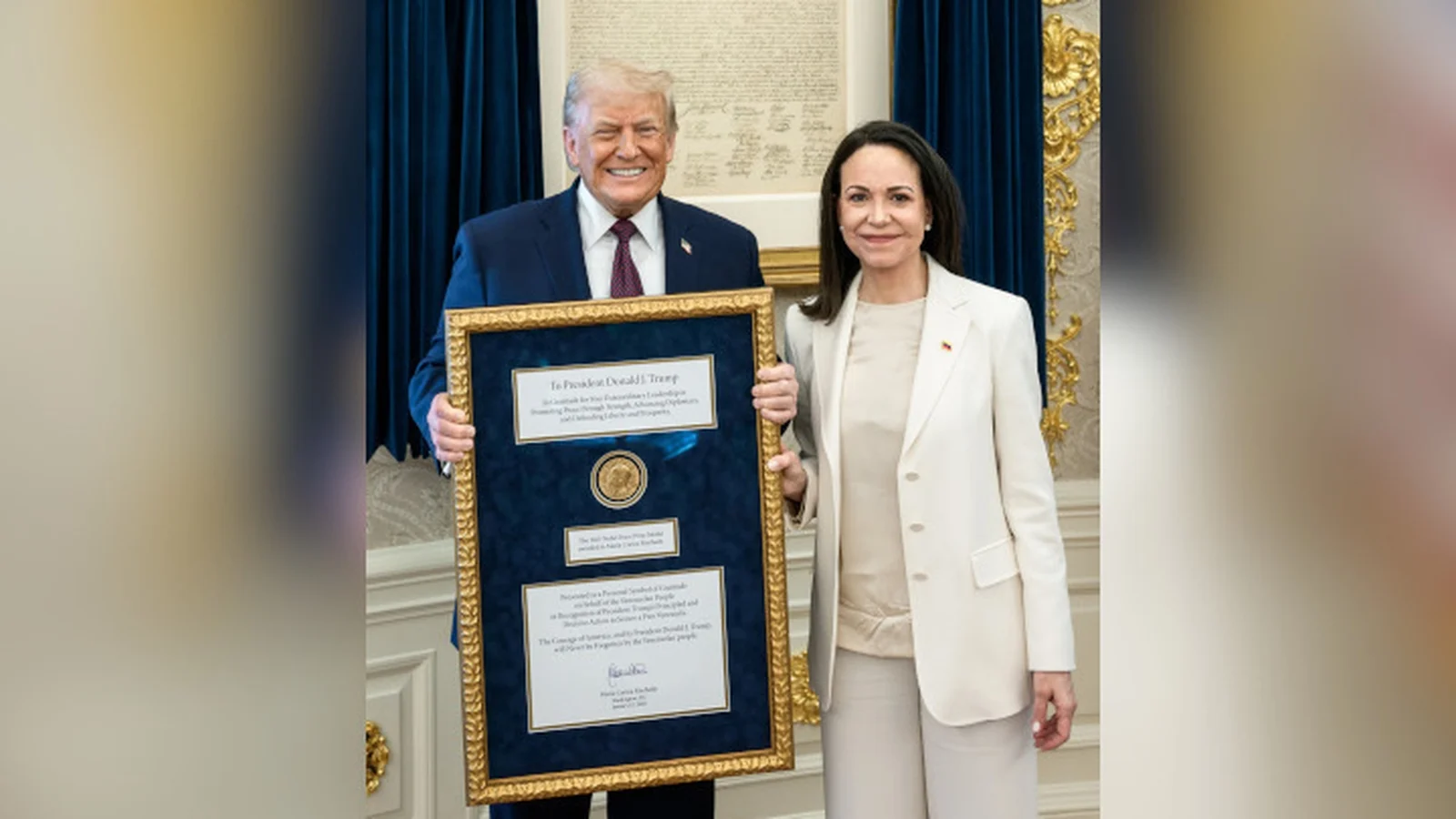
Maria Corina Machado — the Venezuelan opposition leader who, according to the award citation, won the Nobel Peace Prize for “tireless work promoting democratic rights” — placed her medal into the frame of a smiling U.S. president. Photographers snapped; a White House aide beamed. “He deserves it,” Machado announced, a short sentence that landed like a gavel in a room already buzzing with accusation and allegiance.
The image is simple enough: a figure who fled Venezuela by boat not long ago handing over a tiny globe of prestige to a man who has long courted the prize for himself. But the image is also complicated, folded with history, symbolism and a dozen geopolitical ironies.
Oslo’s Calm Clarification
From Oslo came a cooler, more procedural counterpoint. The Nobel Committee — guardians of a prize that once felt sacrosanct and indisputably apolitical — issued a reminder: the laureate is the laureate, regardless of where the medal, diploma or prize money end up. “The medal’s journey does not rewrite the books,” a committee spokeswoman said. “The person named remains the recorded laureate.”
It is an almost legalistic note, but it quietly palpates at a broader question: who owns symbolism when it becomes a political tool?
What Was Given — and What It Means
Machado’s award came with three components: the gold medal itself, a diploma and a monetary prize — historically around 11 million Swedish kronor, roughly one million euros. The Nobel Committee has, in past decades, observed laureates selling, gifting, or donating pieces of their prize without changing the record of who received it. That legal fact is simple. The politics around this morning in Washington are anything but.
“This was not a gift to Donald Trump; it was an appeal to the institution he embodies,” said Lina Herrera, a Venezuelan historian now living in Madrid. “Maria Corina is signaling to the U.S. political machine: recognize and protect our cause. The medal is a megaphone.”
Between Boat Escapes and Backroom Deals
Machado’s journey to Oslo and then to Washington read like a political thriller. After leaving Venezuela by sea, she accepted the prize in Norway. She dedicated it, publicly, to the U.S. president. And yesterday, she handed him the physical symbol of that dedication.
Inside the White House, aides framed the moment as reciprocal. “The president intends to keep the framed medal,” a White House official said to reporters, gesturing at the photograph posted on social channels. “It symbolizes the United States’ support for the Venezuelan people.”
Outside the gilded frames of international diplomacy, Venezuelans watched with a mix of pride, skepticism and exhaustion. More than seven million Venezuelans have left their country in the past decade, fleeing hyperinflation, shortages and political repression. Caracas, once a booming capital fueled by oil billions, is now more often spoken of in numbers: GDP contractions that erased much of a decade’s progress, childhood malnutrition statistics that inflame moral outrage, and the staggering migration toll that has reshaped the geopolitics of the Western Hemisphere.
“We’ve been denied normal life,” said Rosa Delgado, who now runs an arepa stand in Miami’s Little Caracas. “When I see her medal, I feel seen. When I see it given to Trump, I scratch my head. Politics is never clean.”
Voices on the Ground
Not everyone interpreted the scene the same way. In Oslo, a Norwegian political scientist, Dr. Eirik Thomassen, said, “Nobel Prizes have always sat at the intersection of morality and realpolitik. Laureates around the world have used their recognition in myriad ways — to fund causes, to amplify voices, to make statements. What matters is the cause, not the ornament.”
On the other side of the debate, a Venezuelan exile in Madrid, Jorge Ávila, was blunt. “If she’s allying with one foreign leader at the expense of broad-based support, that’s risky,” he said. “Symbols can rally people, yes, but they can also alienate.”
Symbols, Strategy, and the Currency of Legitimacy
Why, you might ask, does a medal matter so much? Because in an era of fractured attention and performative politics, symbols are the currency of legitimacy. A framed Nobel at the White House functions less as a history book entry and more as a billboard. It is a declaration not just of who did what, but who stands with whom.
The transaction also underscores a trend in global politics: the increasing willingness of political actors to convert symbolic capital into strategic partnership. Whether through donations, public endorsements or theatrical handovers, prizes and accolades are being leveraged to reconfigure alliances in a world where traditional diplomacy sometimes feels too slow for the social-media age.
“We are seeing a new politics of performance,” noted Sofia Mendes, a Latin American studies professor at a U.S. university. “Leaders and movements transplant symbols into new settings to claim moral authority. The Nobel, because of its global standing, is high-value currency in this marketplace.”
Questions of Authenticity and Agency
And yet questions remain. Was the medal meant to cement a personal bond, to secure political capital, or to broadcast a plea for intervention? Could the gesture alienate parts of the Venezuelan opposition that are wary of foreign involvement? Could it, conversely, galvanize supporters who see the United States as a necessary counterweight to authoritarianism?
“We’re tired of external saviors and internal sellouts,” said an opposition activist who asked to remain anonymous because of safety concerns. “But we’re also tired of being ignored. It’s a messy calculus.”
After the Photo: What Comes Next?
Pictures, as they say, last longer than promises. The Nobel remains on the record as Machado’s. The medal is in the custody of a president who has long chased the prize himself, and the political winds in Venezuela keep blowing in uncertain directions — alliances shift, interim claims are made, and the oil-rich country’s future is very much an open question.
So where do we go from here? Perhaps the most honest answer is that we do not know. But this episode offers a sharp lesson about our moment: that symbols, like currencies, can be exchanged, invested, or hoarded — and that the stories we tell about those exchanges shape the political imagination.
When you see a medal, what do you see? A bright disk of metal, or a signal flare lighting a contentious path forward? The distinction matters because, as Machado’s journey shows, sometimes the smallest objects carry the heaviest messages.
“Symbols can open doors,” Machado said yesterday as she handed over her medal. “They can also close them.” What doors will open now — and which will close — is a story still being written, on plazas and in parliaments, in living rooms and on the pages of international diplomacy. Will a framed Nobel redraw loyalties or only redraw headlines? Only time will tell.