With the war in Ukraine grinding into its fifth year, US President Donald Trump offered a simple message after what he described as a “very good” meeting with President Volodymyr Zelensky: Russia should make peace remarks that prompted cautious optimism among G7 leaders that an agreement could still be within reach.
The more upbeat tone marked a striking shift from Mr Zelensky’s visit to the Oval Office last year, when Mr Trump told him he had no leverage in any prospective talks with Moscow.
Arriving at this week’s G7 summit in the French lakeside resort of Evian-les-Bains, Mr Zelensky and European leaders aimed to persuade Mr Trump that Ukraine’s battlefield position has strengthened, pointing to Kyiv’s drone incursions deep into Russia as evidence that the dynamics on the ground have changed.
Mr Trump came to the summit brandishing a preliminary deal to end his war with Iran. On Ukraine, he said he would do what he could to bring the conflict to a close, though he gave few specifics on steps that might increase pressure on Moscow.
“Look, Russia should make a deal,” Mr Trump told reporters, saying too many young men were dying on both sides of the battlefield.
“I’m gonna do whatever I can.”
German Chancellor Friedrich Merz said Mr Trump’s words were encouraging.
“I found him to be very cooperative, and I also saw him listening very attentively,” Mr Merz told reporters.
“And in that respect, once again, it gives me a certain degree of optimism that we here, as Europeans and as Americans, are now doing everything we can, together, to end the war.”
Following the group session with Mr Trump, Mr Zelensky told Reuters that G7 leaders agreed Russia was not winning the war.
He said the leaders also discussed possible new sanctions aimed at Russia’s oil exports, its banking system and its military production — measures intended to push Moscow toward negotiations.
Mr Zelensky, who was due to hold face-to-face talks with Mr Trump later, said he had offered to meet Russia’s Vladimir Putin at the G7 summit. A Kremlin aide, however, said the idea did not come up during a call between Mr Trump and Mr Putin.
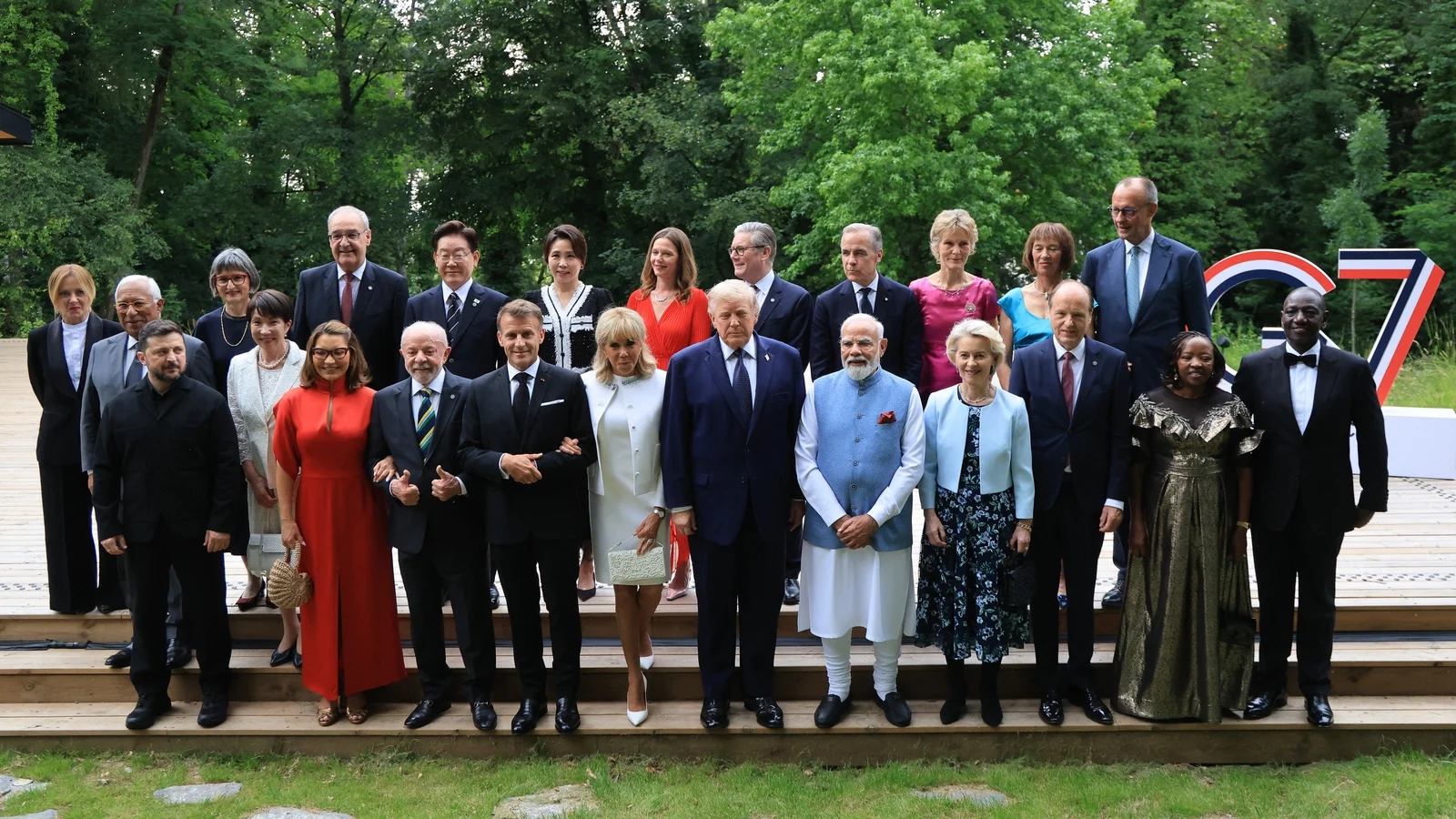
US President Donald Trump and French President Emmanuel Macron wait for a family photo during the G7 summit
Positive talks on Ukraine
Two European diplomats said Mr Zelensky used the meeting to show Mr Trump images of the aftermath of a Russian strike on Kyiv’s Pechersk Lavra monastery yesterday.
One of the diplomats said Mr Trump voiced disapproval of the strike, while the other described the decision to share the images as “psychologically” effective.
European diplomats said the overall tenor of the discussions was constructive.
Still, two diplomats said Mr Trump stopped short of committing to further US sanctions on Moscow, a step European leaders have been urging.
Mr Trump told reporters the United States was now positioned to allow Russian oil waivers to lapse after an interim accord to end the Iran war helped calm markets, but he did not respond directly to questions about wider punitive measures.
European leaders have sought to convince Mr Trump that earlier US ideas about what a settlement might look like were too favourable to Moscow — an argument they say carries greater weight now that Ukraine’s drone operations inside Russia have improved its fortunes.
“The tide is turning for Ukraine,” European Commission President Ursula von der Leyen posted on X.
“Russia’s fatigue is openly showing. That’s the time to double down on our support.”
A French diplomat said G7 leaders committed to bolstering Kyiv’s air defence capabilities, a central request from Mr Zelensky as Russia steps up strikes that hit civilians.
G7 to examine Hormuz shipping problem
Alongside Ukraine, European leaders were also preparing to warn Mr Trump that an interim deal with Iran could entrench Tehran’s nuclear and ballistic missile programmes.
French President Emmanuel Macron said the goal was to secure a “solid, serious agreement that is finalised”.
Today’s working lunch focused on safely reopening the Strait of Hormuz, which Iran largely closed at the end of February.
Leaders also looked at alternative routes that could bypass the waterway, which Mr Trump said would be “completely open” on Friday.
Under the interim deal, a 60-day window would open for technically complex negotiations covering issues including the fate of Iran’s stockpile of highly enriched uranium and the potential lifting of international sanctions.
European allies, however, worry that an inexperienced US negotiating team may not secure a durable nuclear agreement or tackle Iran’s ballistic missile programme in the next stage, raising the risk of a prolonged standoff.
Mr Trump said the deal stated “loud and clear” that Iran would not develop a nuclear weapon — something Iran has long denied seeking to do.